

What to See in Salve
Our journey discovering Salve begins with an unforgettable walk through the countryside among dry stone walls and pagghiare, the typical Salento structures used by farmers to store tools and live in with their families during the summer. Stop by the chapel of Santu Lasi (Saint Blaise) to discover Byzantine frescoes and a majestic statue of the Saint carved from fine Lecce stone. Nearby is the white farmstead Santu Lasi, lime-painted, where, thanks to a very respectful restoration, the farming civilization is alive again among rose gardens, dry stone walls, and succulents on stone hedges.
From Torre Pali to Posto Vecchio with the famous Pescoluse, it’s a succession of emotions, where the sea with a thousand shades of blue combines with good food, archaeological evidence of the countryside, and a medieval village where time seems to have stopped. But the greatest emotion will come from the people of Salve for their genuine and refined hospitality.
Archaeological Sites by Salento Train
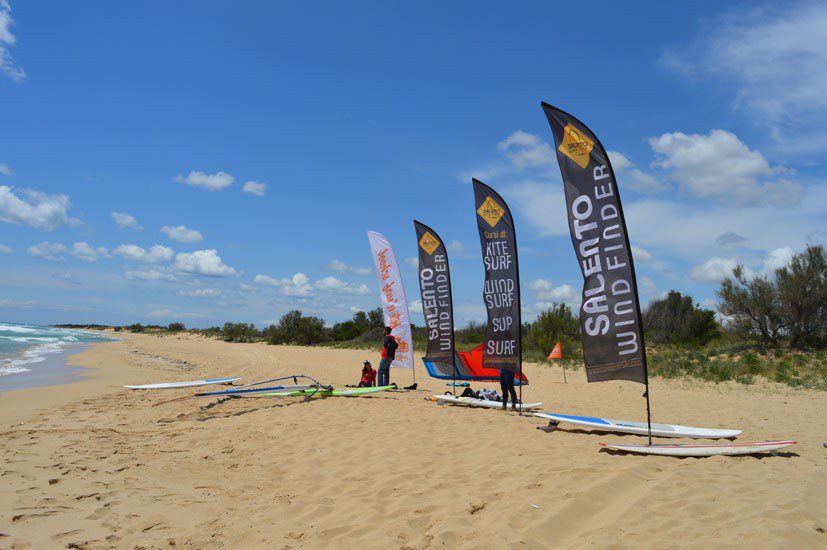
In Salento, you can discover archaeological sites with the Salento Train. For a complete and knowledgeable guide to the area, the ideal is to rely on the experts from the Arches Association. On the beaches, you can also take sailing, windsurfing, and kite surfing courses thanks to Local Crew and Salento Wind Finder. To enjoy the sea from dawn to sunset, the choice is to stay on the beach all day thanks to the services offered by beach clubs, real restaurants and sea-side lounge bars, such as Lido Ristorante La Cozza and Lido Venere at Posto Vecchio, which also offer live music for unforgettable evenings.
After being enchanted by the sea, aboard the Salento Train, you can set off for an excursion through the countryside of Salve, on the Ionian side of Salento. Few know that near the famous Le Maldive del Salento beach lies the most original dolmen in Puglia: carved out of rock, it is half sunk in the ground and half extends its typical stone slab-altar of sacrifices towards the sky, facing west. Then climbing the heights of Salve, you reach a necropolis where you can admire the largest tumulus tomb among all known ones: it covers 100 square meters and certainly belonged to an important clan flourishing 2,500 years before Christ. Crossing the countryside, one experiences the thrill of entering a cave inhabited since Prehistory by Neanderthal Man 70,000 years ago. It is the only prehistoric cave in Salento open to visitors and is located in Montani.
Salve, an Authentic Italian Village
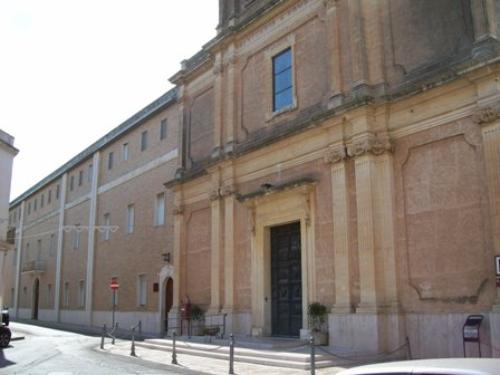
The sun sets on the horizon, the countryside and sea turn orange. It’s time to return to Salve to explore the village of Salve. Part of the Authentic Villages of Italy, in Salve time seems to have stopped. The excursion starts from Borgo Terra, the medieval village where streets intersect perfectly and where you will be surprised by the beauty of Palazzo Montano, a tower house from 1563, splendidly restored. Borgo Terra divides the two squares, one religious and the other political of the town. The religious square faces the Main Church and Palazzo Ramirez, which, owned by the municipality, houses the Tourist Information Office, the Library, and is used as a cultural venue for major and small events.
In Palazzo Ramirez, thanks to the Urban Youth Workshop, some young people have developed small but great entrepreneurial ideas that revive tradition: Silvia Dongiovanni, after working in Milan and Paris in fashion, returned home, creating the fashion house Ground Ground that enhances organic fabrics and earth tones; Andrea De Simeis produces paper starting from natural fibers such as prickly pear, fig, and mulberry; Melissa Calo from the Arches Association offers fabrics woven on hand looms and painted with natural colors.
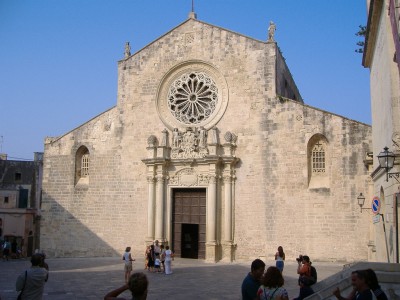
The Main Church, originally built in the Middle Ages, has been rebuilt several times after being damaged by the 1743 earthquake. In 1938, the vault collapsed. But the church rose again more beautiful than ever, with Baroque altars, 18th-century stuccoes, and paintings from the best artistic schools. This splendor expresses the rich landowning class that had olive oil as its gold. Indeed, not far from the church is the underground mill where the oil was extracted to light streets and squares throughout Europe, especially London. The Salentines were once the sheikhs. Hence the rich churches and elegant noble palaces with secret gardens.
The sound of the oldest organ in Puglia, built in 1628 and arriving to us in its original structure, will fascinate you. In Salve organ concerts are often organized to highlight this priceless treasure, kept in the main church. Among the decorations stands out the bas-relief of a kind priest, sainted by the faithful: Alessandro Cardone, who literally stripped off his clothes if he met a poor person on the street.
Surrounded by a metaphysical charm is the Santuario di Santa Marina in the district of Ruggiano. Its facade lights up orange and red at sunset. This is the pilgrimage route that made stops at Ruggiano and Leuca Piccola before arriving at the sanctuary where the world ended (of Santa Maria de Finibus Terrae). Next to the Sanctuary is the well where pilgrims drew precious water and the guesthouse where they spent the night. The sanctuary is linked to devotion to Saint Marina of Bithynia, who protects the liver and, in an ancestral cult, area inhabitants invoked her whenever they saw a rainbow rise on the horizon.
In Salento, East and West blend harmoniously. This is evident in the multifaceted culture of the Salentines, in the house ornaments, and in the gaze of Saint Nicholas, the Eastern saint also venerated in Salve on the fourth Sunday of May. His wooden statue has a peculiarity: one eye is blue, the other green, symbolizing East and West which in Salento share a single soul and merge harmoniously.
Le Maldive del Salento
At Marine di Salve on the Ionian coast of Salento, just 15 kilometers from Santa Maria di Leuca and thirty from Gallipoli, you find the beaches called Italy’s Maldives. Journalists, opinion leaders, and travelers gave this nickname to this stretch of Salento beach after admiring the beauty of the places, the colors of the sea and sand, where the Blue Flag often flies.
Among the most prestigious covers, we recall the one last year by MarcoPolo dedicated to these locations, naming them the Maldives of Italy, with a stunning and sexy Laura Barriales topless against a refreshing blue sea backdrop.
It all started from a business idea suggested by customers themselves to the owner of a beach club who renamed his bathing establishment Le Maldive del Salento.
The Leuca Caves
To not miss out on anything, there is also the possibility of a boat excursion to discover the coast and the nearby Leuca caves with Noleggio Nettuno and Escursioni Nemo. On the Ionian side, you will be amazed by the Grotta delle Tre Porte, symbol of all the Leuca caves, the Devil’s Cave, the Love Cave which lights up red at sunset. On the Adriatic side, not to be missed is a visit to the Cathedral Cave with its bell-like striker, the Breeze Cave, and the Ciolo Lake Cave which houses a lake of icy water accessible only through a narrow tunnel and on foot.
Where to Sleep
Hotels, guesthouses, holiday homes to stay in Salento.