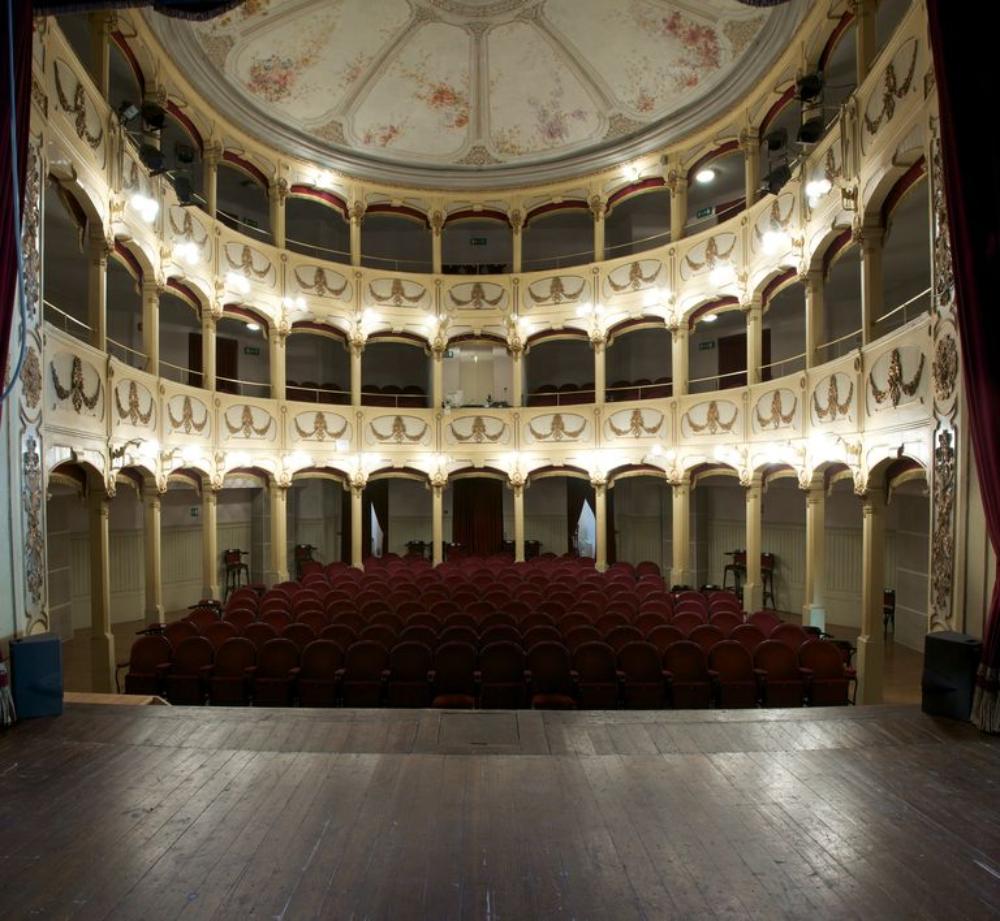


The Ducal Theatre of the Saline, also generally referred to as the “small” or “comedy” theatre, was built in August 1593, thanks to the contribution of a wealthy merchant from Piacenza: Pietro Martire Bonvino. To this end, the spaces located in the upper part of a building, used on the ground floor as a salt and customs warehouse, were suitably adapted; it was located near the church of San Protaso, now long disappeared, not far from the “dei Cavalli” square, at the corner of the current via Romagnosi and via Cavour. No external modification or decoration was made to indicate the newly adapted purpose; it actually seems to have retained the appearance of a fortress, massive and belligerent, complete with surviving battlements. The interiors, however, are better documented thanks to clear plans preserved at the Passerini Landi Library in Piacenza and elaborated in 1758 by Francesco Zanetti, who was in charge of restoring the theatre, declared dangerous since 1746; another plan is kept at the State Archives of Parma, Maps and Drawings collection, 23/35, dated 21 February 1743. The theatre, of small size, had a hall with a “U”-shaped floor plan, an orchestra level and three tiers of stacked boxes, the first resting on a set of wooden columns. Each tier consisted of twenty-six loges besides the ducal one; a last tier, called the “rondoni”, was intended for the lower classes. The stage was rather small and lacked adequate rooms for the needs of performances and actors, as well as space for the orchestra, while there were services for the public such as, for example, a tavern adjacent to the orchestra and a café on the first tier. However, nothing is known beyond the indications concerning the purely architectural structure, that is, for example, whether it had plastic or pictorial decorations or not. It was certainly active until 1804 and, according to an appraisal drafted by Lotario Tomba three years later, it was still in decent conservation conditions. The origin of the Ducal Theatre of Palazzo Gotico, also more generally called Theatre of the Square, would date back to May 1644 when, on the occasion of celebrations for the peace between Duke Odoardo and Pope Urban VIII, a notable event was the staging, in the Hall of the Town Hall Palace still called the “Gotico”, of the tragicomedy La finta pazza by Giulio Strozzi, set to music by Francesco Sacrati and performed by the Accademici Febiarmonici. Most likely, this was the first staging of a musical drama in Piacenza; and the success of the initiative encouraged the idea of building a real theatre in the hall of this palace. The idea was realized in 1646, under the direction of the Piacentine architect Cristoforo Rangoni called Ficcarelli, who set up this theatre hall. With its structure of four tiers of boxes in wood with faux marble, decorated with figures and stuccoes in gold and colors, and with a massive wooden curtain on which it seems the city of Piacenza was depicted, vivid in color and rich in gold, bright with lights, a stage box equipped with machines to satisfy the complicated seventeenth-century stagings; it was qualified as a theatre intended to perform a celebratory and elitist function, thus excluding the paying public. This fact would also be confirmed, according to the collected documentation, by the sporadic activity that took place there, consisting exclusively of important productions of musical dramas and interrupted around 1728. Among the most striking theatrical events, the staging of Coriolanus by Cristoforo Ivanovich in May 1669 is to be remembered, on the occasion of public celebrations wanted by Ranuccio II to honor illustrious guests. The grand spectacle involved, from January of the same year, consistent and appropriate adaptations of the theatre under the direction of the Venetian theatre engineer Gasparo Mauro. The so-called “Cittadella” Theatre would be, in chronological order, the third ducal theatre in Piacenza. Most likely it was built in the second half of the 17th century in the building next to the unfinished Rocchetta Viscontea, connected to the adjacent Palazzo Farnese by a skywalk. It was also practically adjacent to the over three hundred wooden shops built by Ranuccio II for trading goods during the fairs of exchange and merchandise. The essential characteristics and distribution of the spaces of this theatre are also known thanks to the plans drawn by Zanetti in 1758 (another pen and watercolor plan dated 18th century is preserved at the State Archives of Parma, Maps and Drawings collection, 23/59). Larger and better organized than the Theatre of the Saline, the hall had a usual U-shaped plan elongated by the gentle full arch curvature, five tiers of boxes, the last one usually called “rondoni” corresponding to today’s gallery (for a total of ninety-six boxes distributed over the first four tiers), and there were no shortages of ancillary spaces for the public such as the small hall and the café. The large stage was equipped with necessary services, rooms for actors, a tailor’s workshop, etc., as well as space for the orchestra. Very likely it was in this theatre that, under the patronage of Ranuccio II, a significant operatic revival took place connected, among others, to the stage design activity of the Galli Bibiena family. Usually the performances took place in April and September generally coinciding with the important fairs of goods and exchange. Among the most important musical events in this theatre is the performance of Scipione in Cartagine nuova by Carlo Innocenzo Frugoni, music by Geminiano Giacomelli, featuring among the singers the famous Carlo Broschi called Farinelli as protagonist. The show was part of a series of festive events in honor of Enrichetta d’Este, wife of Antonio Farnese, on her first arrival in Piacenza. On this occasion, the theatre was also appropriately restored and described in a celebratory eclogue composed by the Arcadian shepherd Bartolomeo Casali, from whose verses we learn, among other things, that the orchestra “[…] has immense circles of chairs. / Where the noble circle ends / You see a large hanging curtain / And on it wondrous marvels are comprehended: / There is a horse with wings on its back / There are nymphs who have lodging / On clouds there are things / Marvelous enough to be laughed at”. At the end of the 18th century, the Theatre of the Saline was already dilapidated although still used, while the Cittadella theatre was still the most important and aristocratic place for public performances. The city was left without one on Christmas Eve 1798 when a violent fire completely destroyed the latter theatre. It was initially a certain Pietro La Boubé, a French citizen who had enriched himself in Piacenza thanks to prudent speculations, who requested permission from the Government to build a new theatre (which was supposed to be built in an area within the same block where the Municipal would later rise), attaching a project drafted by the Piacentine architect Lotario Tomba. For multiple reasons this initiative did not succeed; instead, a company composed of five Piacentine patricians obtained, in August 1803, from General Administrator Moreau de Saint-Mèry the consent to build a new theatre. Also designed by Tomba, it was built on an area occupied by the Landi Pietra palace (which was demolished to make way for the new building) at the intersection of the current via Giordani and via Verdi near San Antonino. The chosen location was not without problems; on one hand, the new theatre would bring back to social life the square of the ancient Cathedral, on the other, the dialogue of the new architecture with the imposing splendid Gothic church could not be the easiest. Another penalizing aspect was the narrowness of the available area, which the designer solved by reducing, perhaps excessively also for the needs of 19th-century stage technology, the stage, but the foyer and ancillary spaces were also penalized. The construction of the new theatre was carried out in a very short time, a year or little more, and although it lacked a façade and had interior ornaments not entirely in harmony with the elegance of its structure, it was inaugurated on 10 September 1804 with the serious musical drama Zamori, or The Hero of India, on a libretto by Luigi Previdali and music specially composed by Giovanni Simone Mayer and with the ‘heroic ballet’ Emma, or The Judgment of Charlemagne, by Giuseppe Ranzi. The theatre features a hall with an elliptical plan, considered according to Patte’s dictates (Essai sur l’architecture théâtrale, 1782) the one best responding to acoustic and visual needs, four tiers of boxes and gallery, while structurally it is characterized by the presence of large pointed arches, probably a device adopted by Tomba to reduce the spans and counterthrusts without increasing vertical development. In 1826, under the guidance of Alessandro Sanquirico, significant internal decoration work began and a curtain, now lost, was painted. In 1830, following Lotario Tomba’s drawings, partially modified, Sanquirico himself completed the façade, inspired, also by the express wish of the commissioners, by the Scala in Milan. In 1857, architect Paolo Gazzola was commissioned to carry out further major restoration works; in particular, the roof was rebuilt and the hall above the orchestra level was enlarged creating a space for scenic painters, while about forty ancillary rooms were also newly built and others enlarged. Great attention was also paid to the decorative apparatus: under the direction of Girolamo Magnani, the hall’s vault was repainted with the collaboration of Paolo Bozzini; furthermore, the decorations of the atrium were redone by Gaetano Albertelli, as well as those of the stairs and stuccoes and gildings of the proscenium and boxes, giving the environments the aesthetic appearance they still retain today. The old wooden structures such as the roof, the stage and the now lost stage machinery were rebuilt by Giuseppe Mastellari, machinist of the Regio Theatre of Parma. In 1938-1939 the partitions of the third and fourth tiers of boxes were demolished to create two levels of galleries. The winches, drums and wooden grids were demolished during a 1970 restoration in which the wooden roof was replaced with a masonry one. In the 1976-1979 restoration, the stage design workshop was converted into an auditorium room for conferences and concerts, and improvements were made to service rooms. Of the ancient musical furnishings only an organ remains, purchased in 1836 from the Serassi brothers of Bergamo. Recently the theatre has been the subject of an important restoration intervention again. In the spring of 2001, on the occasion of the first centenary of Giuseppe Verdi’s death, the Scenographers’ Hall of the Municipal theatre exceptionally hosted two exhibitions. One was an exhibition of paintings by Pietro Fornari who, inspired by the master’s works, portrayed well-known and lesser-known heroes and heroines from the Verdi repertoire. This was followed by a review of graphic works by Giancarlo Braghieri inspired by Verdi’s music. Permanently exhibited in the theatre café is the ‘Portrait of a Woman with Three Roosters’, a large painting from 1950 by Luciano Spazzali, an artist from Piacenza. (Lidia Bortolotti)
Information about Municipal Theater
Via Giuseppe Verdi, 41,
29121 Piacenza (Piacenza)
Source: MIBACT