


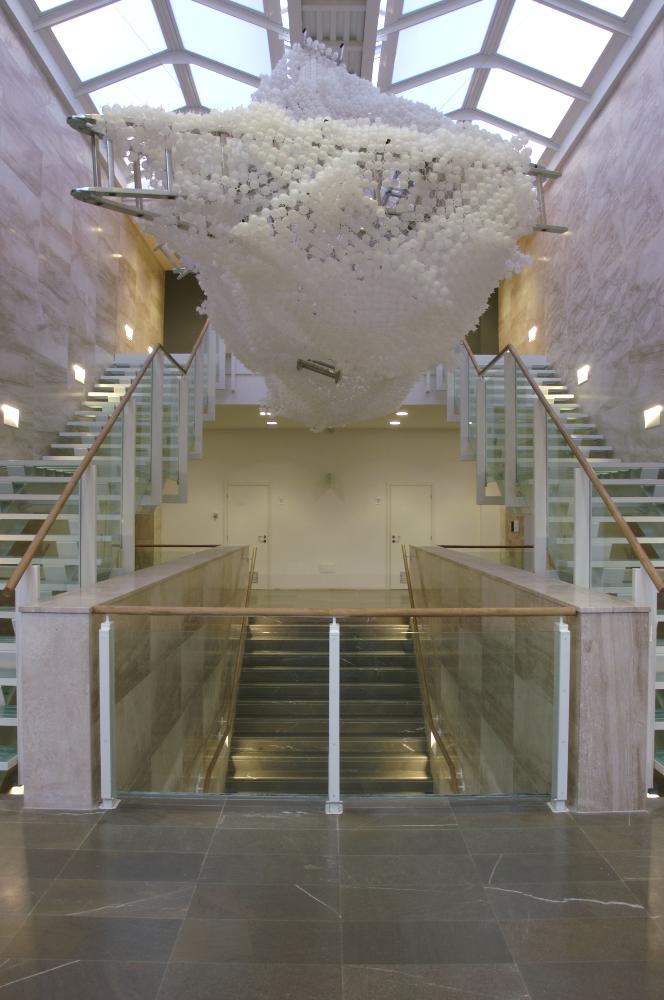


The artistic heritage of the nineteenth and early twentieth centuries is presented here in a refreshed form that pays particular attention to the history and culture of the Bologna area. The added value of the museum lies in positioning itself as an institution interested in documenting and promoting contemporary Italian art through the selection, sponsorship, and acquisition of works by young artists to create an important permanent collection. Founded in 1925 at Villa delle Rose and reorganized in 1936, the Modern Art Gallery of Bologna has always housed, in its collections, works from the nineteenth century, the twentieth century, and contemporary times, whose original core was significantly expanded from 1961, thanks to the direction of Francesco Arcangeli and the brief tenure of Carlo Volpe.
Since 1975, the Gallery has been housed in the building designed by architect Leone Pancaldi in the city’s fair district; its partial completion resulted in limited space that hindered the exponential growth of the collections and necessarily favored exhibition activities. From that moment, the institution became the vital center of urban contemporary culture: initially directed by a board composed of critics and intellectuals supporting Franco Solmi’s leadership, including Renato Barilli, Emilio Contini, Vincenzo Accame, and Giorgio Celli in the first term, and again Barilli with Thomas Maldonado, Italo Zannier, Flavio Caroli, and Pier Giovanni Castagnoli in the second, the museum was subsequently led by Pier Giovanni Castagnoli until 1994, when it was transformed into a Municipal Institution. Since then, two directors have succeeded, Danilo Eccher and Peter Weiermair with four-year terms, not particularly rooted in the city’s cultural fabric but successfully carrying out intense international promotional activities, a course continued by Gianfranco Maraniello since 2005; the Gallery’s Board of Directors and Scientific Committee, also appointed by the Mayor, work synergistically with the Direction.
The gallery’s assets boast over four thousand works, half of which are graphic, exhibited both permanently and on rotation. The collections largely represent the panorama of twentieth-century Emilian art, complemented by important works by major masters of Italian art and distinguished European and American artists.
Among others, there are works by Carla Accardi, Valerio Adami, Franco Angeli, Karel Appel, Stefano Arienti, Hans Arp, Ugo Attardi, Donald Baechler, Roberto Barni, Vanessa Beecroft, Davide Benati, Vasco Bendini, Simon Benetton, Luigi Bianchi, Enzo Bioli, Umberto Boccioni, Floriano Bodini, Alighiero Boetti, Christian Boltanski, Aldo Borgonzoni, Dino Boschi, Maurizio Bottarelli, Remo Brindisi, James Brown, Alberto Burri, Carlo Carrà, Maceo Casadei, Athos Casarini, Felice Casorati, Bruno Cassinari, Enrico Castellani, Maurizio Catellan, Angelo Caviglioni, Bruno Ceccobelli, Mario Ceroli, César, Giovanni Ciangottini, Lea Colliva, Gianni Colombo, Pietro Consagra, Carlo Corsi, Gino Covili, Tony Cragg, Crash, Leonardo Cremonini, Enzo Cucchi, Pirro Cuniberti, Dadamaino, Giorgio de Chirico, Mario De Maria, Paola De Pietri, Filippo De Pisis, Luciano de Vita, Gianni Dova, Pablo Echaurren, Max Ernst, Jean Fautrier, Ferruccio Ferrazzi, Giannetto Fieschi, Garzia Fioresi, Giosetta Fioroni, Jean Michel Folon, Lucio Fontana, Franco Francese, Futura 2000, Giuseppe Gabellone, Remo Gaibazzi, Omar Galliani, Gino Gandini, Marco Gastini, Mimmo Germanà, Quinto Ghermandi, Ferruccio Giacomelli, Piero Gilardi, Gilbert & George, Giuseppe Graziosi, Piero Guccione, Giuseppe Guerreschi, Franco Guerzoni, Virgilio Guidi, Renato Guttuso, Eduoard Habicher, Keith Haring, Emilio Isgrò, Marcello Jori, Yumi Karasumaru, Giovanni Korompay, Nello Leonardi, Loncillo, Carlo Leoni, Carlo Levi, Osvaldo Licini, Marco Lodola, Emanuele Luzzati, Mino Maccari, Renè Magritte, Piero Manai, Paolo Manaresi, Pompilio Mandelli, Giovanni Manfredini, Giuseppe Maraniello, Anacleto Margotti, Vittorio Mascalchi, Titina Maselli, Roberto Sebastian Matta, Eliseo Mattiacci, Carlo Mattioli, Lorenzo Mattotti, Fausto Melotti, Plinio Mesciulam, Vittorio Messina, Nino Migliori, Luciano Minguzzi, Gian Marco Montesano, Henry Moore, Mattia Moreni, Ennio Morlotti, Ugo Mulas, Zoran Music, Hidetoshi Nagasawa, Mario Nanni, Ugo Nespolo, Nunzio, Luigi Ontani, Mimmo Paladino, Leone Pancaldi, Giulio Paolini, Claudio Parmeggiani, Augusto Perez, Cesare Peverelli, Lamberto Pignotti, Piero Pizzi Cannella, Armando Pizzinato, Fabrizio Plessi, Giovanni Poggeschi, Jackson Pollok, Arnaldo Pomodoro, Graziano Pompili, Concetto Pozzati, Sepo, Bruno Pulga, Andrea Raccagni, Oliviero Rainaldi, Carol Rama, Giuseppe Romagnoli, Sergio Romiti, Mimmo Rotella, Bruno Saetti, Lucio Saffaro, Salvo, Juliaõ Sarmento, Germano Sartelli, Aligi Sassu, Emilio Scannavino, Mario Schifano, Julian Schnabel, Toti Scialoia, Sean Scully, Gino Severini, Ardengo Soffici, Mario Sironi, Pino Spagnulo, Adriano Spatola-Graham Sutherland, Tancredi, Emilio Tadini, Antonio Tapies, Marco Tirelli, Mark Tobey, Ernesto Treccani, Giulio Turcato, Giuseppe Uncini, Franco Vaccari, Sergio Vacchi, Emilio Vedova, Claudio Verna, Lorenzo Viani, Farpi Vignoli, Antonio Violetta, Wols, Erwin Wurm, William Xerra, Nicola Zamboni. Since 1997, the Gallery has been equipped with a new exhibition sector inside the building called ‘Spazio Aperto’, while temporary exhibitions are also held at Villa delle Rose, converted into an exhibition space since 1989. The Modern Art Gallery’s activity has been intense since its inception, focusing on the enhancement and promotion of significant and relational contemporary research in the regional, national, and international artistic landscape, organizing more than three hundred and ninety-five exhibitions, including the group shows Art as Self-awareness against Fascism of Yesterday and Today (1975), Europe/America – Determined Abstraction (1976), Art Nouveau in Bologna and Emilia Romagna (1977), The Shape of Writing (1977), Performance Today (1977), The Metaphysics of the Everyday (1978), Ars Combinatoria (1979), Ten Years Later – The New New (1980), Metaphysics: The Twenties (1980), The Etching School in Bologna (1982), Photographic Experimentation in Italy (1983), Informal Art in Italy (1983), Border Art.New York Graffiti (1984), Austrian Art 1960-1984 (1984), The Eighties (1985), Sculpture and Ceramics in Italy in the ‘900 (1989), Materially. Sculptors of the Eighties (1989), The Nineties (1991), New Bologna Workshop.
Visual and Sound Art (1992), Art in France 1970 – 1993 (1994), Italy Workshop (1997), Europe Workshop (1999), Appearance (2000), The Shadow of Reason (2000), Paintings in the Region, Italian Art. The Last Forty Years, where “anomalous materials,” “iconic” and “aniconic” painting were explored (1997-1999), The Nature of Still Life (2002), and The Nude Between Ideal and Reality (2004); and the related solo exhibitions, first and foremost, by Giorgio Morandi (1975), Xanti Schawinski, Luciano De Vita, Luciano Minguzzi (1975), Carlo Corsi (1977), Vasco Bendini, Giovanni Korompay (1979), Dino Boschi, Mattia Moreni, Renato Guttuso, Mimmo Paladino (1981), Andrea Raccagni, Emilio Vedova, Luigi Ontani (1982), Mario Merz (1983), Mario Nanni, Bruno Saetti, Piero Manai (1985; 1988), Lucio Saffaro (1987), Duilio Cambelotti (1990), Piero Dorazio, Concetto Pozzati, Lucio Fontana (1991), Tancredi (1992), Luigi Ghirri (1993), Ilario Rossi (1994), Gianfranco Ferroni, Maurizio Bottarelli, Franco Guerzoni, Vittorio D’Augusta, Nunzio, Jannis Kounellis, Pompilio Mandelli, Fabrizio Plessi (1995), Gilbert & George (1996), Julian Schnabel (1997), Anselm Kiefer (1999), Arnulf Rainer, Augusto Perez, Sergio Romiti (2001), Antonio Violetta, Erwin Wurm (2002), Claudio Parmiggiani, Marco Tirelli, Raymond Pettibon, Friedrich Dürrenmatt, Bruno Pinto (2003), Piero Manai and Pirro Cuniberti (2004), the latter exhibited in the rooms of the Archaeological Museum of Bologna.
Spazio Aperto’s activity, coordinated by Dede Auregli with a committee of experts including Chiara Bertola, Roberto Daolio, Claudio Marra, Claudio Spadoni, Alessandra Vaccari, and the director of GAM, started in 1997 with the support of Emilia Romagna Region’s Cultural Department with the main task of promoting emerging young artistic activity from the regional territory. The project hosted various continuous exhibitions, with different curatorships, solo shows, duo or multiple-name exhibitions, exchange shows, group exhibitions, and awards, whose protagonists later confirmed themselves as artists capable of impacting the art system: remembered are Vincenzo Izzo and Alessandra Tesi, Francesco Bernardi and Cuoghi Corsello, Nicola Cucchiaro and Andrea Renzini, Giovanni Manfredini, Maurizio Arcangeli and Yumi Karasumaru, Cristiano Pintaldi, Vanessa Beecroft and Shirin Neshat, Giovanni Albanese and Sabrina Mezzaqui, Luca Caccioni, Sara Ciracì-Michele Mariano-Marco Samorè, Alessandro Bazan-Andrea Chiesi-Daniele Galliano, Mat Collishaw, Eva Marisaldi, Clara Bonfiglio-Vittorio Corsini, Enrica Borghi, Paola De Pietri, Marco Neri and Andrea Salvino, Bertozzi & Casoni, Sabrina Torelli, Marcello Maloberti, Emilio Fantin, Claudia Losi, and the group shows 8 Artists/8 Critics, Collaudi, Open Space for Drawing, and Keep’n Touch, the European Eurostar project and, in 2000, the Alinovi Award retrospective. The award, established in memory of critic Francesca Alinovi by a group of critics named “Friends of Francesca” in 1986, is now in its nineteenth edition and recognizes young artists chosen for truly innovative artistic experimentation, in line with the scholar’s research.
Winners have included Luigi Ontani, Societas Raffaello Sanzio, Denis Santachiara, Aldo Spoldi, Piero Gilardi, Corrado Levi, Andrea Taddei, Marcello Jori, Premiata Ditta, Studio Azzurro, Cuoghi and Corsello, Eva Marisaldi, Cesare Viel, Cesare Pietroiusti, Luca Vitone, and Sissi. Since 2005, the Gallery has become the venue for the Furla Art Prize, organized in collaboration with the Querini Stampalia Foundation. This prize, now in its eighth edition, also aims to reward emerging young artists from the artistic horizon through a selection made by local, national, and international critics. MAMbo presents and hosts the winners’ works in its exhibition spaces, among which are “Shift, 2008” by Alberto Tadiello (Furla Prize 2009) and “Journey in Italy” by Matteo Rubbi (Furla Prize 2011).
The Gallery also hosts the Art Section of the Dams Award. Art, Music, and Performance for the national competition of DAMS in Italy, promoted by the DAMS Degree Course of the University of Bologna; in 2004, at its third edition, it aimed at fostering the creativity of recent graduates in art, cinema, music, and performance; and for young Italian artists, the “Friends of the Modern Art Gallery of Bologna” Association established, also in 2004, the Maretti Prize, which aims, through Christian Maretti’s patronage, to restore the purchase awards mechanism intended to increase the Institution’s assets with works that encourage the creativity of new generations. In the first exhibition, artists who have already stood out in the most qualified circuit of experimental contemporary art exhibited, such as Sergia Avveduti, Giuseppe Caccavale, Pier Paolo Campanili, Annalisa Cattani, Andrea Melloni, Federico Pietrella, Leonardo Pivi, Marco Samoré, and Sissi.
The Gallery carries out fundamental educational activities in art through the Educational Department, whose program is based on study opportunities aimed at children, teenagers, and teachers of schools of all levels to involve its audience in the creative processes of making art. The Modern Art Gallery was moved in 2007 to the archaeological-industrial area of the former Bread Oven, where the Manifattura delle Arti was born from the restoration of the former Tobacco Factory, designed by architect Ilario Rossi; and for which, in 2005, the IdeART for the Manifattura Public Art project competition was announced, won by Eva Marisaldi with the “AAVV” (Various Authors) project, applying the law of July 29, 1949, no. 717, through regional law 16/2002. This excellent situation constitutes an opportunity for the expansion of the collections and simultaneously offers the possibility to be actively synergistic with the Salara space (where exhibitions of Kounellis and Plessi were organized in 1995), with the Lercaro Collection, and with the laboratories of the Department of Music and Performing Arts of the University of Bologna.
In 2007, the Modern Art Gallery was transformed into MAMBo, a museum relocated to the city center within the ten thousand square meters of the former Bread Oven whose industrial and monumental architecture, dating back to the Great War era, is softened by a gallery with basket arches in the Long Wing; the former Bread Oven underwent a restoration splendidly functional for its new use but highly respectful of its original features. Gianfranco Maraniello, Director since 2005, and Lorenzo Sassoli, President of the Institution, were tasked with steering and inaugurating it with an important thematic exhibition “Vertigo. A Century of Off-Media Art from Futurism to the Web” alongside Germano Celant.
The new museum structure, extraordinary for multi-floor exhibition spaces, ample storage, a large public library, catering, and bookshop, is integrated into a mini city cultural district, the Manifattura delle Arti, which includes the Cineteca, the laboratories of the Department of Music and Performing Arts, the Department of Communication, and the Salara exhibition venue. Drawing from the great legacy of the Modern Art Gallery of Bologna and its acquisitions (with works ranging from the nineteenth century to today), MAMbo aims to integrate research and experimentation with the importance and quality of a precious collection. A dedicated space will be assigned for a conscious and critical re-examination of the Gallery’s artistic heritage, with particular attention to the history and culture of the territory that Bologna is part of and its great artistic tradition.
Thanks to the contribution of Unicredit Group and the Emilia Romagna Region, MAMbo has initiated new and important collaborations to support and enhance contemporary culture. Between 2007 and 2008, MAMbo continued activities with a cycle of solo exhibitions: alongside Eva Marisaldi and Diego Perrone, solo shows by Adam Chodzko and Bojan Šar?evi? were held.
With these, the museum reaffirms the central role of Italian artistic research in its exhibition programming through new projects. In particular, through the entrepreneurial planning of UniCredit Group, MAMbo’s cultural research can select, sponsor, and acquire works by young artists to create an important permanent collection of Italian art in the spaces of the former Bread Oven. In the same year, 2008, exhibitions by Luigi Ontani, Walzer Guyton, Ding Yi, de Rijke/de Rooij, and Giuseppe Penone were inaugurated; additionally, the “Performance Day” took place as part of the third BlueArt Roads exhibition project, along with a series of seven evening meetings exploring aspects of MAMbo’s environments and collections perceptible even without the use of sight. Moreover, between the end of 2007 and 2008, the ongoing “Time Code” series held eight events featuring video works by Roberta Piccioni and Pavel Braila, Alejandrio Vidal, Tellervo Kalleinen and Oliver Kotcha Kalleinen, Ottonella Mocellin, Nicola Pellegrini, Almagul Menlibayeva, Schwinger, Knut Asdam and Moser, Sara Rossi and Martin Sastre, Riccardo Benassi, Shona Illingworth, and finally for “Time Code #8”, works by Pierre Coulibeuf and Simonetta Fadda. Among recent cultural activities was a lecture on Pietro Consagra’s abstract sculptural work, on the occasion of the reinstallation at the Charterhouse of the “Totem of Liberation” sculpture previously located in the garden of the former Modern Art Gallery of Bologna. Additionally, there will be two independent but connected exhibitions in the series on Jeroen de Rijke and Willem de Rooij, a joint project of MAMbo and K21 Kunstsammlung Nordrhein-Westfalen.