

La “Strada degli Stranieri”, ha origine sul litorale Jonico, all’altezza dell’antica Metapontum (oggi Metaponto, frazione di Bernalda, nel materano) nota città della Magna Grecia e taglia completamente la Basilicata da Est ad Ovest per raggiungere l’altra antica città fiorente sotto i greci, Paestum (provincia di Salerno).
All’occhio attento non sfugge che il percorso, ricostruito da Mimmo Saracino (nelle foto), è quasi completamente in Basilicata. Per essere più meticolosi la “Strada degli Stranieri” è un’arteria che interessa l’intera Lucania antica. Si tratta di un tratturo utilizzato per la transumanza ed è grazie agli studi sugli spostamenti dei pastori in antichità che questa “strada” è stata tracciata.
Why the Road of the Foreigners?
La Strada prende il nome dai “greci” che percorrevano la strada da una costa all’altra. I “greci” erano denominati “stranieri”. Lungo il percorso, tuttavia, grazie alle varie diramazioni che l’arteria presenta, si immettevano anche pastori del luogo che andavano a popolare uno dei maggiori tratturi di transumanza dell’area meridionale.
The “Road of the Foreigners” and Archaeology
E’ sufficiente pensare all’origine e alla fine di questa strada per capire quanta importanza ha avuto quest’arteria nei millenni. Le antiche città greche di Metaponto e Paestum erano collegate tra di loro grazie a questo “tratturo”. Tuttavia la strada attraversa anche aree romane ed insediamenti molto noti diversi secoli prima di Cristo ed in particolare siti fortificati dell’antica Lucania. L’area della Torre di Satriano, per esempio, è completamente tagliata da questa strada ma ne sono interessati anche altri siti molto importanti, come Vaglio, sempre in provincia di Potenza, Civita di Tricarico (nel materano), Serra del Cedro, Roscigno nel Cilento. Lungo il percorso, dunque, i luoghi trasudano storia antica ma anche modernità grazie al percorso che si snoda da un “crinale” all’altro attraversando vetusti insediamenti e moderne aree urbane. Percorrere questo cammino dà il senso di come i lucani si siano spostati e abbiano fortificato i loro insediamenti.
The “Road of the Foreigners” Today
Il percorso, di circa 200 chilometri, è oggi composto da strade comunali anche interamente asfaltate (un esempio è la strada comunale di Tito in area Torre di Satriano) che prende il nome di “Stranieri” (non è un caso ma bensì la prova) e di antiche mulattiere. Da oriente ad occidente, dunque, se volete anche viceversa per ripercorrere una delle più importanti vie della cosiddetta “transumanza orizzontale” (si oppone a quella “verticale” che vede le greggi spostarsi dalla pianura alle alture per poi scendere a valle prima dell’inverno). Una strada molto nota in antichità come “Trazzera degli Stranieri” o “Tratturo degli Stranieri” oppure “Tratturo Regio degli Stranieri” che ben si presta a chi vuole intraprendere un cammino a piedi seguendo il percorso a zig zag tracciato dagli animali durante gli spostamenti.
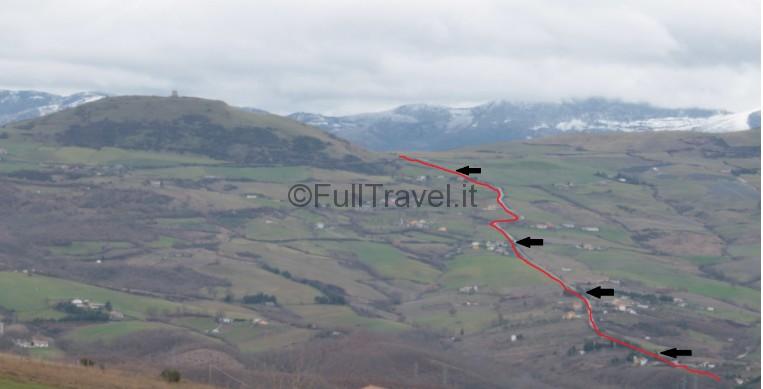
The route of the “Road of the Foreigners”, from Metaponto to Paestum
“Coming from Metaponto to Grottole, the road offers 2 possibilities:
a) from the ancient city of Metaponto it heads towards the Tavole Palatine, runs alongside the Bradano river and from the S.Giuliano bridge it turns West to join the SS 7 Appia between Grottole and Grassano.
b) from Metaponto through Bernalda, old Pomarico (Castrocicurio) and Grottole, the road overlaps the SS 7 Appia and reaches Grassano, heads NW to point 423, here it overlaps again the SS 7 “Appia” until the junction between Acqua Frisciana and Le Piane. From point 331 it intersects with a road leading to Calle, which connects the Basento with the upper Bradano area.
Continuing to overlap the SS 7, the route turns SW, skirting Serra del Cedro, passes near the town of Tricarico and reaches the “Tre cancelli” locality, where it crosses the tratturo coming from the Basento, crosses Albano and continues towards S. Maria delle Fonti of S. Chirico Nuovo- Tricarico.
Continuing NW, it “cuts” the bend that the SS 7 makes near Cupolicchio and reaches Taverna Arsa, where it branches NW towards Serra di Vaglio-Torretta and West, descending to the Basento. Continuing along this last branch, at point 584 tratturi coming from Brindisi di M., Vaglio and Tolve converge. From here the road, running along the Basento towards West, reaches the Vaglio Basilica railway station.
At this point the route crosses other tratturi that go from Montegrosso to Vaglio, Serra di Vaglio, Cancellara; continuing west, it crosses the Tiera stream and, overlapping SS 7, heads towards Potenza through Varco d’Izzo, continues along the Basento through the “industrial area” of the capital, passing near the ancient S.Vito bridge24, until it reaches the junction of the Gallitello stream with the Basento river25. Continuing west, it skirts the Tora stream, overlapping the SS “del varco” towards Picerno; at km 49, near “masseria Tramutola”, it leaves the state road for a stretch (where it makes a sharp turn), then rejoins it further ahead at km 46.7. The route, following a flat path, intersects the SS 95 “di Brienza” at point 816, from here it begins the descent towards S-SW until “Taverna bruciata”, a confluence point of tratturi coming from Tito, Picerno, Monte li Foi, Satriano. From this point it continues towards SW beginning a steady climb until Torre di Satriano.
Having crossed point 844 with a descent towards S-SW, it skirts the Cammarara stream in the territory of Satriano and reaches the Melandro stream, from here it crosses the river at point 483 and at point 489 two possibilities open:
1) The road begins a steady climb southward, continues through C. Corte, and then reaches points 545 and 566. Still heading south, it reaches the fontana del Barbone at point 749 and passes to the west, under Toppo Avezzale, continues through Masseria Gianlorenzo and heads towards Atena Lucana.
2) The road heads west through Acqua dei Salici, bypasses Monte Airella and continues towards the Braide locality and then to the town of Polla.
The first hypothesis seems more plausible as the road retraces the ancient Satriano-Atena tratturo (see cadastral maps) with not too steep slopes, and with a shorter route; it also crosses or skirts the ancient Lucanian fortified site of Atena.
Crossing the Diano valley, the road climbs towards S.Rufo, Roscigno-Monte Pruno, Bellosguardo and through the Cilento mountains reaches Paestum.
* This route is proposed exclusively for FullTravel readers and was traced by Mimmo Saracino (taken from the magazine “Leukanikà”).