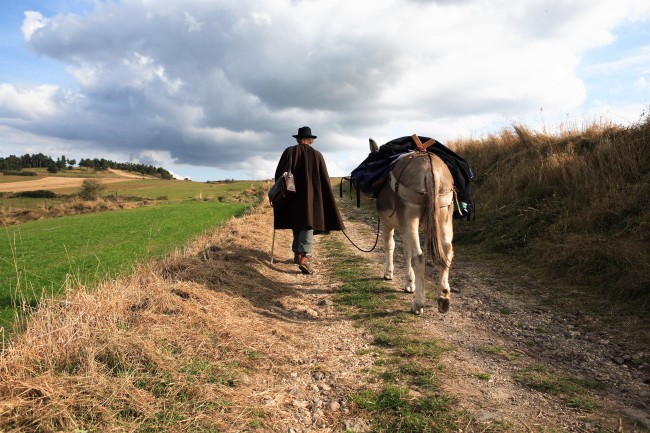


The “Strada degli Stranieri” begins on the Ionian coast, near the ancient city of Metapontum (now Metaponto, a hamlet of Bernalda in Matera province), a renowned city of Magna Graecia. The route crosses the entire region of Basilicata from East to West, reaching the other ancient and flourishing Greek city, Paestum (in the province of Salerno).
Looking closely at the route, as reconstructed by Mimmo Saracino (see photos), you’ll notice that it lies almost entirely within Basilicata. More precisely, the “Strada degli Stranieri” is an artery that traverses the whole of ancient Lucania. This route, originally a herding trail used for transhumance, was mapped thanks to research on the ancient movements of shepherds.
Why is it called ‘Strada degli Stranieri’?
The route is named after the “Greeks” who journeyed from coast to coast; in the past, these “Greeks” were referred to as “stranieri” (foreigners). Over time, local shepherds also began using the road, which, thanks to its many offshoots, became one of southern Italy’s major transhumance trails.
The “Strada degli Stranieri” and Archaeology
Consider its starting and ending points to understand the strategic importance this trail held for millennia. The Greek cities of Metaponto and Paestum were directly linked by this herding path. But the road also cuts through Roman areas and several pre-Roman settlements, especially fortified Lucanian sites that predate Christ by centuries. The area around Torre di Satriano, for instance, is intersected by this trail, as are other key archaeological sites like Vaglio (Potenza province), Civita di Tricarico (Matera province), Serra del Cedro, and Roscigno in Cilento. Walking this path immerses you in both ancient history and present-day landscapes, as the trail zigzags along the region’s ridgelines through age-old settlements and modern towns. Traveling this route reveals how Lucanians moved and fortified their territories through the ages.
The “Strada degli Stranieri” Today
Today’s route covers about 200 kilometers and includes both paved local roads (like the Strada Comunale di Tito near Torre di Satriano, which even takes the name “Stranieri” as proof of its origins) and old mule tracks. Whether east to west or in reverse, you’ll be retracing one of the main routes of so-called “horizontal transhumance”—unlike “vertical” transhumance that saw herds moving between plains and mountains with the seasons. Known historically as the “Trazzera degli Stranieri”, “Tratturo degli Stranieri” or “Tratturo Regio degli Stranieri”, this path is ideal for modern hikers looking to follow the ancient, twisting trails left by livestock migrations.
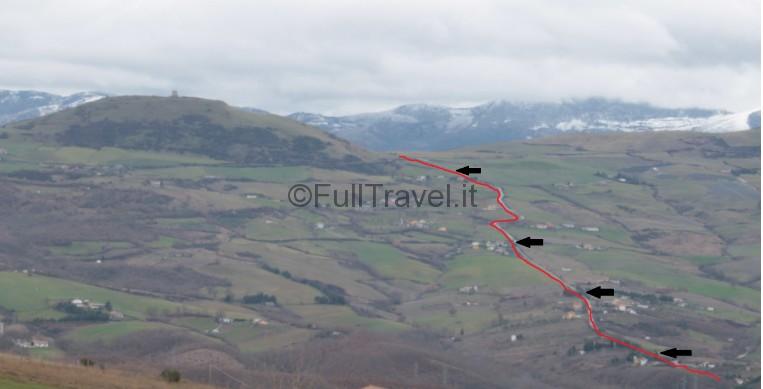
The route of the “Strada degli Stranieri”: from Metaponto to Paestum
“Starting from Metaponto to Grottole, the road offers two options:
a) From the ancient city of Metaponto, it heads toward the Tavole Palatine, runs alongside the Bradano river, and at the S. Giuliano bridge turns west to connect to the SS 7 Appia between Grottole and Grassano.
b) From Metaponto, it goes through Bernalda and old Pomarico (Castrocicurio) to Grottole, then overlaps with the SS 7 Appia until Grassano. It continues northwest to point 423, once again overlaps the SS 7 “Appia” up to the junction between Acqua Frisciana and Le Piane. From point 331, it intersects with a road leading to Calle, connecting the Basento with the upper Bradano area.
Continuing alongside the SS 7, the route veers southwest past Serra del Cedro, skirts around Tricarico, and reaches “Tre cancelli”, where it meets a trail coming from Basento, crosses Albano, and heads toward S. Maria delle Fonti di S. Chirico Nuovo-Tricarico.
Still moving northwest, it bypasses the SS 7’s bend near Cupolicchio, reaches Taverna Arsa, then branches northwest to Serra di Vaglio-Torretta, and west, descending to the Basento. Here, at point 584, trails from Brindisi di M., Vaglio, and Tolve converge. The route follows the Basento westward to the Vaglio Basilica train station.
At this point, the trail crosses other paths from Montegrosso towards Vaglio, Serra di Vaglio, and Cancellara; continuing west, it fords the Tiera stream and, once again overlapping the SS 7, passes through Potenza via Varco d’Izzo and continues along the Basento past the industrial area, near the old S. Vito bridge, reaching the junction of the Gallitello stream and the Basento. Heading further west, it runs next to the Tora stream, following the SS “del varco” toward Picerno. At km 49, near “masseria Tramutola”, it briefly leaves the main road (where the highway curves) before rejoining it further along at km 46.7. The route, mainly flat here, intersects the SS 95 “di Brienza” at point 816 and starts to descend southwest to “Taverna bruciata”, where trails from Tito, Picerno, Monte li Foi, and Satriano meet. From here, it moves southwest, beginning a steady climb up to Torre di Satriano.
After passing point 844 and descending southwest alongside the Cammarara stream within Satriano territory, it reaches the Melandro river, then fords it at point 483. At point 489, the route splits in two:
1) The road climbs steadily south toward C. Corte, reaching points 545 and 566. Still heading south, it arrives at “fontana del Barbone” (point 749), passes west below Toppo Avezzale, goes to Masseria Gianlorenzo, and then heads toward Atena Lucana.
2) The road moves west through Acqua dei Salici, around Monte Airella, continues toward Braide, and then to the town of Polla.
The first option appears more likely, as it follows the old Satriano-Atena herding trail (see land registry maps) with gentler slopes and is shorter, also crossing or skirting the ancient fortified Lucanian site of Atena.
After crossing the Vallo di Diano, the trail ascends to S. Rufo, Roscigno-Monte Pruno, Bellosguardo, and through the Cilento hills reaches Paestum.
* This route is provided exclusively for FullTravel readers and was mapped by Mimmo Saracino (extracted from the magazine “Leukanikà”).