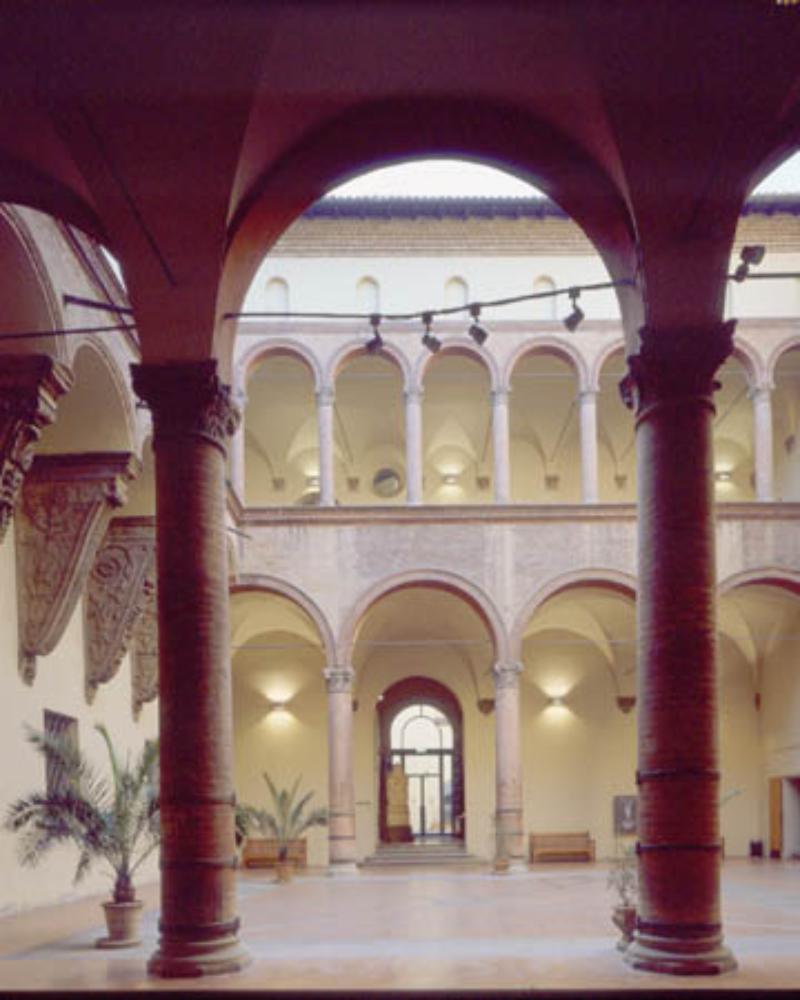
La Galleria Ricci Oddi was inaugurated in 1931, in the spaces of the former Convent of San Siro, adapted into a museum by the architect Giulio Ulisse Arata. The development of public access to the collection of Giuseppe Ricci Oddi was very long and problematic, precisely because the Municipality wanted to fulfill the wishes of the Piacenza patron who had wanted to dedicate a collection of artistic importance for public use to his city. The art collection, contemporary to him, for Giuseppe Ricci Oddi (1868-1937) began in 1897 with a taste projected both towards Piacenza expressions and towards the various Italian researches of the second half of the 19th century, never getting too close to the most radical avant-gardes and with attention directed towards some moderate early 20th-century innovations, such as the stylistic nuances of Symbolism and the experiences of impressionist and fauvist origin developed by the most up-to-date Italians. Following the death of the philanthropist, the Gallery continued to increase 20th-century art and, after a significant restoration lasting from 1997 to 2001, the collections are presented to the public in a new setup that provides several spaces more suitable to new museum needs: an underground room and a whole floor for education.Stefano Fugazza, director until 2009, conceived the new museum setup organizing it by rooms: the honor hall is used for temporary exhibitions or for the display of new acquisitions, the rooms are harmoniously arranged with works by artists grouped by belonging to neighboring geographical areas, stylistic affinities, and chronological congruencies that particularly testify to the figurative researches of the 19th and early 20th centuries. The 20th century opens with works by the Emilians, such as Amedeo Bocchi, Giuseppe Graziosi, Garzia Fioresi, Alfredo Protti, Giovanni Boldini, along with the Italo-French research of Mario Cavaglieri; and is followed by works of Piacenzans Luigi Arrigoni, Alfredo Soressi, Luciano Richetti, and Bruno Cassinari, also enriched by the sculptures of Medardo Rosso, Domenico Trentecoste, Libero Andreotti, Ermenegildo Luppi, Attilio Selva, Pietro Canonica, Quirino Ruggeri, Alessandro Moretti, and Arturo Dazzi. The Venetian figurative culture of the 20th century is opened by Pietro Fragiacomo, Guglielmo and Beppe Ciardi, Francesco Sartorelli, Ettore Tito, Ferruccio Scattola, Guido Cadorin, and Lino Selvatico; Roman pictorial research is testified by Antonio Mancini, while the South sees interesting contributions from Vincenzo Irolli. A transitional movement between past and future, crossing the century, was Symbolism, in which clear signs of cultural renewal can be recognized later detonated in the birth of European avant-gardes. Figuratively it is represented by important works by Giulio Aristide Sartorio, Plinio Nomellini, Camillo Innocenti, and Felice Carena, as well as interesting paintings from Emilia-Romagna, such as Adolfo De Carolis, Mario De Maria, Cesare Laurenti. Attendance at the Biennials of the first three decades of the last century brought collector Ricci Oddi to the knowledge and appreciation of international art, particularly that which had brought significant changes to Italian art: he acquired works by Thorolf Holmboe, Alfred Napoléon Delaunois, Carl Larsson, Albin Egger-Lienz. The vast season of the Italian Novecento artistic movement, with many of its variants, is pictorially represented by Piero Marussig, Gianfilippo Usellini, Massimo Campigli, Ottavio Steffenini, Carlo Prada, Filippo De Pisis, Bruno Saetti, Anselmo Bucci, Leonardo Dudreville, Achille Funi, Gian Emilio Malerba, Ubaldo Oppi, Mario Sironi, Felice Carena, Felice Casorati, Arturo Tosi, Aldo Carpi, Carlo Carrà, Alberto Salietti, Michele Cascella; there are also sculptural works by Adolfo Wildt, Francesco Messina, Umberto Boccioni, and Siro Penagini. Regarding contemporary art collections of the present day, the second half of the 20th century is predominantly documented by Piacenza painting, sculpture, and graphics, with works by Bruno Cassinari, Gustavo Foppiani, Ludovico Mosconi, Armodio (Vilmore Schenardi), Carlo Bertè, Bruno Grassi, Alfredo Casali, Franco Corradini, Giancarlo Braghieri, Mauro Fornari, Giacomo Malfanti, Bruno Sapiente, Bruno Missieri, Secondo Tizzoni, Giorgi Groppi, Paolo Perotti, Sergio Brizzolesi, Giuseppe Serafini, and Alfredo Sorresi, Ettore Bonfatti Sabbioni; and by two groups of works, the Cogni donation of Lorenzo Pepe sculptures and the paintings by Giancarlo Manara, which enrich the Gallery meeting again its natural vocation as a collection of contemporary Italian art. Therefore, the examples of Pavia painting by Contardo Barbieri and Alfredo Mantica, as well as of Emilians Nando Negri, Pietro Ghizzardi, Giuseppe Motti, and Carlo Mattioli, should not be forgotten. The Gallery’s activity aims at acquiring contemporary artistic realities linked to the territory, as well as their enhancement through exhibitions, restorations, conferences, readings, educational activities, publications, and promotional initiatives. Among the latest events are remembered the exhibitions Sculpture of Piacenza of the early 20th century (2002), Piacenza painting of the 20th century (2002), the donation of the Piacenza poet Ferdinando Cogni Sculptures of Lorenzo Pepe (2002), Views on art. Twenty-two Piacenza artists of our days (2002); The very small Gallery. Women artists at Ricci Oddi (2003); in 2004 took place The revolt and the enchantment. Poetry, painting, and sculpture in Nello Vegezzi, The mirror of Venus. Sybille and the city, and Luciano Ricchetti at the first edition of the Cremona Prize (1939), the exhibition The woman in Boccioni’s graphics, The revolt and the enchantment. Poetry, painting, and sculpture in Nello Vegezzi. The following year Stefano Fugazza organized the photographic exhibition Seeing the invisible and the exhibition of the Mancini collection composed of small-format works titled Fifteen by fifteen. In 2006, Angeli, Diavoli, Regine. Gustavo Foppiani graphic artist was inaugurated, while at the Palazzo del Podestà in Castell’Arquato the retrospective Tribute to Umberto Mastroianni was realized. Also, there are monographic exhibitions on Francesco Dossena, Renato Natali, Romano Tagliaferri, and in the Gallery’s Hall of Honor, that on Aldo Brizzi The Neorealism and beyond. 2008 was the year of “Rainer Maria Rilke. The poet and his angels,” an exhibition accompanied by a related program of meetings. The Ricci Oddi’s activity schedule also includes conferences, cultural meetings, presentations of works, and guided tours, among which are the cycles Reading art and Writing art, as well as meetings with artists Maurizio Bottarelli and Armodio as a corollary to the exhibition The soul of the 20th century. In 2010 exhibitions “Alfredo Tansini painter and photography. Materials for a rediscovered artist” and “Bitter chalice. Female figures between the 19th and 20th centuries in Ricci Oddi’s works” were organized. Of 2011 are the solo exhibition “Stefano Bruzzi, the poetics of snow” and the study day titled “The eighty years of Ricci Oddi. A modern art gallery in 1930s Italy,” on the occasion of the eightieth anniversary of the Gallery’s foundation.
Information on Ricci Oddi Modern Art Gallery
Via San Siro 13,
29121 Piacenza (Piacenza)
0523320742
[email protected]
https://www.riccioddi.it
Every day 9:30-12:30; 15:00-18:00
Source: MIBACT