


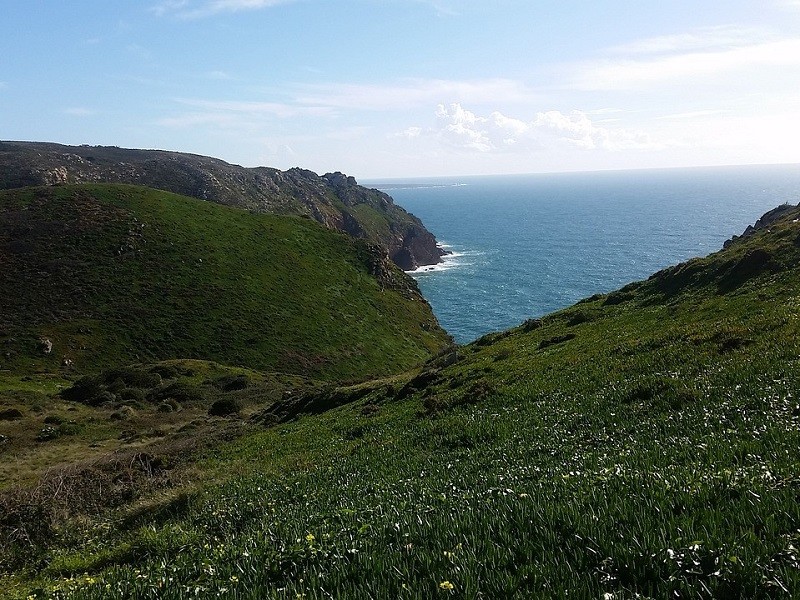
Sintra is located about 30 kilometers from Lisbon. Despite the short distance, the two places could not be more different: Sintra is surrounded by lush greenery and mountains, which meet the Atlantic Ocean in steep, dramatic cliffs, creating a wild and rugged coastline.
This spectacular landscape has charmed many romantic nobles and artists since the 18th century, who chose Sintra for their summer retreats. Among them were Hans Christian Andersen and Lord Byron, who famously called it a “glorious Eden.”
It’s no surprise then that Sintra is home to many villas and palaces, once owned by royalty and aristocrats, and since 1995 a UNESCO World Heritage Site.

Best Things to See in Sintra
1 Sintra’s Landscape
Sintra’s territory is shaped by the Sierra de Sintra, a 10-kilometer mountain range stretching from the northern edge of the Tagus estuary to the Atlantic Ocean, ending at Cabo da Roca, the westernmost point of mainland Europe. The mountains aren’t particularly high—the tallest, Cruz Alta, reaches 529 meters—but their sedimentary nature creates a dynamic, often rugged landscape covered in rich vegetation.
The mountains give way to mostly high, rocky coastline, with occasional breathtaking beaches. Heading north along the coast, you’ll find the wild and secluded Praia da Ursa, the more accessible Praia da Adraga, and Praia Grande, known for its strong Atlantic waves, making it a paradise for experienced surfers. On the southern slopes above Praia Grande, you can see numerous dinosaur footprints fossilized in the rock.
2 Sintra National Palace
The Sintra National Palace (Sintra Palacio Nacional) stands at the center of town. Its origins trace back to North African Moors who conquered the Iberian Peninsula in the early Middle Ages. After the Christian reconquest, it became the property of the Portuguese royal family, who began rebuilding and expanding it from the 15th century onward. Though built in separate phases, the wings are harmoniously connected with stairs and courtyards, making it an outstanding example of organic architecture.
The dominant style is Manueline Gothic. The most fascinating room, apart from the lavish halls, is the kitchen, with its two towering 33-meter conical chimneys, a true city icon visible from afar.

3 Quinta da Regaleira
A short walk from Sintra’s center, Quinta da Regaleira was the estate of Antonio Augusto Carvalho Monteiro, known as “the Millionaire” for his fortune gained in Brazil from gems and coffee. Built in the early 20th century, the property includes a manor house, a chapel, and a vast park filled with fountains, grottos, and tunnels, many of them interconnected.
The architecture is mostly neo-Gothic, but there are nods to other styles. The most intriguing aspect is the estate’s symbolism: with references to Freemasonry (of which Monteiro was a member), the Templars, the Rosicrucians, and occult sciences like alchemy. Most striking are two “inverted tower” wells, which were likely used for initiation rituals.

4 Castelo dos Mouros
Castelo dos Mouros takes us back to the Middle Ages: this fortress was built between the 8th and 9th centuries by Moorish populations. Its peaceful surrender to Christian forces in 1147 was a key event in the Reconquista, as the fortress overlooked all of Sintra. After centuries of neglect, King Ferdinand II restored it in the 19th century. Visiting Castelo dos Mouros is a unique experience: while the steep climb requires some effort, stunning views and the magical path along the ancient walls make it worthwhile. Don’t miss the chapel ruins within the fortress.

5 Palácio da Pena
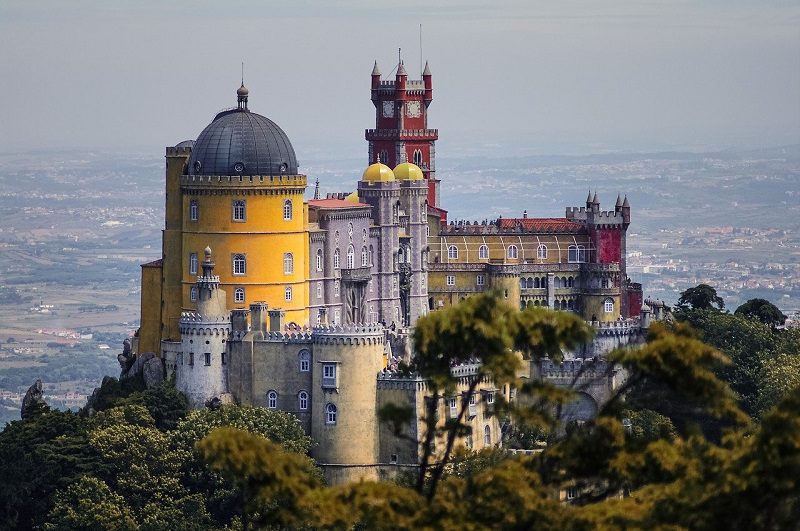
On a hilltop above Sintra stood a medieval chapel, later joined by a monastery built on the site of an apparition of the Virgin of Pena. In the 19th century, King Ferdinand II decided to build the royal family’s summer residence here, incorporating the old buildings: this became Palácio da Pena. The palace is one of the finest examples of Romantic architecture, famed for its bold eclecticism. Touring the palace feels like traveling through time, moving past Baroque, Gothic, Islamic, Manueline, and Renaissance styles boldly juxtaposed. Its striking color palette—red, yellow, and blue—is as vivid as the architecture. The interiors, decorated with stucco, trompe-l’oeil frescoes and azulejos tiles, echo the opulent exterior. Thanks to its elevated position and vibrant colors, Palácio da Pena is even visible from Lisbon on clear days.
6 Palácio de Monserrate
Originally a chapel dedicated to Our Lady of Monserrat and later an agricultural estate, the Palácio de Monserrate stands today as a neo-Moorish mansion. Built in the mid-19th century by Sir Francis Cook, the garden was designed by English landscape painter William Stockdale and a botanist. The 30-hectare park is the estate’s greatest highlight, home to over 2,500 plant species arranged by their geographic origin.

7 Convento dos Capuchos
Hidden in Sintra’s woods, about 7 kilometers outside town, lie the ruins of a Capuchin friary. Built in the mid-16th century, the Convento dos Capuchos was used until 1830, when monastic orders were abolished in Portugal. Since then, it’s been left to nature, now seamlessly blending with the forest. For lovers of atmospheric, gothic ruins, this moss-covered monastery is a must-see.

8 Queluz
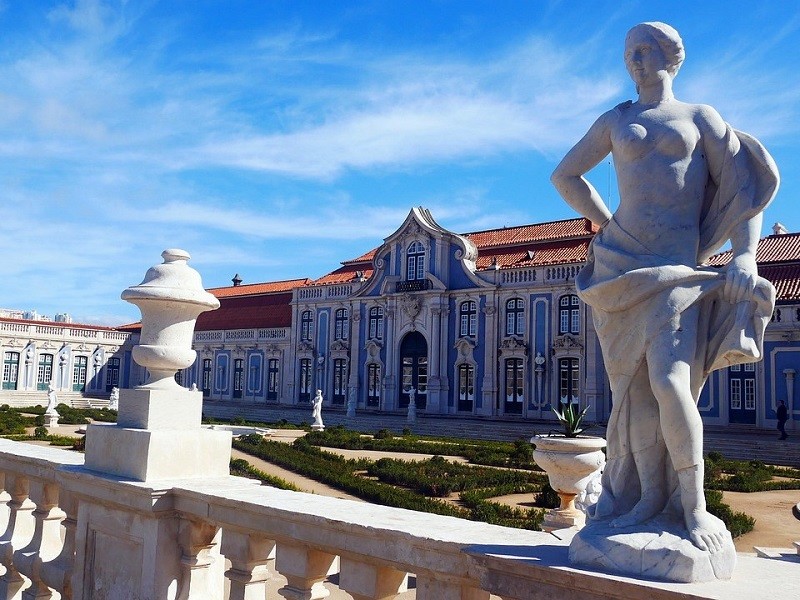
Palácio de Queluz is an elegant Rococo royal residence. Built from the mid-18th century, it’s nicknamed “the Versailles of Portugal”—though, unlike the original, its smaller size exudes refined charm rather than sheer grandeur. Queluz is marked by its many façades and gardens. The main façade opens onto a city square and is understated. On the Robillon Wing, a staircase with differently sized steps creates a unique perspective, enhancing its grandeur. The south side features a simple Doric colonnade contrasting with a baroque upper order, while the ballroom evokes Borromini’s style. The gardens, decorated with statues and fountains—including one with tritons and dolphins attributed to Bernini—are ringed by a long canal lined with azulejo tiles.
9 What to Eat in Sintra
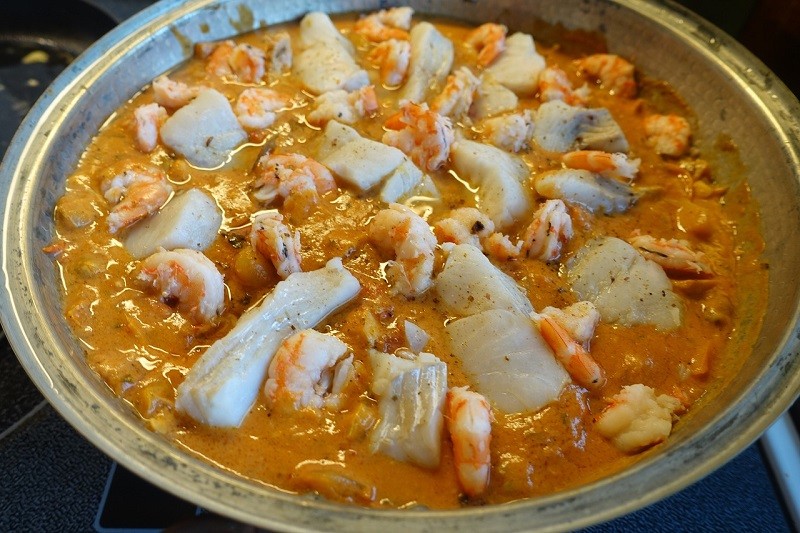
Like much of coastal Portugal, Sintra is known for excellent seafood restaurants at reasonable prices. The signature dish is bacalhau (salt cod), with 365 ways to prepare it—one for each day of the year. Another classic is arroz de mariscos, a seafood rice with shellfish. A land-sea specialty is carne de porco à Alentejana: pork cooked with clams. Roasted chicken, frango assado, is also popular here. Nearby Colares is famous for its sandy vineyards and distinctive red wines worth sampling.
10 Where to Stay in Sintra
To experience a real aristocratic stay in Sintra, check in at Palacio de Seteais. Built in neoclassical style in the 18th century for Dutch ambassador Daniel Gildemeester, today it’s a luxury Tivoli hotel with frescoed rooms, a spa, and a beautiful park with a pool. Double rooms start at 180 euros. For a central alternative, just steps from the National Palace, the Tivoli Hotel—also from the Tivoli group—offers four-star accommodation with doubles starting at 80 euros.