

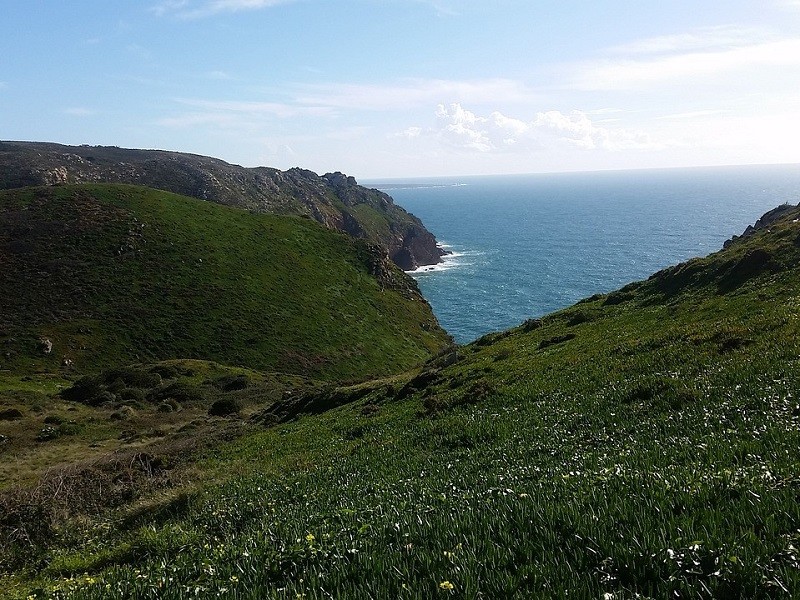
Sintra is located about 30 kilometers from Lisbon. Despite the short distance, the two places could not be more different: Sintra is surrounded by greenery, in a mountainous area that suddenly ends only in front of the Ocean, creating a rugged and wild coast.
The beauty of the landscape has touched the romantic heart of many nobles and artists who, since the eighteenth century, have chosen to vacation here. Among them, Hans Christian Andersen and Lord Byron, who called it a “glorious Eden.”
Therefore, it is no surprise that the territory of Sintra hosts numerous villas and palaces, once residences of royalty and aristocrats, which became in 1995 a UNESCO World Heritage Site.

Sintra sights to see
1 The landscape of Sintra
The territory of Sintra is characterized by the Sierra de Sintra, a chain about 10 kilometers long, stretching between the northern edge of the Tagus estuary and the Atlantic Ocean, culminating with Cabo da Roca, the westernmost point of continental Europe. These are not particularly high mountains: the highest peak, Cruz Alta, is 529 meters. Their sedimentary nature, however, generates a very rugged landscape, sometimes harsh, covered by lush vegetation.
These rough features overlook the coast, almost always high and rocky, which sometimes opens onto beautiful beaches. Going along the coast towards the North you will find, in order, the wild and hidden Praia da Ursa, the more accessible Praia da Adraga, and the Praia Grande, exposed to the fury of the Ocean and therefore a paradise for experienced surfers. On the hills that border the beach on the southern side of Praia Grande it is possible to see numerous fossilized dinosaur footprints.
2 The National Palace of Sintra
The National Palace of Sintra (Sintra Palacio Nacional) stands in the center of the town. Its origins date back to the time of domination by the North African Muslim populations who, in the Early Middle Ages, had conquered the Iberian Peninsula. After the Reconquest, it became property of the Portuguese royals who, from the 15th century onwards, began rebuilding it and adding new parts over the centuries. These bodies, although conceived independently, are harmoniously connected by stairs and courtyards, making the residence a beautiful example of organic architecture.
The dominant style is Gothic Manueline. The environment that fascinates the most, despite the presence of richly decorated official halls, is the kitchen famous for the two enormous conical chimneys 33 meters high. These chimneys, visible from far away, have become an icon of the city.

3 The Quinta da Regaleira
Located a short distance from the center of Sintra, the Quinta da Regaleira was the estate of Antonio Augusto Carvalho Monteiro, nicknamed “The Millionaire” for the fortune he had accumulated in Brazil through the trade of precious stones and coffee. The property, built at the beginning of the twentieth century, includes a palace, a chapel, and a huge park rich in fountains, caves, and tunnels, often interconnected.
The architecture is predominantly neo-Gothic, although there are references to other styles. But the most interesting feature of the complex is the symbolism and the mixture of esoteric references that permeates it: the structures and decorations seem to refer to Freemasonry, of which Monteiro was a member, but also to the world of the Templars and the Rosicrucians, as well as occult sciences such as alchemy. The most striking example are two wells, resembling “negative” towers, that were probably used for initiation rites also linked to cartomancy practices.

4 The Castelo dos Mouros
The Castelo dos Mouros takes us back to the Middle Ages: it is indeed a fortress built between the 8th and 9th century AD by the Moorish populations. Its peaceful submission to the Christian troops, which took place in 1147, marked an important moment in the history of the Reconquest, as the fortress dominated the entire territory of Sintra. After some centuries of abandonment, its restoration and enhancement began in the mid-19th century under King Ferdinand II. Visiting the Castelo dos Mouros is a unique experience: although the steep slope requires some physical effort, the effort will be rewarded by wonderful views and the charm of the path along the fortifications. The remains of the chapel inside the walls are also not to be missed.

5 The Palace of Pena
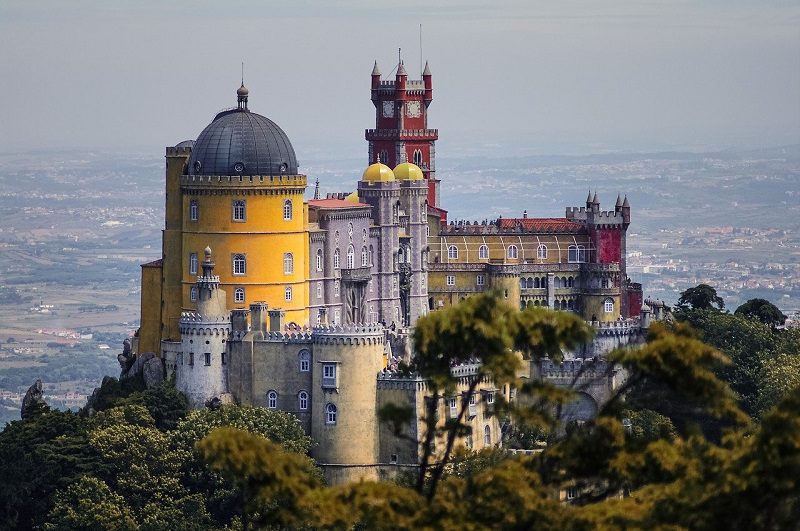
On the top of a hill in Sintra there was a medieval chapel, to which a monastery was later added, built on the site of an apparition of Our Lady of Pena. In the 19th century, King Ferdinand II decided to build the summer residence of the Portuguese royals including the remains of this complex: thus the Palace of Pena was born. This residence is considered one of the highest expressions of Romantic architecture for its eclecticism taken to extremes. The impression during the visit is that of a journey through time across Baroque, Gothic, Islamic, Manueline, and Renaissance architectures brazenly juxtaposed. The visual impact is completed by an extravagant palette of colors, dominated by variations of red, yellow, and blue. The interiors, decorated with stuccoes, trompe-l’oeil frescoes and azulejos, the typical painted tiles, are also coherent with the opulence and eccentricity of the exterior. Because of its position and its colorful vibrancy, the Palace of Pena is even visible from Lisbon on clear days.
6 The Palace of Monserrate
Originally a chapel dedicated to Our Lady of Monserrat and later an agricultural estate, the Palace of Monserrate today presents itself as a neo-Moorish style residence. It was built in the mid-19th century by Sir Francis Cook, who entrusted the design of the park to the English landscape painter William Stockdale and a botanist. And indeed the park, which extends over about 30 hectares, is probably the most spectacular part of the complex, with more than 2,500 plant species grouped according to their geographical area of origin.

7 The Convent of the Capuchins
In the middle of the woods of Sintra, about 7 kilometers from the inhabited center, lie the ruins of a Capuchin friars’ monastery. Built in the mid-16th century, the Convent of the Capuchins remained in use until 1830, when monastic orders were abolished in Portugal. Since then, it has been abandoned, becoming one with the surrounding nature. Therefore, for those who love Gothic landscapes, these isolated ruins covered with moss are an unmissable attraction.

8 Queluz
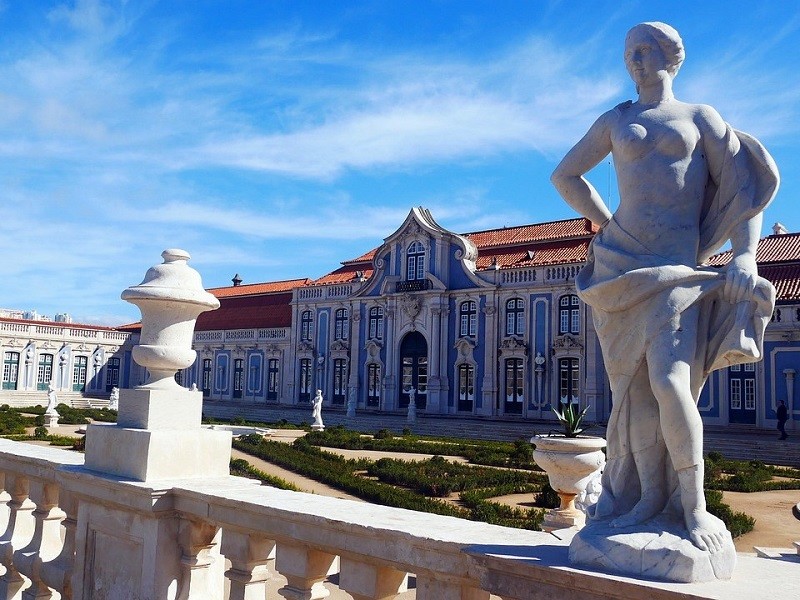
The Palace of Queluz is an elegant royal residence in Rococo style. Built starting in the mid-eighteenth century, it is called “the Versailles of Portugal” even though, unlike the French palace, the smaller dimensions convey refinement more than magnificence. Queluz is characterized by its many facades and the garden. The main facade, which opens directly onto a city square, is very sober. In the front facade of the Robillon wing, the staircase with steps of varying heights creates a perspective illusion that increases its majesty. On the southern side of the same wing, a sober Doric colonnade contrasts with an upper order decorated in Baroque style. Finally, the facade of the ballroom recalls the style of Borromini. The gardens are decorated with statues and fountains, including one with tritons and dolphins attributed to Bernini. Along the gardens runs a canal, more than 100 meters long, bordered by banks richly decorated with azulejos.
9 What to eat in Sintra
As in the entire coastal area of Portugal, in Sintra it is possible to find excellent fish restaurants with reasonable prices. The king of Portuguese cuisine is bacalhau (cod), which in this country can be enjoyed in 365 different ways, one for each day of the year. The other typical dish is arroz de mariscos, risotto with shellfish and seafood. Halfway between land and sea is the carne de porco a Alentejo, pork meat cooked together with clams. Typical of the area is also the tasty frango assado, roasted chicken. In the territory of Sintra, on sandy soils a short distance from the Ocean, is the Colares area, famous for its ungrafted vineyards. From here come fine red wines that must be tasted.

10 Where to sleep in Sintra
If you want to experience an aristocratic stay in Sintra, the place to go is the Palacio de Seteais. Built in neoclassical style in the 18th century for the Dutch ambassador Daniel Gildemeester, it is now a luxury hotel of the Tivoli chain, with frescoed rooms, a SPA, and a beautiful park with a swimming pool. Double room starting from 180 Euros. An alternative in the city center, just a few steps from the National Palace, is the Tivoli Hotel, a four-star hotel of the same chain as the Palacio de Seteais. Double room starting from 80 Euros.