


Dresden (Dresden) is a beautiful city in Saxony, in Germany. Although it was almost completely destroyed during World War II (notably the bombing between February 13 and 15, 1945, by the British and Americans), it is a city rich in art that deserves the nickname “Florence on the Elbe“, the river that flows through it. Dresden to see. The German city immediately appears charming to those who visit for the first time. And Dresden is beautiful at Christmas but also throughout the rest of the year.
- What to see in Dresden
- What to see in Dresden
- Dresden Germany points of interest
- 1 Frauenkirche of Dresden
- Frauenkirche opening hours
- Ticket prices to visit Frauenkirche
- 2 Semperoper Theater of Dresden
- Ticket prices to visit Semperoper
- 3 Hofkirche, the Catholic Church of Dresden
- 4 Zwinger Palace, a baroque masterpiece
- Opening hours of the Zwinger Palace
- 5 Neustadt, the artists’ district of Dresden
- 6 Brühlsche Terrasse, the “Balcony of Europe”
- 7 Albertinum of Dresden
- Albertinum opening hours
- Ticket prices to visit the Albertinum
- 8 Pfunds Molkerei, the most beautiful dairy shop in the world
- Opening hours of Pfunds Molkerei
- 9 How to get around Dresden and how to arrive: trains, buses, planes
- Dresden Tourism
- 10 Where to eat and drink in Dresden
- 11 Where to sleep in Dresden
What to see in Dresden
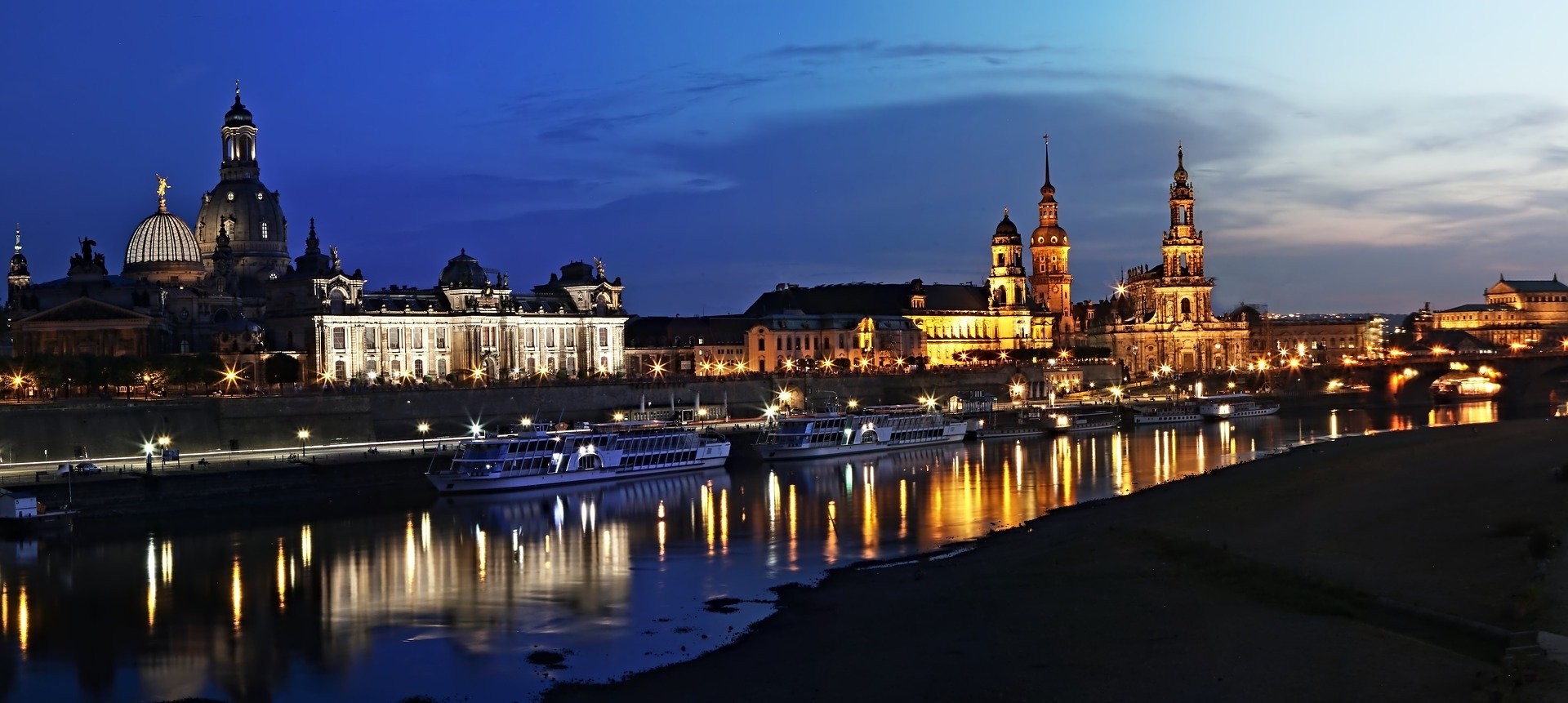
There are many things to see in Dresden. If your question is what to see in Dresden in one day or visit Dresden in two days, know that in both cases, with obviously different timing, it is all possible. Dresden in one day requires quite a forceful tour. However, it is possible to visit the city of Saxony without neglecting the monuments of Dresden, many of which are listed below. Therefore, visiting Dresden in one day remains a feasible goal even though there are really many things to see in Dresden. If you have some time, try to set it aside for this charming German city that will not disappoint you. Dresden to see over a weekend or in three days is still the best advice.
What to see in Dresden
In Dresden, there is no problem about what to do or what to see because the capital of Saxony suits all visitors. It is especially the baroque-style palaces and monuments that represent the attractions of Dresden, but its cultural liveliness, with events and festivals throughout the year, places the city of Saxony among the most interesting in the European scene. Dresden has been known since the 1700s, and it is from that period that the nickname “Florence of the North” originates, which together with the current “Florence on the Elbe” indicates the extraordinary artistic beauty of the city of Saxony. Here are some tips on what to see and what to do in Dresden.
Dresden Germany points of interest

1 Frauenkirche of Dresden
The Frauenkirche is certainly one of the most visited places in all of Germany. It is the symbol of Dresden’s rebirth with its famous dome. It is the Church of Our Lady that collapsed two days after the fatal bombings. It has been rebuilt exactly like the original as a symbol and reminder of what happened during the bloody World War II. The altar, for example, was restored through careful and meticulous assembly of thousands of original pieces that shattered. The Frauenkirche was reopened for Protestant worship in October 2005 and since then has been visited by over ten million visitors. Today the Frauenkirche hosts numerous festivals and events all year round.
Frauenkirche opening hours
Monday to Friday: from 10:00 to 12:00 and from 13:00 to 18:00. Reduced hours on weekends.
Ticket prices to visit Frauenkirche
Free entry. For the dome visit: 8 euros; 5 euros (reduced); 20 euros (families).

2 Semperoper Theater of Dresden
The Semperoper Theater in Dresden stands in one of the most beautiful squares in Germany: Theaterplatz. The Dresden Opera Theater suffered a fire in the early years after construction (1845) and only in 1878 was it able to present itself to the world as one of the most important classical music venues. It suffered the violence of World War II and only in 1985 did it return to music. Guided tours of 45 minutes in German are available, but English materials can also be found on site.
Ticket prices to visit Semperoper
7 euros (full price); 5 euros (reduced).

3 Hofkirche, the Catholic Church of Dresden
The Hofkirche of Dresden is a Catholic church, completed in 1755 (started in 1739) and became a cathedral in 1980. It is located at the end of the bridge over the Elbe River and is in the high Italian Baroque style. It suffered wartime damage and was completely restored. Important features include the tower with its 85.5 meters in height and the 78 statues placed in niches and on balustrades. Notable internal features include the pulpit, carved in 1722, the Ascension altarpiece from 1751, and the Silbermann organ from 1753. This church houses the remains of several kings and princes of Saxony. An urn contains the heart of Augustus the Strong (his body is buried in Krakow). Another notable church is the two-tower Christuskirche, dating back to 1903 and the purest example of Art Nouveau architecture in Dresden.

4 Zwinger Palace, a baroque masterpiece
The Zwinger Palace is one of the most important baroque buildings in Germany. With its pavilions and galleries, the “Crown Gate”, the “Nymphs’ Bath” and not least the gardens in the Zwinger courtyard, it is an oasis for every Dresden visitor. The strange sounding name “Zwinger” is a term used in military architecture and refers to the original position of the building opposite the defensive wall around the city. However, it did not have such a function. The Zwinger courtyard was a garden and orange grove, a place for court festivals. Its buildings house art collections and a rich library. The galleries with their balustrades, statues, and vases constitute a baroque Gesamtkunstwerk where architecture and sculpture are inextricably linked together. The Zwinger is famous for its Dresden Porcelain Collection, the scientific instruments displayed in the Royal Cabinet of Mathematical and Physical Instruments and the magnificent art collections housed in the Zwinger Palace. It is also worth visiting the Zoological Museum and the Historical Museum with its exhibitions of weapons from the fifteenth to eighteenth centuries.
Opening hours of the Zwinger Palace
Tuesday to Sunday: from 10:00 to 18:00.

5 Neustadt, the artists’ district of Dresden
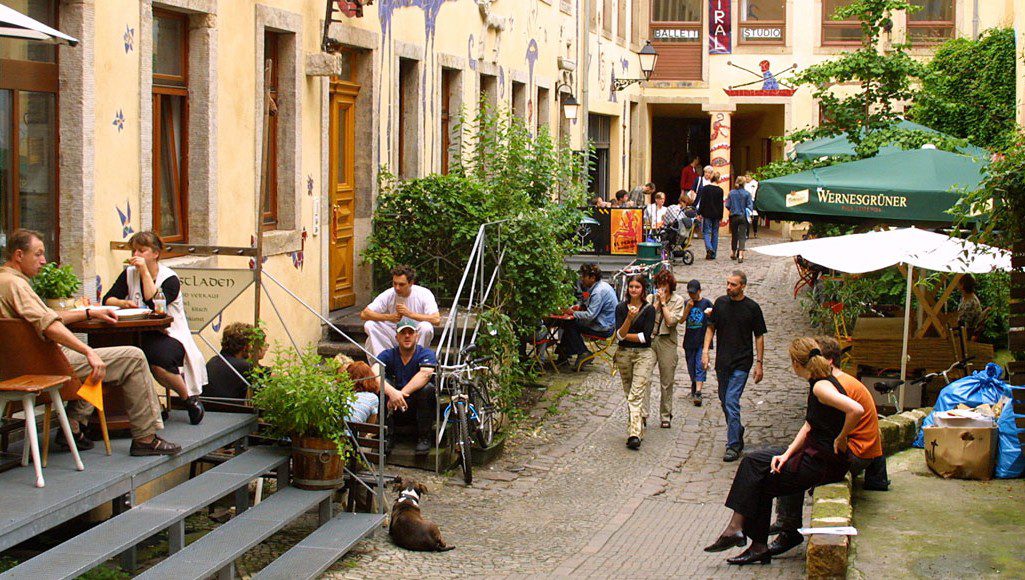
In the city center of Dresden, crossing the Augustbruke bridge, lies the district of Neustadt, well known for its lively atmosphere with its trendy venues. It is a district that was not damaged by the bombings of World War II and presents itself with all its picturesque corners. Here is the Kunsthofpassage, a unique place in Dresden that consists of a arcade of five courtyards designed according to specific themes by designers, artists, and builders. Inside these original courtyards are restaurants, cafes, galleries, and shops where creativity is freely expressed.
For example, in the courtyard of “Mythical Creatures” you can see strange animal figures on the building walls; in the courtyard of “Metamorphosis”, true transformations take shape; in the “Courtyard of Elements”, water passing through funnels along the wall produces music; entering the “Courtyard of Animals”, it feels like being in the savanna with paintings of giraffes, monkeys, and buffalo, while in the “Courtyard of Light” a building reflects sunlight from outside to inside, providing its heating.
6 Brühlsche Terrasse, the “Balcony of Europe”
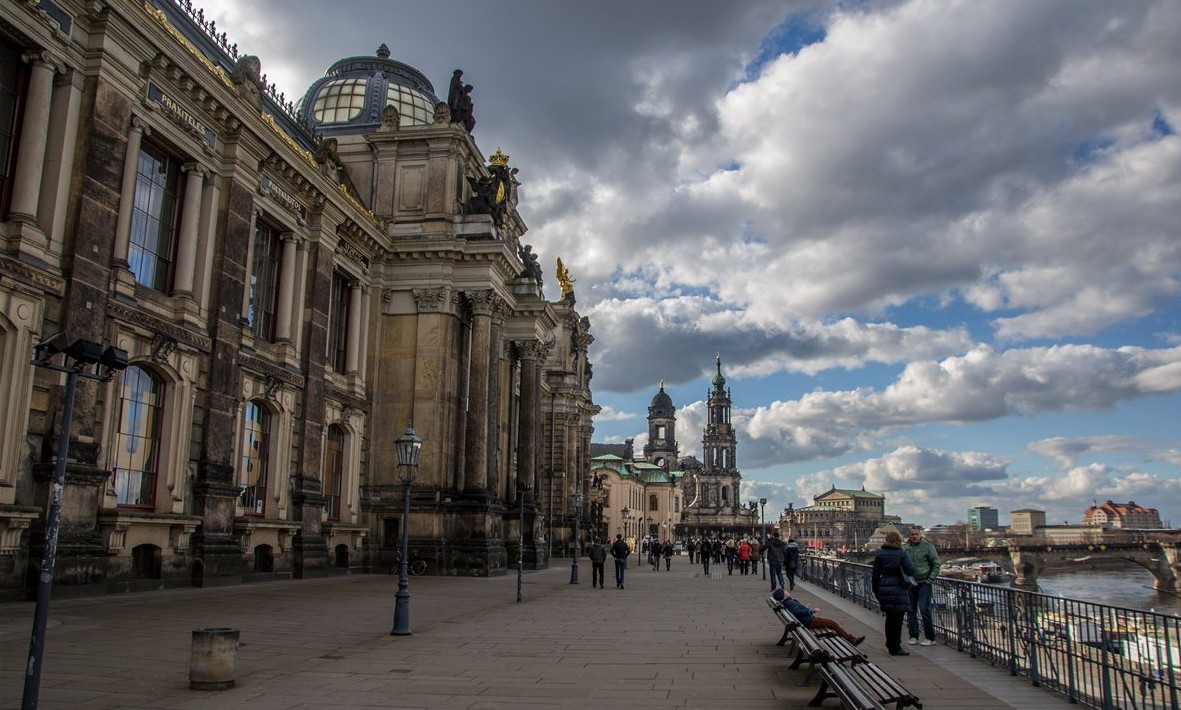
No trip to Dresden is complete without a visit to the Brühl Terrace or Brühlsche Terrasse, also known as the “Balcony of Europe“. The terraced promenade was part of Dresden’s original bastion, later becoming the Royal Palace garden. Notable are the sculptural groups on the staircase representing morning, noon, evening, and night. The only surviving original group is the Dolphin Fountain from 1749. Also interesting is the College of Art, built in 1894, and the Moritz Monument, the oldest surviving monument in Dresden, erected in 1553. Finally, visit the Terrassenufer on the banks of the Elbe, the boat dock. A walk in this area is very interesting as it is flanked by some of Dresden’s most beautiful historic palaces, including the Royal Art Academy and the Albertinum Museum.
7 Albertinum of Dresden
Damaged in 2002 by flooding of the Elbe River, and reopened to the public in 2010, the Albertinum is named after King Albert of Saxony who commissioned its construction between 1887 and 1889. The Albertinum is spectacular like the world-class art collection it houses. The museum is best known for its impressive New Masters Gallery with its rich collection of Romantic and Realist works, as well as French, Polish, Romanian, Hungarian, and Belgian paintings from the nineteenth century, along with German Impressionists. Other highlights include the Sculpture Collection, featuring works from Egypt, Western Asia, Greek, Roman, and Etruscan periods.
Albertinum opening hours
Monday to Sunday: from 10:00 to 18:00.
Ticket prices to visit the Albertinum
8 euros (full price); 6 euros (reduced, up to 16 years); children: free.

8 Pfunds Molkerei, the most beautiful dairy shop in the world
Built in 1880, Pfundsmolkerei is considered by many as the most beautiful dairy shop in the world (mentioned in the Guinness World Records), whose walls are covered with richly painted tiles. It all started in 1879 when a farmer had the idea to supply fresh milk every day to Dresden residents. He opened his store on Görlitzer Straße. A year later, in 1880, his brother joined him. Because the store was too small, it was moved in 1891 to Bautzener Straße, number 79. The shop survived the Dresden bombing in 1945. After a brief closure in the 1970s, the shop was reopened in the 1990s. The hand-painted tiles by Villeroy and Boch in 1892 tell the story of the dairy trade. Today Pfunds Molkerei mainly offers raw milk cheese products. A cheese tasting is not to be missed.
Opening hours of Pfunds Molkerei
Monday to Saturday: 10:00 – 18:00 – Sunday: 10:00 to 15:00.

9 How to get around Dresden and how to arrive: trains, buses, planes
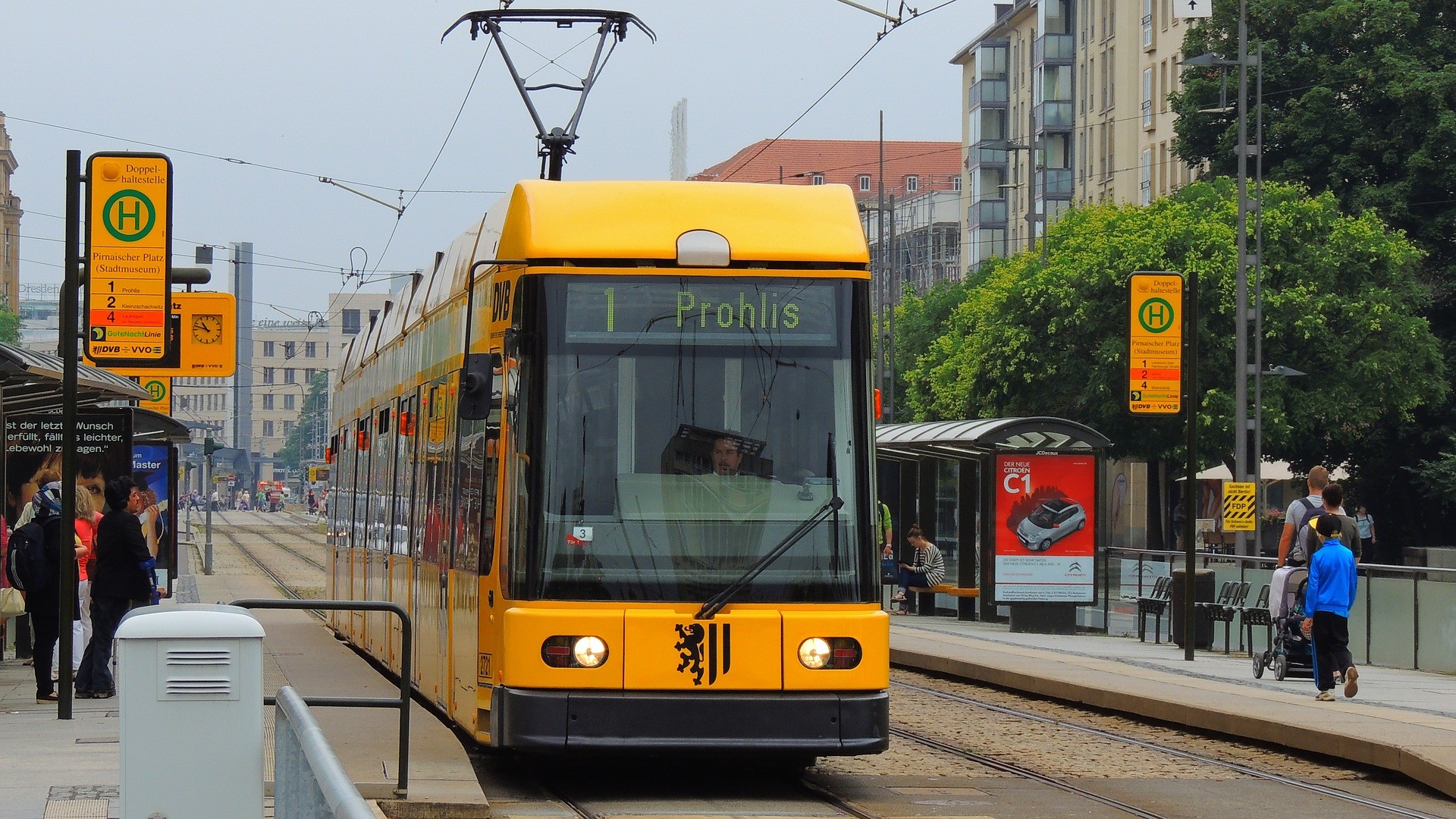
Dresden stretches along the Elbe River, which separates the old town (Altstadt) from the new town (Neustadt) to the north. The most important Dresden monuments can be reached on foot in just 10 minutes from the city’s main station (Hauptbahnhof) via the popular pedestrian shopping street Prager Strasse. The Augustus Bridge is the city’s most important bridge. Fully pedestrian, west of the riverside promenade Brühlsche Terrasse shopping area, this bridge connects to the new town.
Below the promenade is the Terrassenufer with all the docks where river boats moor. Continuing after the Augustus Bridge, you reach the city’s most famous shopping street, pedestrian-only, which goes up to Albertplatz. Here is the nightlife and pub district, Äußere Neustadt. Dresden has two railway stations. Almost all trains arrive at both stations. The main railway station is called Dresden Hauptbahnhof while the second is Dresden-Neustadt. The bus station is near the Hauptbahnhof. Dresden is served by an airport about 9 km north of the city.
Dresden Tourism
10 Where to eat and drink in Dresden
The city is full of restaurants and bars where you can eat and drink. In the Altstadt area there are several options suitable for the masses. If you are looking for typical local places, try searching along the “tavern district street”, Weise Gasse or towards Neustadt, the artists’ district. During the Christmas season do not miss the typical Dresden sweet, Dresdner Stollen, which stays fresh for a long time. It symbolizes the baby Jesus wrapped in swaddling clothes.

11 Where to sleep in Dresden
Hotels in Dresden are not affordable for every budget. They are among the most expensive in Germany. However, there are several alternative solutions. Here is a selection of hotels in Dresden but also consider options such as hostels or budget guesthouses.




