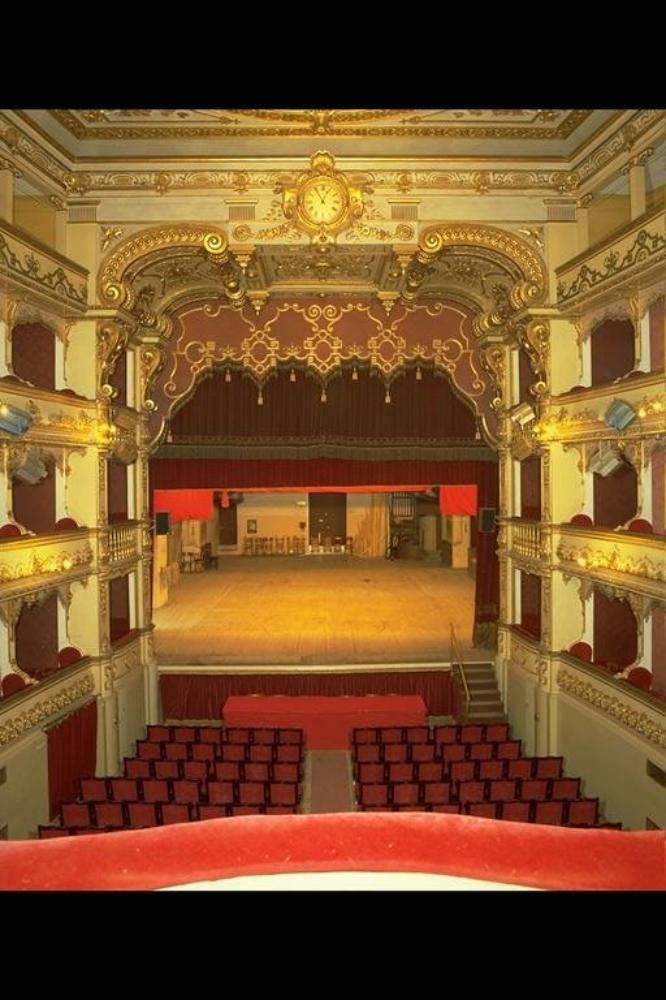


In 1745 the private little theatre of Palazzo Malvezzi was destroyed by fire and Bologna’s public theatre called “della Sala” located in the Palazzo del Podestà in today’s piazza Maggiore, required urgent restoration. Thus, at that time the city urgently needed to build a new building; however, only in January 1756 did the Bolognese Senate decree to commission the execution of a project for a new theatre.
The renowned theatre engineer Antonio Galli Bibiena was chosen, who had already offered his candidacy to the Senate in 1754, but was only considered two years later when he became a member of the Accademia Clementina for his high merits as a set designer and architect.
It was probably Antonio Bibiena himself who proposed to the Senate to build the new theatre along San Donato street (now via Zamboni) where the fabled Palazzo dei Bentivoglio once stood, which three centuries earlier had hosted one of Europe’s most refined courts. On the area facing today’s piazza Verdi, occupied by the remains of the Palace and its famous gardens, destroyed ‘by popular fury’ in 1507 when the family was expelled from the city, the new foundations were laid in spring 1756.
Antonio Bibiena took charge of the works, assisted by master builder Michelangelo Galletti. As the perimeter walls were rising, Bibiena “challenged Galletti on the structural soundness” (Bergamini 1981, p. 3). This was a significant issue, and Bibiena was asked to explain and justify the reasons for his decisive opposition. As the works delayed with no solution found, the Assunti di Camera decided to ask Bibiena to construct a model of the elevation and plan for public judgment by the citizens.
The most influential citizens became personally involved, unleashing a fierce and lively debate. Prominent Bolognese architects such as Dotti, Torreggiani, and scientists like Gabriello Manfredi and Eustachio Zanotti opposed Bibiena. It has been noted that “the controversies were [due] partly to personal rivalries and jealousies, but were also primarily ideological and connected to the spreading Enlightenment ideas clashing against Bibiena’s design, which represented the consolidated Baroque tradition of his illustrious family” (Historic Theatres… 1982, p. 207).
The temperature of the polemics is testified by Venetian writer Francesco Algarotti, who left a printed essay contesting all Bibiena’s design choices, chiefly: the decision to build the cavea in masonry (fire-resistant) rather than wood, and the bell-shaped floor plan. Bibiena defended himself with his generational experience, “contrasting the stern theory of his predecessors with the advantages of sound pragmatism.” (cit., p. 207).
Bibiena was forced to modify the original project, not least for economic reasons that did not allow realizing the same richness of ornamentation as the original wooden one still preserved in the central foyer. He wanted the rustic ashlar on the first order of boxes to recall established architectural principles of private residence exteriors, and to create a more pronounced bell-shaped plan ending in a highly projecting stage mouth adorned with Corinthian columns and statues recalling external balconies on a city street. The ceiling of the stalls was meant to depict a fake sky.
The current project’s development must have been very laborious, as several “intermediate” designs closer to the final result have been preserved and published. The stage mouth was reduced, the boxes differentiated into just two types, and the bell shape was much less accentuated. Early designs show that the noble floor of the façade was to be decorated with elegant windows topped by pediments and separated by pilasters. Only the portico was retained in the final construction, conceived to ensure a continuation of the paratactic layout of the covered city streets.
“The stone used by Antonio Galli Bibiena for the theatre interior had to be changed in the end because it was too reflective” (Forsyth 1987, p. 13). In former times, to preserve the full sound of orchestral music, music halls were covered with a thick layer of sound-reflective plaster.
The theatre was inaugurated on 14 May 1763 with the premiere of the opera Il Trionfo di Clelia with libretto by Pietro Metastasio and music by Gluck. The production was realized by Bibiena himself but rushed and reduced to the essentials. Despite the non-realization of numerous parts of the building and service rooms, the Municipal Theatre can be considered Bibiena’s most important theatrical achievement, even if for many years after the opening it mainly staged prose plays and carnival balls.
Upon the inauguration of the new Teatro Corso in 1805, the image of the Municipal Theatre was relaunched by renewing outdated technology. The mechanic Ferrari built a winch system to raise the stalls, expanding the stage space for festivities, still perfectly functional today if the fire safety system’s piping did not hinder its movement.
Between 1818-1820 the city architect Giuseppe Tubertini carried out the first major restoration. “The perimeter vault of the stalls was rebuilt and decorated by Mauro Beri, who, following Bibiena, created an architectural solution where, however, with a changed conception, set designer Pietro Fancelli painted the allegories of Music, Poetry, Painting, and History. The cornice running at the top of the hall and the entablature of the stage mouth were removed; the articulation of surfaces was mitigated by adjusting the parapets of the boxes as well as the underlying support cornices, changing also the shapes of the corbels and related ornaments in the arches of the boxes, where balustrades had a flared shaft with a foliate collar” (Bergamini 1981, p. 11).
Corinthian pillars with architraves replaced the original Bibiena columns in the stage mouth. The curved wall structures connecting the stalls and stage mouth were removed, along with two niches containing statues of Music and Poetry by Antonio Schiassi. About thirty years later, in 1853-1854, Carlo Parmeggiani added four large coffered corbels in the stage mouth, made some alterations to the corbels of the third order of boxes and to the loggia cornice. The stalls vault was repainted by Giuseppe Badiali and Antonio Muzzi.
“Skilled artisans Antonio Tognetti, Giuseppe Pacchioni, Vincenzo Testoni, and Agostino Viallet contributed to the still existing plastic ornamentation. The glossy white zinc paint was intended to complement the decoration of banners, curtains, cushions, and French wallpaper in the boxes. With gold, red predominated.” (cit., p. 11). A new curtain was made by painter Napoleone Angiolini, depicting the Apotheosis of Felsina “in pure Gandolfian style” (Historic Theatres… 1982, p. 88). Its sketch is preserved in the National Art Gallery of Bologna. In 1861 the rear façade of the theatre was rebuilt by Coriolano Monti.
The same year, Luigi Samoggia and Luigi Busi repainted the ceiling of the stalls again with decoration harmonizing with the entrance doors, chiaroscuros, and chandeliers designed in pseudo-18th-century style to fit the overall theatre style. A severe fire destroyed the stage and Angiolini’s curtain in 1931. The following year, Armando Villa rebuilt the current stage.
Finally, in 1935-1936 architect Umberto Ricci completed the façade, which had always remained unfinished, in its present form. On 23 June 1980, the theatre was declared unusable and closed to the public due to wood, especially under the loggia floor and fourth and fifth order boxes, severely damaged by woodworms.
The layering of not always exemplary restorations (added structures had caused instability in some boxes) and the hall’s acoustics made restoration complex. At the suggestion of Cesare Gnudi, the Municipal Theatre’s Board of Directors appointed a restoration commission capable of evaluating and guiding the technicians’ work. The commission included Giorgio Festi, Angelo Cavalli, Pier Luigi Cervellati, Andrea Emiliani, Cesare Gnudi, Camilla Malvasia, and Ezio Raimondi. Work proceeded at a very intense pace to avoid longer closure than planned.
The year after reopening, major work that did not require closure was completed. Floors were consolidated, the hall and attic vault repaired, the roof redone, floors and plaster restored, and safety systems installed according to the law. Wooden structures were treated against infestations, most paintings and decorations restored, and service conditions improved. On 5 December 1981 the curtain rose again with Giuseppe Verdi’s Aida. The theatre is an Autonomous Body, producing about eighty performances a year, equipped not only with standard services but also a historical archive, a library, a modern rehearsal room for choristers and one for the orchestra. (Caterina Spada)