

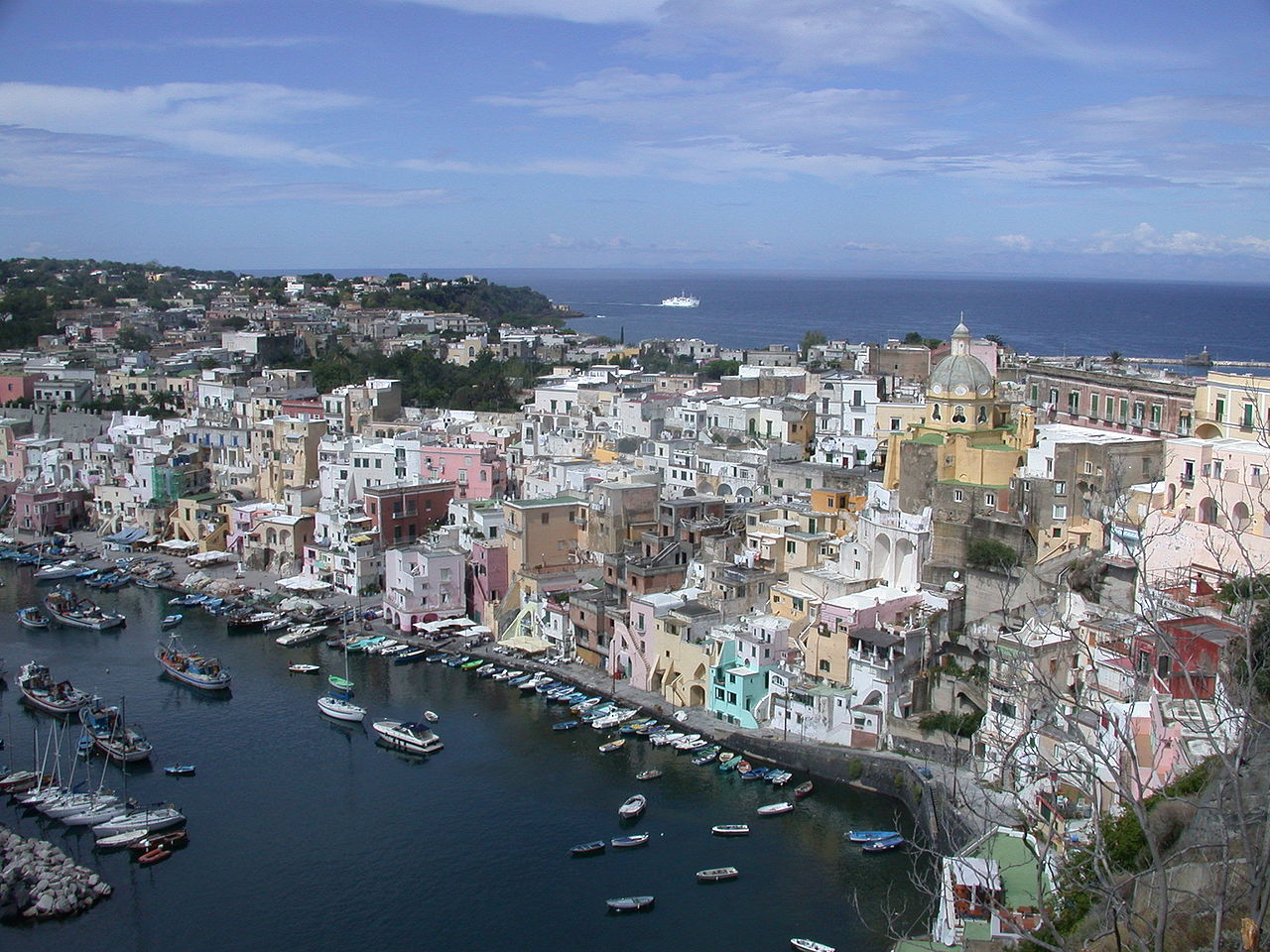

For classical mythology, Procida, in Campania, is a flower fallen from mount Epomeo of the nearby island of Ischia. Another legend says that in the belly of the island hides the giant Typhon, who wanted to overthrow Jupiter and was instead thrown to the earth; the giant is now under the basalt that imprisons him, shaking his 50 heads to free himself. Let’s see what to see in Procida.
Procida, Italian Capital of Culture 2022
1 Procida, where it is located
Geologically the island is linked to the Campi Flegrei, the “burning fields” of the ancient Greeks and rests on four extinct craters. Procida is a mystical, magical island, rich in popular culture and with a great tradition of seafaring art. Its history is quite eventful. It was colonized by the Greeks of the Naples gulf, then by Chalcidian and Erythraean colonists and in Roman times it was attacked several times. Later, with its lord Giovanni da Procida, it played an important role in the War of the Sicilian Vespers between the Angevins and the Aragonese in the 13th century.

2 Procida in history
In the Sixteenth century, Procida suffered repeated attacks from Saracen pirates, which devastated the economy and caused a drastic reduction in the population. At that time, Procida had fewer than 2000 inhabitants, all concentrated within the walls of the small Terra village.
In 1799, during the Neapolitan revolution that established the Parthenopean republic declaring the Bourbon power obsolete, Commodore Trowbridge and his English soldiers occupied the island and by order of Nelson suppressed the riots by killing 12 Procida inhabitants.
The period of emigration overseas at the end of the last century then dealt the final hard blow to the island’s economy. Young Procida natives went elsewhere to seek work, and left for South America and the United States. Many sailors sought employment on foreign merchant ships and few were the fortunate ones who remained in their homeland. All these events have made the Procida character mild and at the same time brave, capable of enduring hardships and devoted to religion. On the island, violent crimes are very rare; its inhabitants are rather reserved and are “islanders” almost by choice.

3 Procida today
Procida today is a flourishing and wealthy island, although this is not apparent. Here all the men are skilled sailors and proficient fishermen. For fishing, they rely on the goodwill of the seasons, drawing favorable signals from the sky. Although they know their craft perfectly, they are cautious and do not risk more than necessary, as good seafaring culture has taught them. Meanwhile, shipowners and captains with large ships challenge oceans and storms to successfully complete their rich commercial expeditions.
In the nineteenth century, Procida’s sailing ships traveled all seas and sailed as far as Australia. In Procida, many families own at least one ship, usually commanded by the same shipowners. It thus becomes a family-run business, where the men on board perform the seafaring work while the women on land manage the ship-business. For many months of the year, contact between the crew and family members occurs only via radio, and during rest periods, when everyone is home, there is a great celebration.

4 Procida and the longline fishing lines
It is said that some navigators from Procida, during their long journeys to the East, imported from China a secret recipe for tanning the threads of fishing lines and nets. In Procida, two types of thread are produced this way, one transparent and shiny, unique in Europe, and the other orange, traditional. With this thread, fishermen set up their longlines. These are complex deep-sea fishing systems, often exceeding 500 meters in length and armed with a few thousand hooks.

5 The people of Procida and the sea
The people of Procida live next to the sea and naturally live “from” the sea: and this has made their wealth. Economic well-being has led to a demographic increase, and today the island counts 2700 inhabitants per km², one of the highest population densities on earth. Life in Procida is peaceful, and among the sunlit house walls, one enjoys family serenity; for the people of Procida, family is very important, perhaps precisely because of the forced separation caused by work at sea. Some houses are immersed in citrus groves and vineyards, or peek out among jasmines and fragrant plants; the island is a vast primitive Mediterranean scrub resting on yellow and gray tuffs and volcanic basalts from many millennia ago. Procida is a land of great charm.

6 Vivara, the natural reserve island
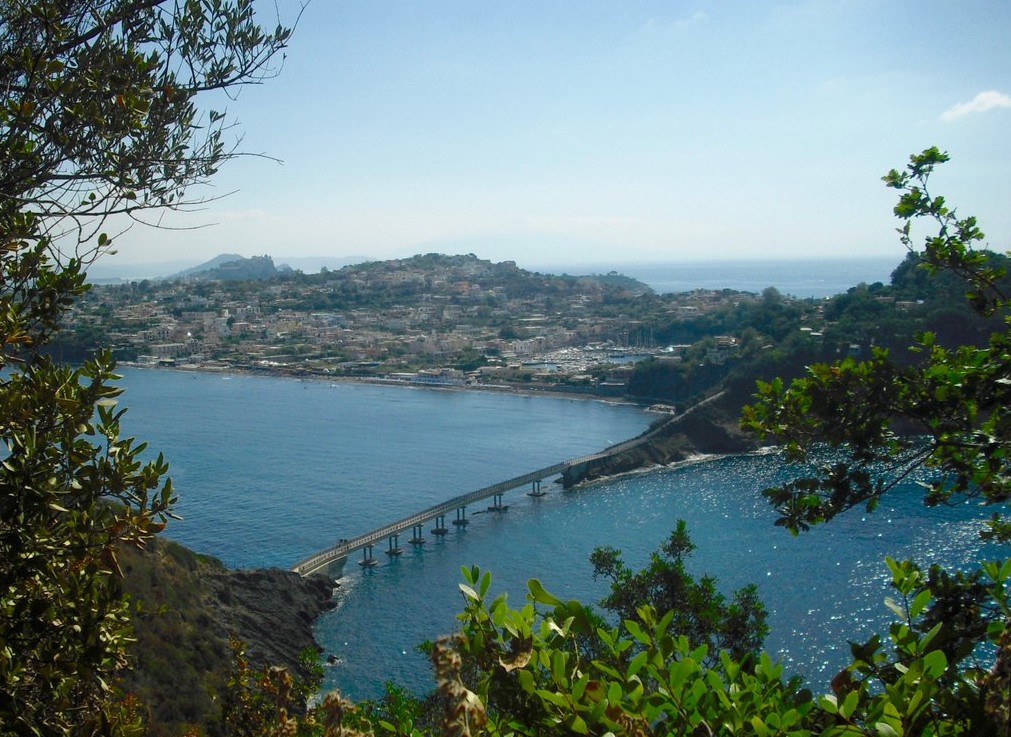
At the far edge of the island is Vivara. It is a small islet of just 34 hectares, connected to Procida by a bridge-aqueduct. Here, in a sort of phytoclimatic relic that has survived the passage of time, live over 500 botanical entities, including many specimens of downy oak and pubescent oak. The wild vegetation of this lush natural reserve, the crest of an open crater, is completed by the prickly pear and the poisonous ferula with its yellow umbels.
In the eighteenth century Vivara was one of the many royal hunting reserves, governed by very strict measures. Here the King of Naples Charles of Bourbon established a vivar, a rabbit farm. Today wild rabbits are still present and access rules remain strict, especially after recent archaeological excavations that brought to light some very important Mycenaean artifacts. Entry into the nature oasis is only possible from May to October.
From the summit of the 109 meters of Vivara, the island of Procida appears flat as a sole, although the great Latin poet Virgil said “tum sonitu Prochyta alta tremit“. The highest points on the island are the Elm, at 51 meters, and Terra Murata, 91 meters above sea level.
7 Borgo Terra
In the sixteenth century, the village of Terra was the only urban center on the island. At the top of Terra Murata, overlooking the sea, surrounded by walls and detached from the daily life of the island, there is the castle that belonged to the abbot of Procida, Cardinal Innico d’Avalos. From this position, one dominates the channel that separates the island from the mainland. Once the castle was a royal residence. Transformed into a high-security prison, the penal institution was then closed in the fifties. Since then, the imposing structure has been abandoned.

8 The Corsair Barbarossa and the Pirates
Defeated by the winds of Libeccio and Tramontana, the castle was a privileged observation point for the sighting of Saracens and barbarians from Africa, who with their raids sowed terror and death throughout the Mediterranean. Legend has it that the corsair Khair-ad-din, better known as “Barbarossa,” in 1534 attempted with his fast ships the assault on Procida. But Saint Michael the Archangel appeared in the sky who with his shining sword surrounded the citadel with flames to protect it, and with a lightning bolt drove away the feared Turkish pirate. Even today some old Procida fishermen say they have seen chains and anchors that the pirates threw into the sea bottom to escape faster. History, however, gives us a different version of the facts. During the assault of 1534, around mid-August, the Muslims landed on the island and almost destroyed it.
The district Terra Murata was looted and completely burned, the pirates devastated the crops and reduced many inhabitants to slavery. Even worse was the raid in the last ten days of June 1544, during which the same corsair Barbarossa and his men captured about one thousand five hundred people, after burning houses, wheat, and everything else they found along their path. However, in 1627 the islanders, very devoted to Saint Michael, dedicated a silver statue to him and in Terra Murata named the Abbey after him.