

In southern Italy, the territories of the provinces of Salerno and Potenza are particularly rich in abandoned villages and ghost towns.
It is difficult to outline a route that can connect all these small villages. The lack of direct road connections would extend travel times so much that it would take at least 15 days to make a fairly complete tour of the territory. Accommodation is also not always easy. The lack of mass tourism has not favored the creation of facilities, but there is always some Motel along the road where you can sleep. It is instead very easy to find inns and trattorias where you can eat “homemade” cuisine at really affordable prices.
However, let’s try to outline an itinerary by trying to visit the most interesting locations.
Abandoned villages Campania
Roscigno
Starting from Salerno, take state road no. 18 south and then no. 166, up to Roscigno. The village is located 570 meters high on a hill overlooking the valley of the Ripiti stream, a tributary of the Calore river in Salerno. Roscigno has recently been included in the UNESCO-protected world heritage list, and is now divided into two villages: one ancient, almost completely abandoned due to a landslide, and a newer one higher up, recently built in a safer area.
The ancient village of Roscigno, with agro-pastoral origins, probably dates back to the 1300s and its original nucleus was located much lower. Following progressive landslides, the inhabitants were forced to move increasingly upwards until reaching the current plateau in the 1700s. The last houses built in the old village date back to the beginning of this century. Then the slow and definitive transfer of the village to the current location was decided, in a safe position chosen by the Civil Engineering Department, a few kilometers higher up.

Sacco Vecchia
Just a few kilometers from Roscigno is Sacco Vecchia, built on the ridge of Mount Motola. The village overlooks the deep gorge of the Sammaro stream, which divides the municipality of Sacco from that of Roscigno. It is a settlement of early medieval origins in an almost inaccessible area, which shows traces of religious and fortified buildings probably dating back to the 1200s, almost certainly abandoned due to their inaccessible location.
At this point there are two alternatives: either continue inland, or proceed towards the sea. Let’s go inland. Taking state road no. 166, upon arriving at Atena Lucana you will take the Autostrada del Sole northbound, up to Sicignano degli Alburni. Continuing towards Potenza, at the Buccino exit there is the road to Romagnano al Monte. We are north of the Alburni mountains, on the border between Campania and Basilicata.
Romagnano al Monte
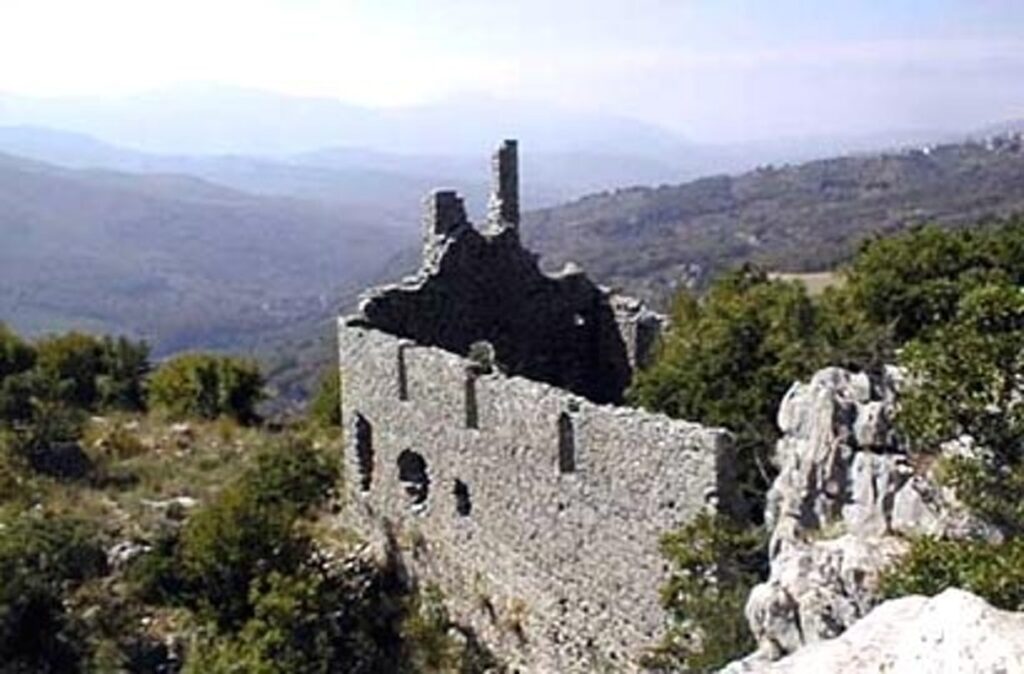
Romagnano al Monte, 641 m above sea level is perched on a rocky spur and overlooks the deep ravine of the Bianco river valley. The area is characterized by mountainous reliefs with steep cliffs overlooking precipices. The village was completely abandoned after the 1980 earthquake, while in the 1960s there were more than 600 inhabitants. Of medieval origin, Romagnano al Monte has experienced a history very similar to that of other modest mountain clusters under pastoral regimes, a history linked to the affairs of feudal properties. At the top of the village are the remains of a baronial castle wall, while in the center at Piazza SS Rosario there is the Town Hall and the 18th-century church of Madonna del Rosario. After the earthquake, the inhabitants moved to a tent camp (Romagnano Nuovo) about 1 km from Buccino and currently reside there after receiving small plots of land free of charge from the State, proportional to the properties they had in the old village. Only 8 years before the earthquake did the aqueduct arrive in Romagnano.
Returning to the highway and after passing Potenza, take state road no. 407 Basentana which crosses the Lucanian valleys adjacent to the southernmost Campania.
There, the same stories of feudal exploitation (the barons were the same, Sanseverino, Morra, Carafa, etc., who ruled them) and emigration, along with certainly very hostile nature, characterized by valleys and steep ravines, deep gullies, and barren, arid hills, have made life difficult for the inhabitants, who were ultimately forced to leave their homes.
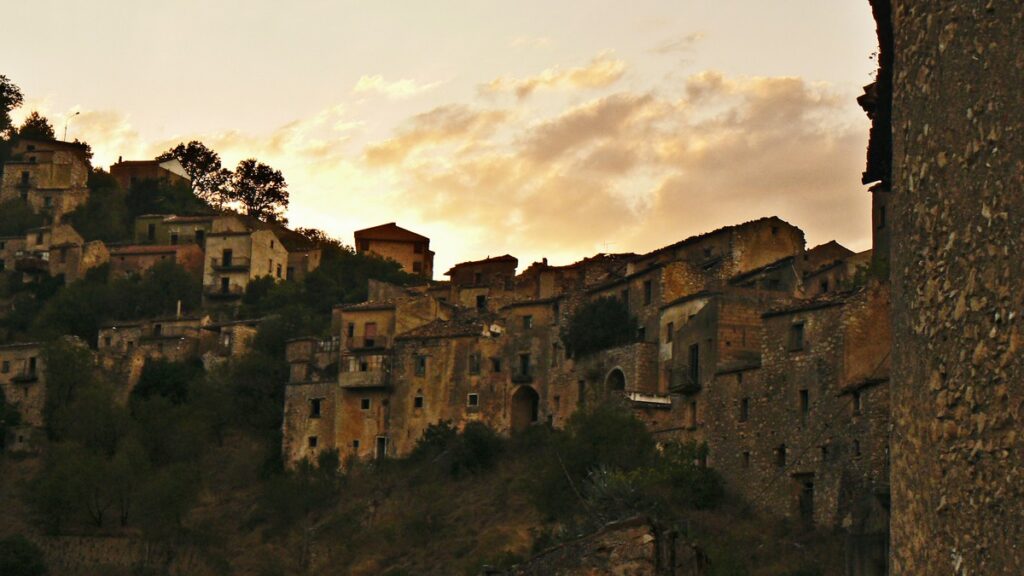
San Severino di Centola
If from Roscigno one decides instead to take the road to the sea, it is necessary to return to state road no. 18. After passing Paestum and its Temple area, you reach Vallo della Lucania. A few more kilometers and you will take state road no. 447 to Palinuro.
In this extreme strip of the Cilento coast, there is San Severino di Centola, another small abandoned village. The town is located on a rocky ridge overlooking the Mingardo River gorge. The spectacular landscape enjoyed from this privileged vantage point is a good reason for a walk to the town; the ruins of the Molpa castle, which legend says was abandoned after the sacking by Saracen pirates, can be glimpsed along the road leading to the uninhabited village.
Here, the causes of abandonment are to be found in economic rather than geological reasons. The particular position of the village, perched on the cliff, caused the slow and constant decrease in the number of inhabitants over the centuries, to the point of crippling – in the 1960s – the village’s economy, mainly based on agricultural production. The exodus of the remaining population, attracted by livelier coastal locations, was completed about fifteen years ago and San Severino is currently inhabited by only one person, an artist and foreigner.
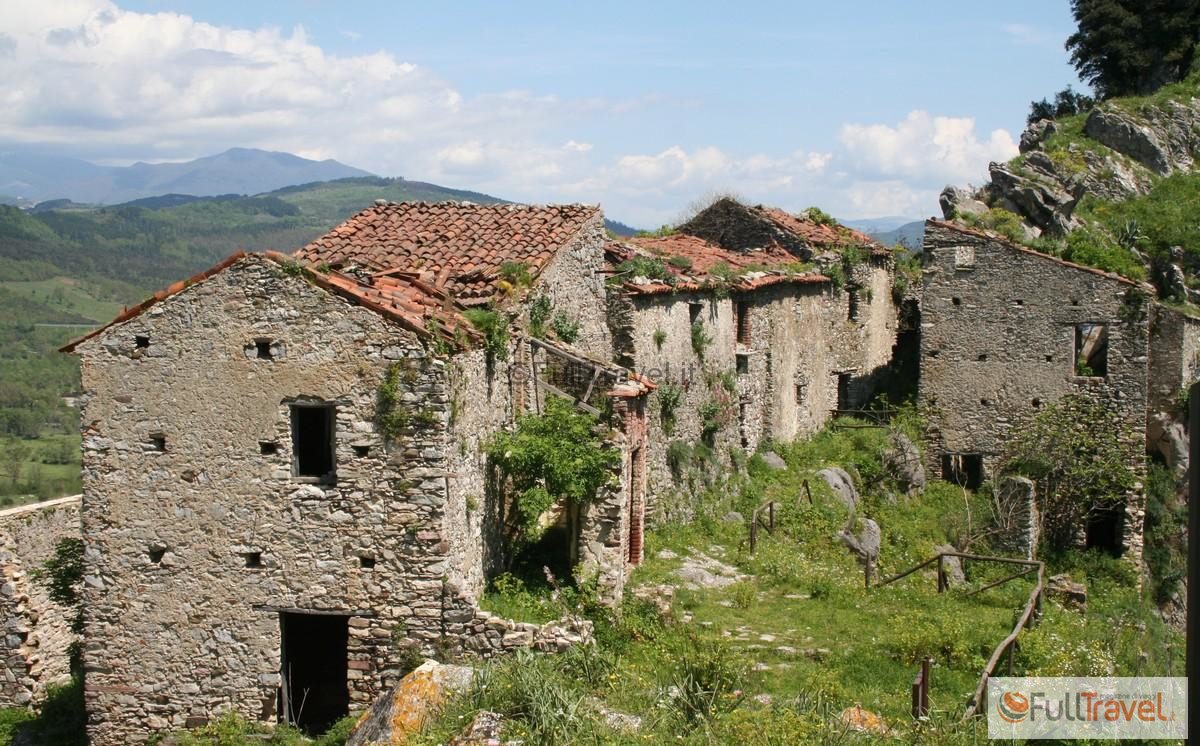
Other abandoned villages in Campania
Scattered throughout the Salerno territory there are numerous abandoned hamlets (such as Case di San Giovanni a Punta Tresino in the municipality of S. Maria di Castellabate, Tuoro and Cavalli near Roccadaspide, San Nicola di Centola near Palinuro, Sorbo near Salerno), which testify to the capillarity of the ancient network of self-sufficient agricultural and pastoral communities subjected to the feudal regime. Generally, the hamlets are located in hard-to-reach areas and, with the end of large estates, they gradually lost their function and therefore were abandoned.
The feelings that unite all the now deserted places are those of deep melancholy but also great curiosity. There are many causes of abandonment of a settlement: in some villages the exodus is total, in others only the historic center is emptied, for reasons that must be identified from time to time.
Abandoned villages in Basilicata
In Basilicata along the valleys of the Basento and Agri rivers there are completely abandoned villages:
Old Campomaggiore
Old Campomaggiore 40 km from Potenza, not far from state road 407 Basentana, is located on a high plateau, on the northern slope of the Lucanian Dolomites, one of the most extraordinary rock landscapes in Italy, with very high ridges and deep valleys and gorges. The village already existed in the Swabian era, but its history is marked by abandonments: one in the 17th century and a second in 1885 when a landslide forced the inhabitants to leave the village and build a new one 3 km away. Today, the almost ghostly ruins of the ancient village can be visited.
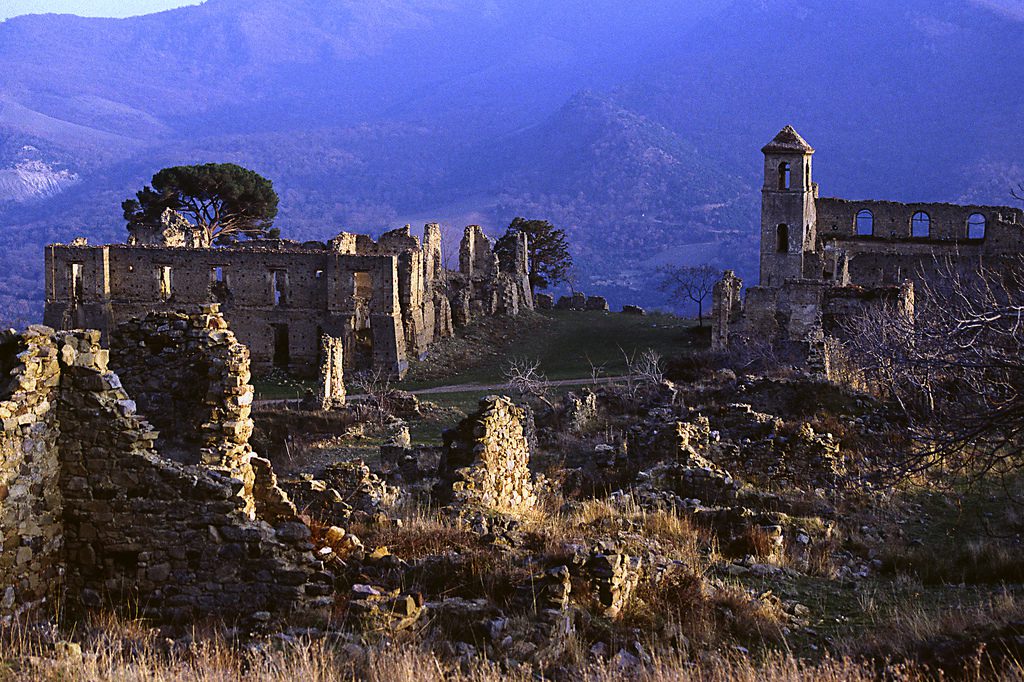
Craco
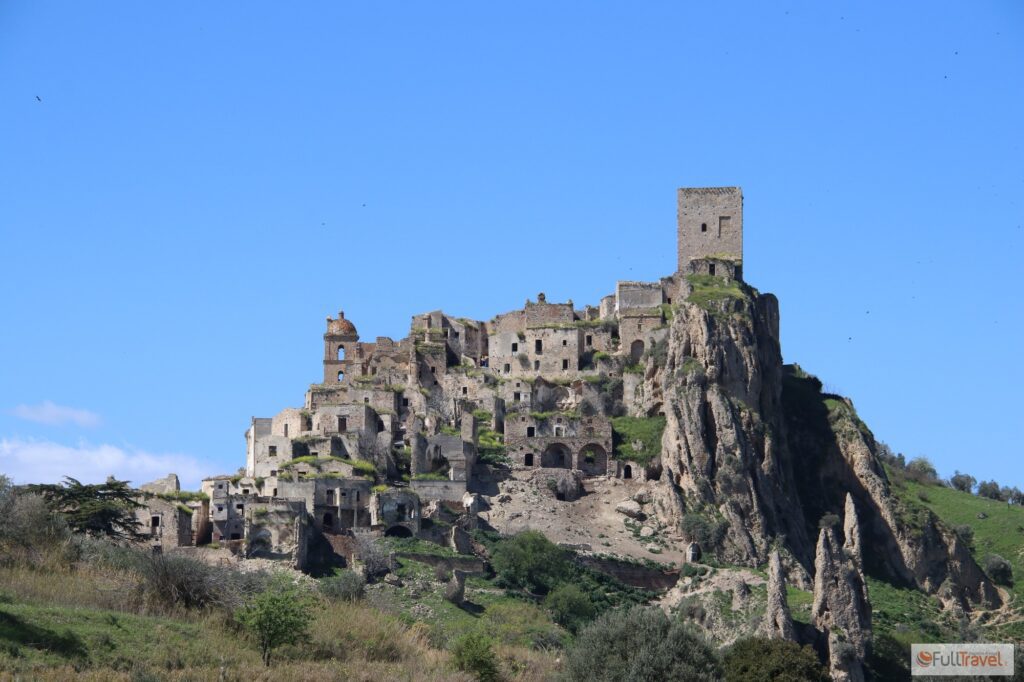
Craco, on the other hand, is in the province of Matera and is spectacularly perched on a hill. Although it is in better condition than Campomaggiore, it is completely abandoned and rapidly deteriorating. The cause of the abandonment is probably a large landslide that endangered the village.
These homogeneous and thematic itineraries are connected to a process of recovery, where possible, of the ancient building structures and the historical and artistic testimonies of a lesser-known Italy, less fortunate but certainly not poor in culture.
Survived over the years mostly thanks to their safe position on mountain ridges and because they were far from main commercial and military routes. Then their difficult history, often marked by centuries of feudal exploitation, was definitively interrupted by traumatic events.
Certainly emigration, since the post-war period, dealt a hard blow to small rural centers, depopulating them largely, but also a hostile nature characterized by landslides and soil slips contributed to the degradation of the old dilapidated houses; then again earthquakes, especially the last one in 1980, led to the complete abandonment of the villages.
The causes of depopulation vary from town to town, although all stories are similar. In the province of Salerno, on the Alburni mountains, among caves and woods, in a harsh and dangerous territory, many villages have long coexisted with precarious soil conditions. The sandy nature of the soil is very fragile, and erosion appears over large areas with characteristic badlands. Furthermore, numerous landslides, accelerated by rainwater infiltrating the dense network of karst conduits, contribute to the soil slipping. The caves and the large number of foothill springs certainly do not help to stabilize the soil.