


10-Day Itinerary in New England
In New England, there is a world of gardens in historic homes and museums, in towns and villages, in nature reserves and protected areas. You can stroll through arboretums and greenhouses, along the coast and in open fields and meadows, in wooded areas and luxury resorts. In this northeastern region of the United States, there are native, rare, and exotic plants, flowers, bulbs, and trees, well-kept lawns, fantastic color combinations, ornamental structures, and trails. There are secret gardens, tropical gardens, orchid gardens with little houses, vegetable gardens, stone and hillside gardens, and Japanese-style gardens with stunning locations.
- 10-Day Itinerary in New England
- 1st stop: BOSTON / arrival and walk at Boston Public Garden
- BOSTON: visit to the Isabella Stewart Gardner Museum and Arnold Arboretum
- 2nd stop: coast north of Boston, northern Massachusetts side, Ipswich area
- Visit to the Castle Hill on the Crane Estate
- Visit to Zimmerman House
- 3rd stop in Cornish, New Hampshire
- Cornish
- Visit to Saint-Gaudens National Historic Site
- Cornish Art Colony
- Gardens of Cornish
- 4th stop: towards Williamstown
- 5th Stop: towards Lenox in southern Berkshire
- Lenox
- Stockbridge
- 6th stop: towards Hartford, capital of Connecticut
- 7th stop: Gilded Age Mansions in Newport
- 8th stop: Cape Cod and its gardens
- Cape Cod
- Heritage Museums & Gardens
- 9th stop: Cape Cod National Seashore Park
- Cape Cod National Seashore
- Brewster
- 10th stop: towards Plimoth Plantation
- Pilgrim Fathers
- Wampanoag Natives
- New England Route Map
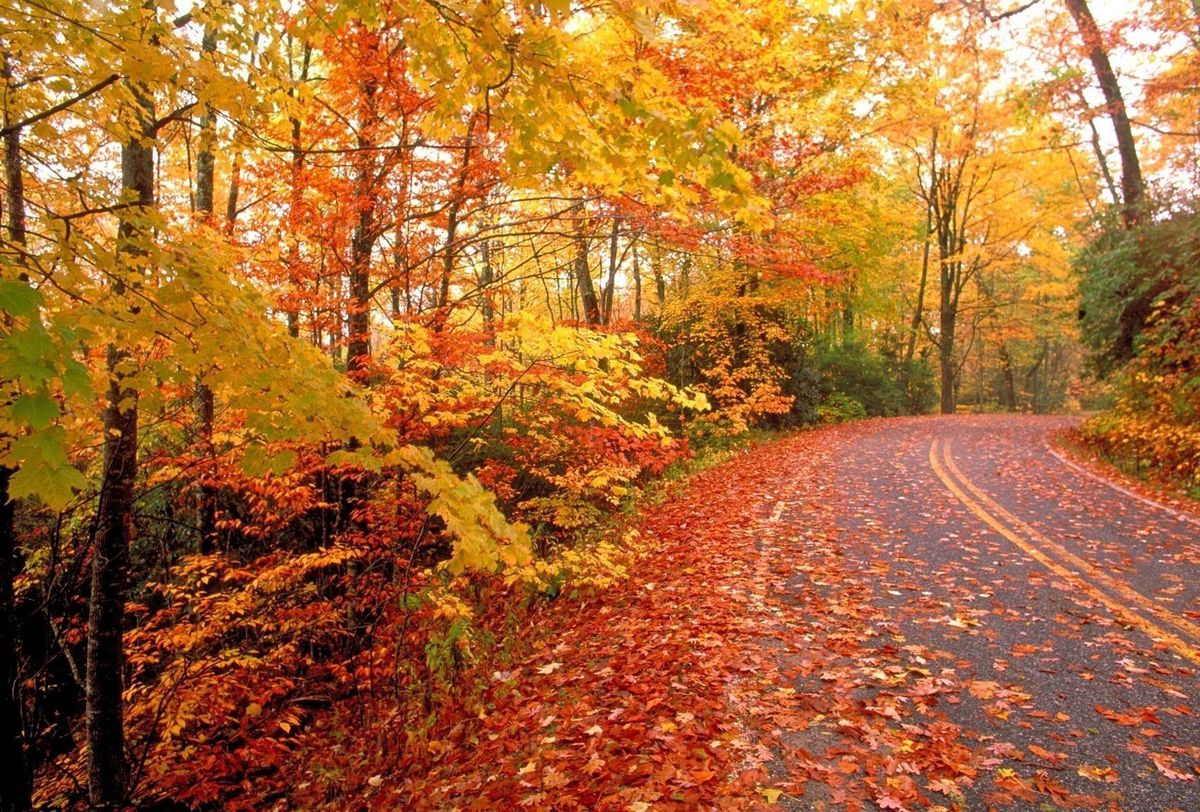
The largest landscaped collection of native plants in the northeastern United States is found here, as well as one of the oldest botanical gardens in the country. Autumn is perfect for discovering the small and large natural treasures of New England, kissed by the kaleidoscopic atmospheres of the colors of the Indian Summer. It is suggested to make the trip no later than the first half of October to catch the autumn palette and colors that fade from north to south of the region in a time frame starting from mid-September and lasting until the end of October. Obviously, in the northern part of New England the “Indian Summer” begins earlier, while in the southern part it can be enjoyed even in early November. Our itinerary in New England starts from Boston. Don’t forget to prepare the documents to travel to the United States in time.
The Boston Public Garden is in the heart of the city, adjacent to America’s oldest public park, the Boston Common. Together these two parks form the northern side of the Emerald Necklace, the “Emerald Necklace,” a long strip of parks designed by the famous American park architect Frederick Law Olmsted. The Public Garden connects to the south with Boylston Street, west with Arlington Street, north with Beacon Street, and east with Charles Street which separates the Public Garden from the Boston Common. The park contains numerous plants and a pond of over one and a half hectares upon which from April to late October boats shaped like swans – Swan Boats – sail, a famous Boston attraction with guided tours on the lake. Another characteristic feature is the numerous bronze statues adorning the park, including Make Way for Ducklings, a tribute to a famous children’s story.

BOSTON: visit to the Isabella Stewart Gardner Museum and Arnold Arboretum
Isabella Stewart Gardner Museum Boston is the beautiful house-museum at Fenway Court designed by Isabella Stewart Gardner, a Bostonian magnate and billionaire, who collected exquisite works over several years of travels in Europe and Asia. The residence, in Venetian Renaissance style, preserves paintings by El Greco, Tiziano, Vermeer, Sargent, just to cite some painters. There are over 2,500 artworks, including the first Matisse painting acquired by an American museum. Gardner was a controversial and crossover figure in late 19th and early 20th century Boston, as she mingled with enlightened personalities and eccentric artists, was a muse and patron, and ran a salon “outside of Puritan norms.” In 2012 the museum’s new wing designed by architect Renzo Piano was inaugurated: an addition to the Boston Fenway Cultural District, where the famous Museum of Fine Arts is also located.

The day continues with a visit to the ARNOLD ARBORETUM in the beautiful Jamaica Plain neighborhood – 107 hectares that are part of Boston’s Emerald Necklace park system designed in the late 1800s. The arboretum is the largest plant research center with about 14,000 trees across 5,000 classifications. The Visitor Center has maps and brochures for self-guided tours, exhibitions about the Arboretum and its plants, seasonal displays, a shop with books and educational items for children and adults, kids’ activities, and restrooms. The Arboretum is open year-round from dawn to dusk with free access. It is this garden where the carriage scene from the movie Little Women (2019) directed by Greta Gerwig was filmed.
In Boston, at least three days should be dedicated to exploring its many squares, ancient streets, and neighborhoods where finely kept flower beds stand out, such as Beacon Hill, Back Bay, or the South End. Commonwealth Avenue is lined with magnolia trees and delightful period buildings, studded with meticulously landscaped gardens. It is a delight in every season. Do not miss the walk along the innovative Rose Kennedy Greenway that runs alongside the Harbor Walk on the waterfront. This winding long green area is an interesting and inviting mix of various plantings interspersed with gardens, decorated with artistic and luminous installations, benches and lampposts, fountains, and water features. It is the perfect urban solution replacing vehicle lanes (now all underground) to allow citizens and visitors a “friendly” and pleasant walk, especially during the spring bloom or in autumn.
Visit to the Castle Hill on the Crane Estate
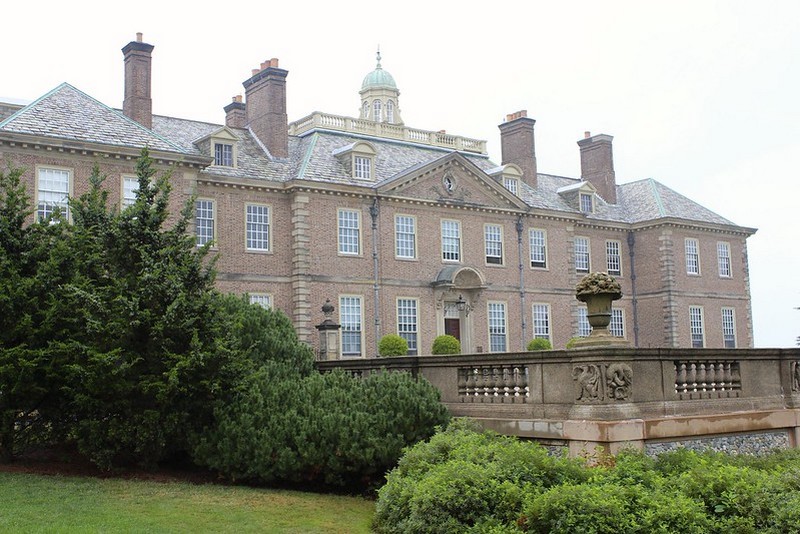
Castle Hill refers to a “drumlin” (a particular type of hill shaped like a whale’s back or a “donkey back”) of 66 hectares surrounded by sea and salt marsh or to the villa on the hill. Both are part of the Crane Estate of 849 hectares located on Argilla Road in Ipswich, Massachusetts. The former summer residence of the Richard T. Crane, Jr. family includes a historic mansion, 21 buildings, and a landscape overlooking Ipswich Bay, along the coast north of Boston.
The property’s name comes from the promontory of the namesake Ipswich in England, from where the English colonists who founded the Massachusetts Bay Colony came. Centuries before becoming the opulent summer residence of one of America’s richest families, Castle Hill was known to the native Indians who called it “Agawam” referring to the abundant fishing. In the early 1880s, J. B. Brown transformed Castle Hill Farm from an agricultural holding to a proper “gentleman’s farm,” improving roads, the park, and elevating the farmhouse into an elegant cottage now known as The Inn at Castle Hill. Many scenes of the movie The Witches of Eastwick (1987) directed by George Miller, based on the novel by John Updike featuring Jack Nicholson, Cher, Susan Sarandon, and Michelle Pfeiffer, were shot on this estate.
Richard T. Crane, Jr. bought the property in 1910 and transformed Castle Hill into an example of the “American Country Place Era” with its farm and buildings, park and gardens, and several natural areas. The Crane family hired some of the most famous architects of residences and gardens of the time. The first home built on top of the Castle Hill hill, a revival of an Italian Renaissance villa, was designed by Shepley, Rutan and Coolidge, later replaced in 1928 by the 59-room Stuart-style mansion designed by architect David Adler. The house is furnished with period furniture. Castle Hill also hosts a wide variety of wildlife typical of northeastern Massachusetts forests. Deer, foxes, wild turkeys, and many songbirds can be observed on the many trails of Castle Hill. Moreover, Castle Hill is home to many pairs of great horned owls and red-tailed hawks that nest there. Thanks to its Atlantic Ocean location near Crane Beach, rare species such as vultures and migratory hawks, and occasionally bald eagles, can be spotted. It is suggested to have lunch at The Inn at Castle Hill by booking in advance.
Visit to Zimmerman House
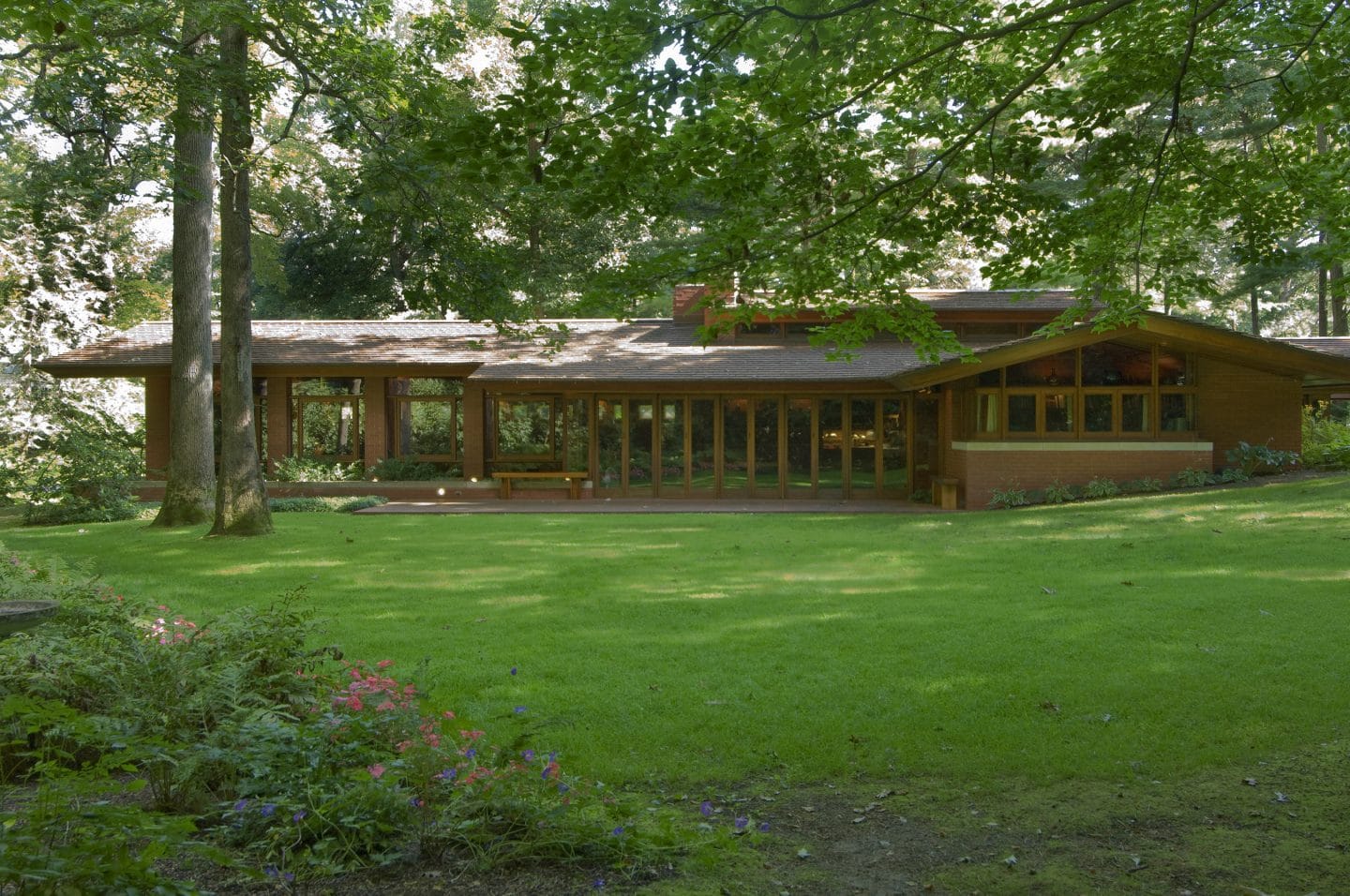
About 70 km further north is the state of New Hampshire and the town of Manchester. Upon arrival: visit the Zimmerman House, a historic home located at 223 Heather Street, built in 1951; it is the first of two houses in New Hampshire designed by Frank Lloyd Wright and one of the Prairie School models in the northeastern United States. The house is now owned by the famous Currier Museum of Art, which offers tours of the building listed on the National Register of Historic Places in 1979. The home was created for clients Dr. Isadore and Lucille Zimmerman.
Wright redesigned the house around a rock positioned right at the entrance. His design extended to include all the interior furnishings, furniture as well as the mailbox, and specified the garden plantings. The visit starts at the Museum then continues into the house, making sure to have booked the visit in advance. Private tours, requiring at least two weeks’ notice, may also be available.
(135 km)
Cornish
The home at Cornish once belonged to American sculptor Augustus Saint-Gaudens and includes delightful gardens and walking paths. Cornish is a village of about 1,600 inhabitants along the banks of the Connecticut River in Sullivan County. The covered bridges of Cornish are a real record since no other location in New Hampshire can boast as many. The most notable is the Cornish-Windsor Covered Bridge, which spans the two banks of the Connecticut River and is the longest two-span covered bridge in the world, built in 1866 at the cost of $9,000: 140 meters, a real link between New Hampshire and Vermont. Don’t miss the Blacksmith Shop Covered Bridge, the Blow-Me-Down Covered Bridge, and the Dingleton Hill Covered Bridge.
Visit to Saint-Gaudens National Historic Site
In 1763 the English colonists not only gave the village the name of Sir Samuel Cornish, a Royal Navy admiral, but also settled there using the riverbanks as a transport point for the trees of sailing ships that were channeled on river waters. In 1885 the well-known sculptor Augustus Saint-Gaudens settled there to take walks and escape the summer heat of New York. Augustus Saint-Gaudens is known for the bronze statue of Diana, once on the top of the old Madison Square Garden. His Sherman Memorial shines in the southeastern corner of Central Park, and his Peter Cooper Monument stands firmly outside Cooper Union. He lived in a majestic home on a hilltop surrounded by his studio, gardens, and acres of forest. Today the Saint-Gaudens National Historic Site offers garden tours featuring 150 sculptures and works by Saint-Gaudens. The natural landscape itself is a work of art and deserves walks and nature explorations on the trails. Artists and friends followed Saint-Gaudens; among them painter and illustrator Maxfield Parrish, who designed and built his residence in this area, Oaks.

Cornish Art Colony
The entire area became the center of the well-known Cornish Art Colony, one of the first artists’ colonies in the United States and, similar to others in Connecticut, New York, Massachusetts, and Dublin in New Hampshire, the natural scenic beauty, climate, and relative isolation intellectually stimulated and mutually encouraged the variety of resident artists. The first wave of artists arrived before 1895 and was mostly painters; among the first were George de Forest Brush and Thomas Dewing.
Others followed: painter Henry O. Walker, architect, painter, and engraver Charles Platt; painter and engraver Stephen Parrish with his son, illustrator and painter Maxfield, painter and art critic Kenyon Cox. All purchased land and built residences in the 1890s. Some, including famous sculptor Daniel Chester French, painter John White Alexander, sculptor Paul Manship came for some summers as did President Woodrow Wilson, who made writer Winston Churchill‘s home “Harlakenden House“, (burned down in 1923) the Summer White House from 1913 to 1915. The colony supported an interrelationship between various arts: painting, sculpture, decoration, illustration, architecture, landscape design, novels, journalism, theater, poetry, criticism, essays, composition, music, from Boston and New York. In 1905 it is estimated about 40 families lived there for most of the year and some year-round. Arrival into the colony occurred in three phases: artists and sculptors in the late 1880s and early 1890s; writers in the 1890s; then lawyers, doctors, politicians, and wealthy after 1905.
Gardens of Cornish
Gardens were a common denominator of the colony. Large ones belonged to Thomas Dewing and Stephen Parrish, which went hand in hand with the landscape design of Charles Platt and his protegées Ellen Shipman and Rose Nichols. Stephen Parrish fell in love with the pastoral beauty of Cornish visited together with landscape architect Charles Platt, his student with a house in Cornish. In 1893, Stephen bought 18 acres of land next to Platt and built a house he called Northcote. He spent the next ten years working on the garden, considered by many the most beautiful garden of all the artists’ colony gardens. It was precisely due to the countryside’s beauty as well as the artists’ homes and gardens that Stephen Parrish was enchanted by Cornish and his famous son – Maxfield – followed in his father’s footsteps a few years later, building a house, studio, and fenced garden. The houses were closely connected to the gardens; indoor and outdoor areas framed views. As in Tuscany, building in Cornish was a challenge, but the genius was in understanding the landscape.
From 1893 to 1910 Stephen kept a detailed garden journal, including notes on the climate, birds, daily activities, garden purchases, plant list (including those that grew well), and newspaper clippings about the gardens. There was generous information about painted canvases and visits he received. When granddaughter Anne Bogardus Parrish died in 1966, she left the precious journal to Dartmouth College. Northcote is the best documented garden in all of Cornish and not only attracted attention, but was photographed and described in House and Garden, The Century Magazine, and Country Life in America, and was also published in two important garden books, American Gardens by Guy Lowell and Beautiful Gardens in America by Louise Shelton.
Artists and patrons in Cornish built a number of architecturally remarkable residences. Most of the Cornish Colony heritage is within a 5-kilometer radius, in the northeastern corner of Cornish and southwest of Plainfield. The historic buildings of the Cornish Colony and structures in the villages of Plainfield and Cornish include residences, barns, carriage houses, studios, ancillary structures and gardens, social institutions, and public buildings. About ten properties in Cornish and Plainfield are attributed to well-known architect and resident in the colony, Charles Platt, who blended American influences with Italian villa styles. Besides Platt‘s interventions according to Italian villa style, residences built during this period generally maintain style influences such as Colonial Revival, and Shingle and Craftsman motifs. At the end of the visit it is worth taking a nice walk in Cornish. This idyllic corner of New Hampshire would deserve at least one overnight stay to fully enjoy the pastoral beauty of the landscapes.
Continuation of the journey towards the hills of the Berkshire in Western Massachusetts, place Williamstown (157 km). Arrival and visit to the splendid The Clark Museum. Visit this treasure trove of art and stroll in the vast park where sculptures stand. The Clarks – wealthy magnates from the Berkshire region – donated their extensive private collection of art, paintings, and sculptures to the town of Williamstown, a small jewel in northern Berkshire, western Massachusetts. The delightful museum and art research center Sterling & Francine Clark Art Institute, often simply called the Clark Art Institute or The Clark, was built by a Singer heir, the “barons” of sewing machines, and well hidden in this bucolic area to protect 19th-century works and Italian Renaissance art in case New York were bombed by Germans during World War II. The French art collection includes Impressionists – including countless canvases by Renoir making it the largest collection in the USA –, Degas’ famous ballerinas, along with American paintings and sculptures, works by John Singer Sargent, English silverware, etc. In June 2008 the museum and campus expanded with the addition of the Stone Hill Center, a wing of about three thousand square meters designed by Tadao Andō. This incredible museum is immersed on 52 hectares of garden grounds, uniquely harmonious with the building’s architecture, and invites beautiful walks in the woods, punctuated by views of bucolic scenery. The museum has a cafeteria with excellent snacks.

(44 km) then on to Stockbridge, MA.
Lenox
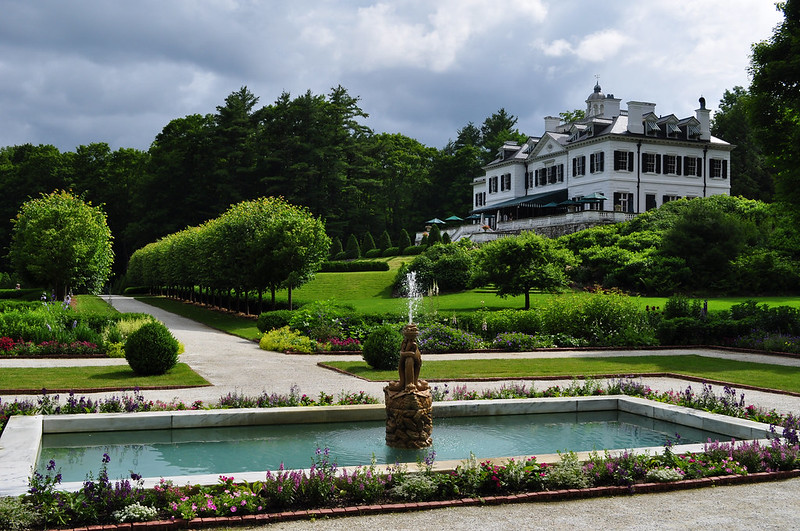
Lenox was home to the famous American writer, the first female Pulitzer Prize winner Edith Wharton, author of many famous novels now known even in Italy (notably Martin Scorsese’s film based on the homonymous book, “The Age of Innocence”). Her residence – The Mount – is a beautiful Italian Renaissance-style country house, which the writer designed along with the land and entire estate, considering it her “first real home.” The Mount celebrated its centenary in 2002 after complete exterior and interior restorations. Wharton was not only an important writer, but became famous for the art of decoration, both of houses and gardens, dismantling old, dark, heavy Victorian decoration canons and fully embracing light and Italian gardens. She wrote essays on this topic, revolutionizing the style of her era and becoming a true “trend-setter.” She lived in Italy and traveled extensively in Europe. She was one of the female representatives of the Boston “intelligentsia” of the late 19th and early 20th centuries. Esteemed by artists and writers such as Henry James who used to spend short stays here. The arrangement of the residence and its vast park is spectacular, as are the historic gardens. The historic house also has a restaurant-bar with a wonderful terrace. Advanced booking for meals on-site is recommended.
Continuation to Stockbridge which hides a variety of natural and art treasures. (10 km)
Stockbridge
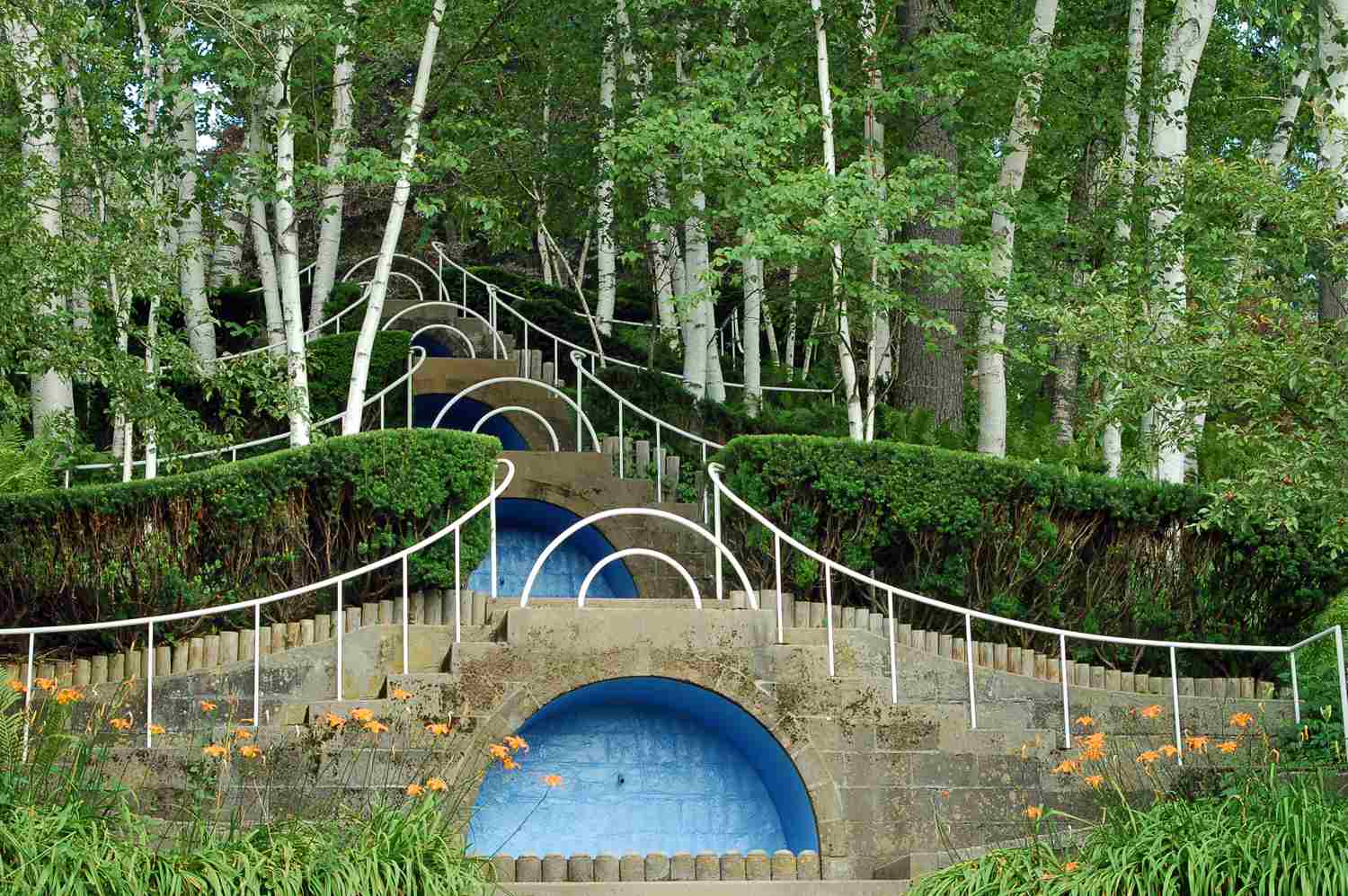
Visit Naumkeag, the former country estate of the well-known New York lawyer Joseph Hodges Choate, located on Prospect Hill Road, Stockbridge, Massachusetts. Three decades dedicated to planting and landscaping have created this splendid New England “cottage garden.” Climb every step of the fountain staircase among white birches and explore all the special gardens, from rose gardens to evergreens. The tour of the house and gardens requires at least two hours. There is a cafeteria offering exquisite sandwiches, salads, drinks, and snacks. Those who want to enjoy a nice picnic on the grass will also find blankets available. Along with the beautiful house, magnificent gardens, and panoramic views, Naumkeag is the quintessence of a Gilded Age country residence. This architectural artwork is also a family home. Joseph Choate, a notable 19th-century lawyer, commissioned the architect firm McKim, Mead, & White to design his 44-room summer cottage Naumkeag, serving as a summer retreat for three successive generations of Choates. With its view of Monument Mountain, its wonderful garden collection created by Joseph Choate’s daughter, Miss Mabel Choate, and Fletcher Steele over 30 years, original artworks, and shingle-style house, Naumkeag gives visitors an unforgettable experience. Stroll through the beautiful gardens: Afternoon Garden, Tree Peony Terrace, Rose Garden, Evergreen Garden, Chinese Garden to find the joyful and creative spirit of Miss Choate and Mr. Steele. Left in inheritance in 1958 – complete with furnishings, gardening tools, and the barn – Naumkeag is a National Historic Landmark that offers a direct connection to the Berkshire region’s historic environment. In addition, it is a place where, just like the Choate family, one feels surrounded by beauty and renewal.
Stockbridge is also well known for having the most important collection of works by illustrator Norman Rockwell. The Norman Rockwell Museum celebrated 50 years in 2019. The NRM is the largest collection of original paintings by Norman Rockwell, who depicted scenes of American provincial life that became famous worldwide. A classic American that brings us back to life in the ‘40s, ‘50s, and ‘60s. He was an illustrator and lived in Stockbridge in the Berkshire hills. His covers for the Saturday Evening Post are cult favorites. The museum stands in a broad green valley surrounded by hills and forests of western Massachusetts. Thanks to major sponsor Steven Spielberg, this museum is undoubtedly one of the state’s top attractions, also for its modern yet classic New England white architecture. In the same location, visit Norman Rockwell’s studio, preserved as he left it (open May through October). After the visit, there is time for a walk along Main Street among shops and art galleries, followed by dinner and overnight at The Red Lion Inn, Stockbridge.
Located on the Connecticut River in the center of the state. (118 km)
Once the city of Hartford, capital of Connecticut, was the richest city in America. Indeed, it was for decades after the Civil War, in the late 1800s, when it also became a hub of lively intellectual, religious, and progressive life. It also had numerous industries, such as silk and weapons manufacturing, and especially publishing. Thanks largely to the latter, the city founded in 1635 by about a hundred dissenting Puritan pilgrims attracted two of the most important authors in American literary history: Harriet Beecher Stowe and Mark Twain.
Reverend Lyman Beecher was an important Congregationalist church minister known for his anti-slavery sermons. His daughter Harriet Beecher Stowe wrote the famous novel “Uncle Tom’s Cabin” while his brother, Reverend Henry Ward Beecher, opposed slavery and supported the temperance movement and women’s suffrage. Harriet’s sister, Isabella Beecher Hooker, was one of the founders of the women’s rights movement. Harriet Beecher Stowe was already famous when she bought the cream-colored villa where she spent the rest of her life from 1864 until her death in 1896. Visit the Harriett Beecher Stowe Center with the family’s historic home.
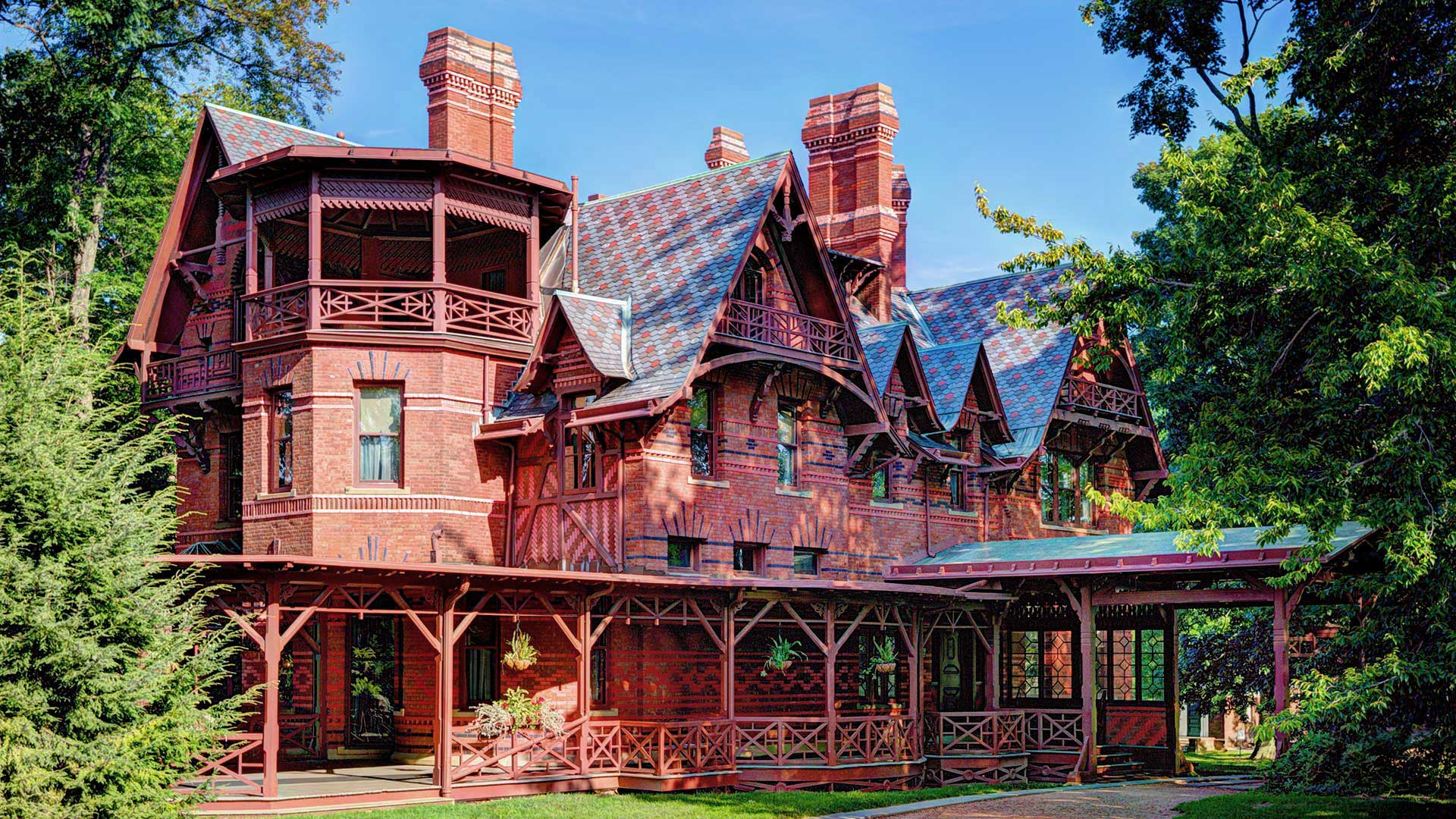
Next door stands another equally fascinating historic home: the Mark Twain House and Museum, home of Samuel Langhorne Clemens and his family from 1874 to 1891. It was designed by Edward Tuckerman Potter and built in American Gothic style. The author of “The Adventures of Tom Sawyer” first came to Hartford in 1871 to visit his publisher. He was a guest at the home of one of Harriet’s sisters in one of the Nook Farm villas and fell in love with the place. A year later he bought four acres just a few hundred meters from Harriet’s house, and two years later moved into his 15-room, 5-bath villa (all with running hot and cold water). Here he wrote Adventures of Huckleberry Finn and A Connecticut Yankee in King Arthur’s Court. The house tour requires at least 1 hour, but it is recommended to add another hour to complete the visit with museum exhibits and the Ken Burns film, Mark Twain. After the visit and a snack, continue towards the small state of Rhode Island to reach the town of Newport. Arrival, stroll, dinner by the sea, and overnight.
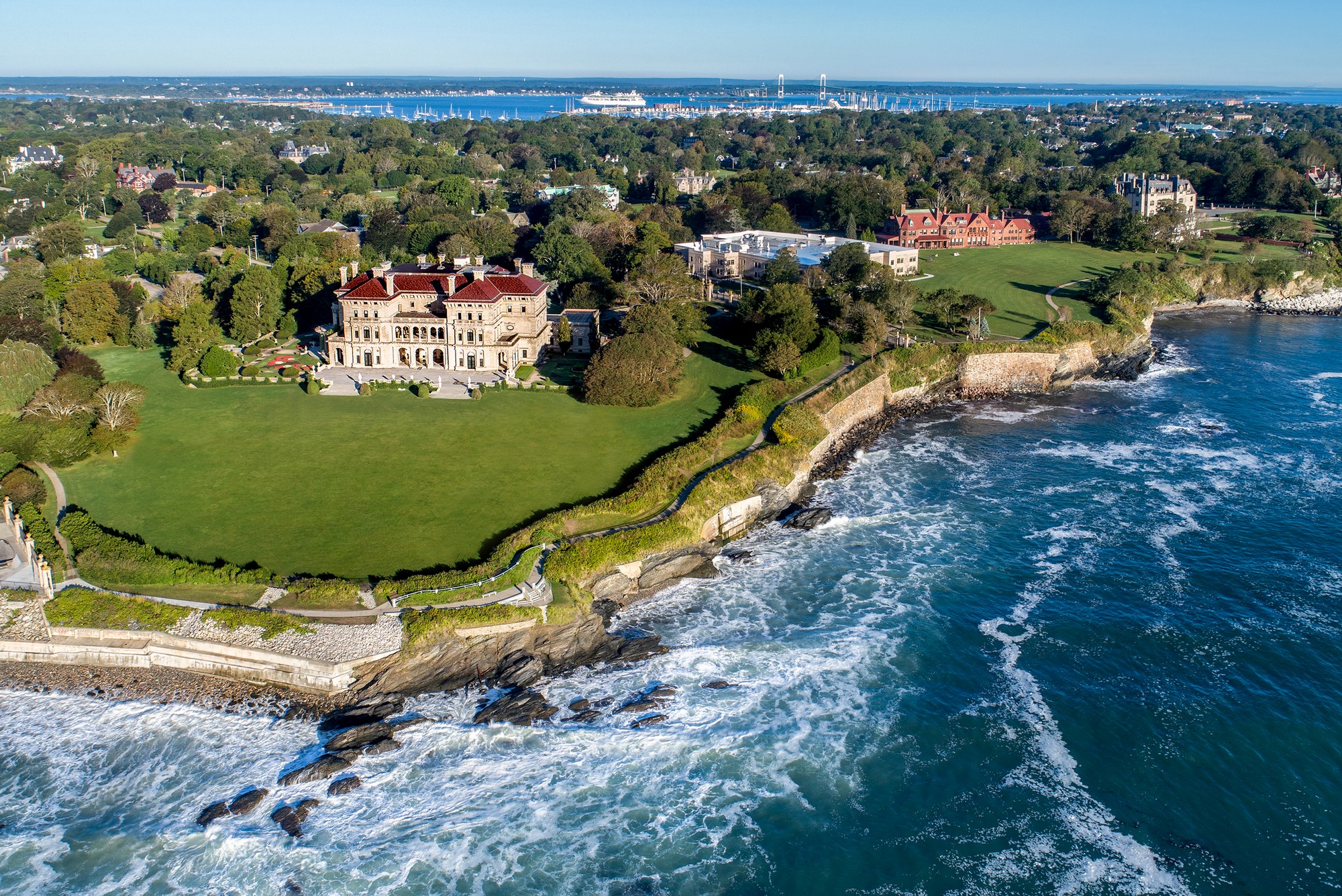
It’s a step back in time: you can play like an extra in the movie The Great Gatsby and wander through beautiful residences, the Newport Mansions, once summer cottages for America’s aristocratic families, the Vanderbilts, the Astors, the Belmonts. That “innocent” world lived on luxury, eccentricity, riches, and looked to Europe for inspiration in arts, palaces, and our natural “savoir vivre.” The first stop in Newport is the Beechwood Mansion of the Astors: once inside the palace, you’ll find yourself back in 1861. Discovering the Rich & Famous continues. Visit the Mansion of Cornelius Vanderbilt, The Breakers, and Edward Berwind’s, The Elms, then William K. Vanderbilt’s The Marble House.
The Mansion The Breakers is the most opulent: built in just two years, from 1893 to 1895, it contains 70 rooms. One idiosyncrasy of the residence is the bathroom sinks: they have four taps, two for hot and cold fresh water, and two for hot and cold sea water. On the upper floor are the children’s and guests’ rooms. The Elms is smaller: inhabited starting in 1901, the Berwinds used to celebrate parties with over 200 guests. The beautiful library in the North Alcove is made of dark and red wood panels: the large fireplace is decorated with plants. Don’t miss a nice outdoor walk admiring also the exteriors, parks, avenues, and gardens of these rich residences: you will fully grasp the opulence of Newport’s Gilded Age. You will walk along the autumn sea and breathe the Newport breeze that made it famous as the sailing capital and birthplace of the America’s Cup. But above all, don’t miss a walk along CLIFF WALK, which follows the east shore of Newport. It is about a five-kilometer walking path, created in 1975, offering unparalleled sea views along cliffs and the natural beauty of the coast: wildflowers, birds, and views of the Mansions. There are eight stops along the route from north to south, starting from First Beach on Memorial Boulevard.
In the late afternoon, continue the journey to reach Cape Cod in Massachusetts, staying in one of its 16 charming seaside villages. Arrival at Sandwich, dinner and overnight (139 Km) at the Daniel Webster Inn.

Cape Cod
Cape Cod holds a special place in the hearts and minds of Americans. Boston, New England, or New York families make it their preferred weekend refuge to escape the pressures of city life. It is, in fact, where the Kennedy clan created their “compound” in the village of Hyannis. Cape Cod is a harmony of nature and simplicity, aesthetic taste, and genuineness. At Cape Cod you find fields near the Atlantic Ocean which are flooded in autumn and produce a distinctive tart fruit, the cranberry, indispensable on the Thanksgiving Dinner turkey plate and also one of the major agricultural export products of Massachusetts worldwide. Fishing traditions and fish markets survive in small coastal villages on the Cape. The sea, boats, and catch represent typical aspects of this peninsula. Images of this island are idyllic visions, which artists and writers from Thoreau to Edward Hopper have immortalized in their writings and paintings.
In autumn, it lights up with bright colors due to Fall Foliage, and the cranberry fields erupt in reddish hues during the annual harvest, offering one of the most incredible natural spectacles. Writers and painters already frequented Cape Cod in the 1800s. Thoreau wrote a book dedicating pages to three long walks on Atlantic beaches from Nauset to Provincetown. Nature observation and the solitary lives of locals and oyster fishermen. Perhaps Cape Cod has inspired famous American writers: from Tennessee Williams to John dos Passos.

Heritage Museums & Gardens
Visit the Heritage Museums & Gardens, Sandwich – Here are 40 hectares of plants, bulbs, splendid flowers, and well-tended lawns. It is an extraordinary environment offering unbeatable horticulture, garden design, outdoor discovery, magnificent collections, and vibrant colors year-round. The region’s moderate temperatures and rainfall allow over 500 varieties cultivated in different garden zones, including the Windmill Garden with its spectacular blooms. Workshops, seminars, and activities are available year-round. Visitors from around the world come to admire three special and permanent exhibition halls: American Folk Art, a vintage carousel, vintage cars inside a replica of a classic Shaker barn in Massachusetts, and temporary exhibits. The gardens offer a collection of thousands of rhododendrons, including the famous Dexter variety, blooming from late May through mid-June. The grounds also include the Old East Mill, a mill built in Orleans, Massachusetts in the 1800s, extensively restored in 1999–2000. A labyrinth designed by Marty Cain, one of North America’s top labyrinth designers, was added in 2002. There is also the Hart Family Maze Garden and Cape Cod Hydrangea Garden. The Special Exhibitions Gallery is a replica of a Revolutionary War building known as The Temple of Virtue in New Windsor, New York, the same location where George Washington gave the first Purple Heart to a wounded soldier. Continue the day with a visit to another historic garden: Heritage Museums & Gardens, Falmouth – Magnificent 1878 estate restored, of the Beebe family, and one of the few remaining examples in the northeast of Queen Anne architecture. The two magnificent gardens’ restoration, begun in two years, was completed in 2013; the mansion and gardens are open to the public for visits from April through October. Walks on the estate are offered on the first and third Sundays of the month during the open season. Guided tours by teachers and pre-scheduled tours are available year-round for groups of five or more people. Paid admission. Continue after the visit to the next stop on Cape Cod, arriving at Provincetown at the northern tip of the peninsula. Walk, dinner, and overnight in Provincetown.

In autumn, through mid-October, the Province Lands Visitor Center of the National Park is also open. Alongside the National Park visit on the Sand Dunes, we highly recommend an excursion aboard a 4×4 vehicle to access the sand dunes and marine nature of the park, the Race Point Lighthouse Tour.
Cape Cod National Seashore
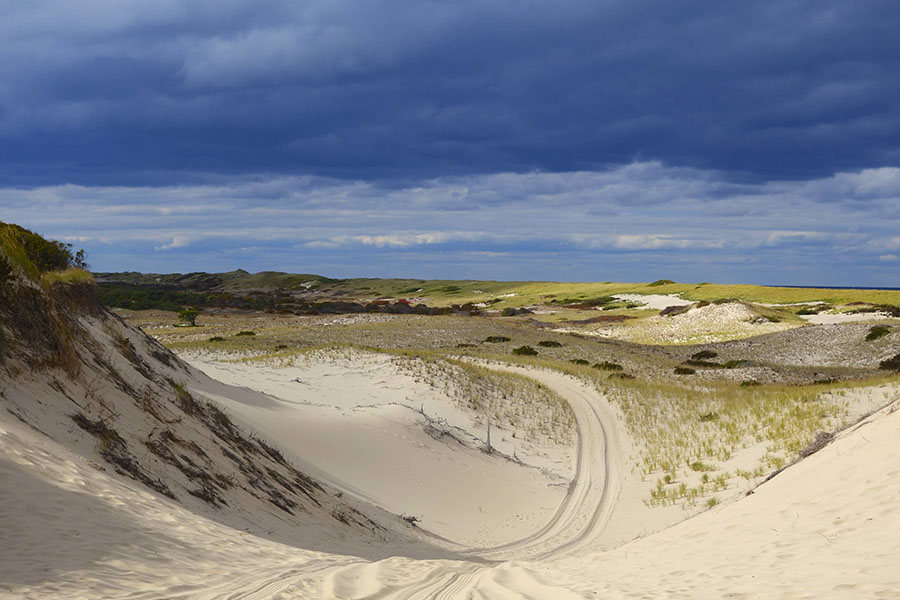
The approximately 18,000 hectares that comprise the Cape Cod National Seashore along about 65 kilometers of land and sea, from Chatham to Provincetown, constitute one of the largest coastal reserves in the United States. Scientists predict that within five thousand years Cape Cod’s shores will disappear due to erosion and rising ocean levels. Cape Cod is a glacial deposit constantly changing shape with the movement of wind and water carving sandy dunes along marine coasts. The cliff at the Marconi Wireless Station near Wellfleet has visibly eroded since Guglielmo Marconi built his tower in 1901. Great Island, once a hunting spot for whalers, is now connected to the peninsula. The entire Cape Cod peninsula loses about one meter of coastline annually due to erosion.
It is one of those classic areas constantly subject to the whims of the Atlantic Ocean. The 1978 storm, the Hurricane Bob in 1991, and the great storms of 1993 radically altered the landscape of the Cape Cod National Seashore. Important architecture related to Cape tradition is found inside the park: lighthouses, Coast Guard stations, as well as historic homes which have always been part of Cape’s charm. This is a park to visit at least once in a lifetime!
Created on August 7, 1961, by President John F. Kennedy, the Cape Cod National Seashore extends for about 60 km of coastline, including the towns of Provincetown, Truro, Wellfleet, Eastham, Orleans, and Chatham: all undeniably charming with architectural beauty. Native Americans began to use this land at least 9,000 years ago. In 1620, a group of Pilgrim Fathers, English religious separatists, explored the area intending to settle the colony. Cape Cod offered many benefits, but after months of searching, they decided to settle in Plymouth. In 1902, Guglielmo Marconi built one of two North American wireless stations in South Wellfleet. On January 18, 1903, the first Morse code communication between Europe and the Atlantic via the Cape Cod station took place. The first sea rescue and lifesaving program in the world was born at the Cape, becoming the U.S. Life Saving Service in 1872, a service as popular as the U.S. Cavalry due to its valiant lifesavers. The park includes beaches, sandy cliffs forming dunes, sandy hollows, tidal holes and flats, salt marshes, and soft grassy lands. Inland you find ponds, natural freshwater pools, cranberry fields. The vegetation includes pines, oak shrubs, and sandy herbaceous plants. Common are beach berries and plums, bayberry and beach plum. Twenty-five wildlife species are protected. Access the park through two Visitor Centers, which also include amphitheaters showing historic and nature films and documentaries. Rangers depart from here for excursions and guided tours. At the Salt Pond Visitor Center in Eastham – open year-round – there is also a cinema room showing a series of historic and naturalistic films, splendid documentaries highlighting different themes related to the park’s history and the peninsula’s ecosystem, which is only 18,000 years old glacial era. The center also arranges a calendar with talks from historians and writers, lighthouse tours – legendary lookouts of Massachusetts coast –, exploration of sand dunes and their characteristic habitats, walks along long sandy beaches, visits to historic homes and the lifestyle of Cape Codders families, and discoveries of curiosities about marine mammals: seals and whales, integral parts of Cape’s wildlife heritage. Lunch is free along Main Street in Provincetown before continuing to the next Cape village, Brewster (51 km).
Brewster
Founded in 1656, Brewster today hosts not only splendid beaches but also historic captains’ houses – many turned into inns – and other historic buildings, antique shops, and some of Cape Cod’s best restaurants. The historic sites are open to the public. The Brewster Historical Society is a great place to start, housed in a 1799 home, Elijah Cobb House on Lower Road. The historical society also runs the 1795 mill, Higgins Farm Windmill, now located at Drummer Boy Park. The Brewster Old King’s Highway Historic District covers much territory around the scenic Route 6A (Old King’s Highway); attractions include the 1881 town hall Old Town Hall, the 1868 women’s library Brewster Ladies Library, and a cemetery dating to 1707. The 1659 Dillingham House is among the oldest in Cape Cod. Finally, the old mill Stony Brook Grist Mill and Museum.
Dinner at Chillingsworth, long considered one of Cape Cod’s best restaurants, attracting food lovers to a venue dating back 300 years; or alternatively at the excellent former fish market, Brewster Fish House.
(75 km)
Plimoth Plantation: called a “living history museum” because it reproduces real life in 17th century Plymouth, the Plimoth Colony lets you travel back in time to experience how people really lived then. You will talk with the Pilgrim Fathers dealing with daily chores, meet crew members who helped bring the Mayflower ship to its historic destination in Plymouth, and meet the original inhabitants of the land, who will tell you how the colonists’ arrival changed their ancestors’ lives, the Wampanoag, “the people of the dawn.” Imagine how different your life would be if you suddenly found yourself in the shoes of the Pilgrim Fathers or the Indians.

Pilgrim Fathers
The Pilgrim Fathers in the village know nothing of the future. Listen to various dialects reflecting their origins. In the village you will be surrounded by modest wooden houses, cultivated gardens and vegetable patches, farm animals, and charming costumed inhabitants belonging to the Plymouth Colony, the first English settlement in New England. The people you meet are interpreters playing the role of residents in carefully replicated period costumes who narrate, more or less, the events of their living period and history: they are the “Pilgrims.” Each has their own story to tell. You can learn about the colony’s early hardships or discover village gossip. You can also ask about religion and their faith, Protestants fleeing England, or about medical practices and relations with the native Wampanoag Indians. If you talk to a housewife, you will learn what “pottage” is, or watch how they roast duck or fish in the oven. You might even help a young settler sow a small field, help build a house, or simply relax on a bench immersing yourself in the unique atmosphere of 17th-century New Plymouth. The museum has accurately recreated every piece you will see and touch. Even the food is prepared as in the 17th century.
Your visit is self-guided, with a map in hand, and you enter the year 1627: feel free to explore the village at your leisure. Don’t be intimidated if you encounter a colonist eating; stop to ask questions or join a lively conversation happening along one of the village streets. Most objects and tools in the houses are modern reproductions of ancient examples and can be touched.
The only detail – perhaps difficult for Italians – is the language used in the village: you should be an expert in Shakespearean to be comfortable in the conversations. Dare: see what reaction you get! Maybe if you reveal you are Italian, the Pilgrim will mention the Medici and talk about Florence, or simply look at you as a Catholic specimen. The opportunity to have a unique experience in a 17th-century village, with a truly English perspective, will make you understand the crucial transatlantic crossing at the time. You will be surprised listening to these people!
Wampanoag Natives
The people you meet at the native Wampanoag campsite talk about the past, but their story is told from a modern perspective. You can enter a traditional wetu house and become part of a world that is certainly unfamiliar to you. Furs, fires, handwoven mats: this is the environment of the traditional Wampanoag Indian family when the Pilgrim Fathers arrived. They tell it from their perspective, that of the indigenous people. Walk in this natural area and smell the sobaheg (stew) cooking on the fire with aromatic herbs. Discover medicinal plants, typical remedies used by the Wampanoag natives, or help carve a canoe from a tree trunk – a mishoon (boat) using ancient traditional techniques. You can also walk along the quiet waters of the Eel River. The Wampanoag have lived in southeastern New England for over 12,000 years. The camp revives their history and lets you meet Hobbamock, a tribe member to learn about Wampanoag culture and history. You will negotiate with the Wampanoag, natives who lived on this land well before the arrival of English colonists, for hundreds of generations. It is important to notice that – unlike the colonial village interpreters – here the people are original natives wearing deer skins and speaking their native, current language, talking about their people, the Wampanoag.

The museum develops in two distinct and separate areas:
- The Plimoth Plantation is about five kilometers from downtown Plymouth
- The Mayflower II is docked in Plymouth harbor
At the Visitor Center, you will find a wide variety of exhibits, restaurants, toilets, and the museum’s main store, including a children’s section and an old-fashioned grocery section. At the Crafts Center (craftsmen’s stable), you will meet and see artisans at work creating reproductions for Plimoth Plantation historic sites. You can have lunch at the Plantation cafeteria.
Continue to Boston where the trip ends and the experience of parks, gardens, and historic homes of this America immersed in history and tradition concludes.
©Thema Nuovi Mondi