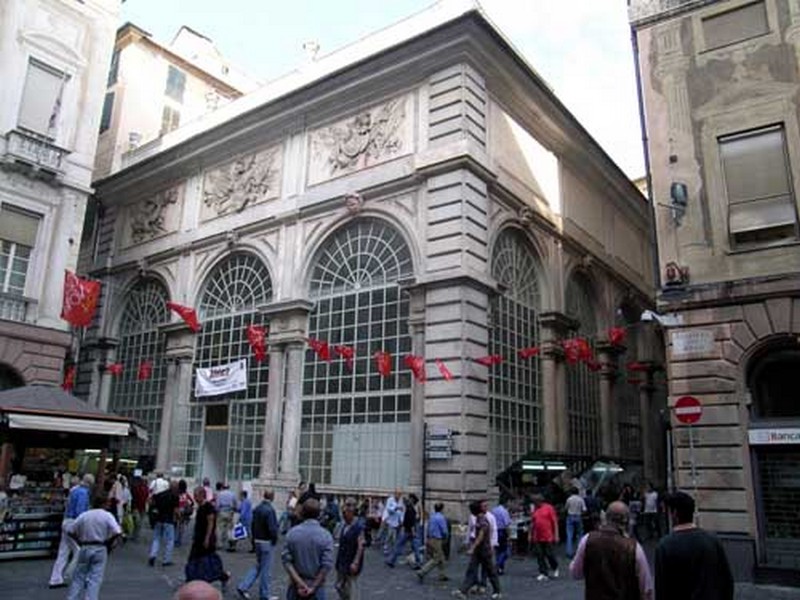
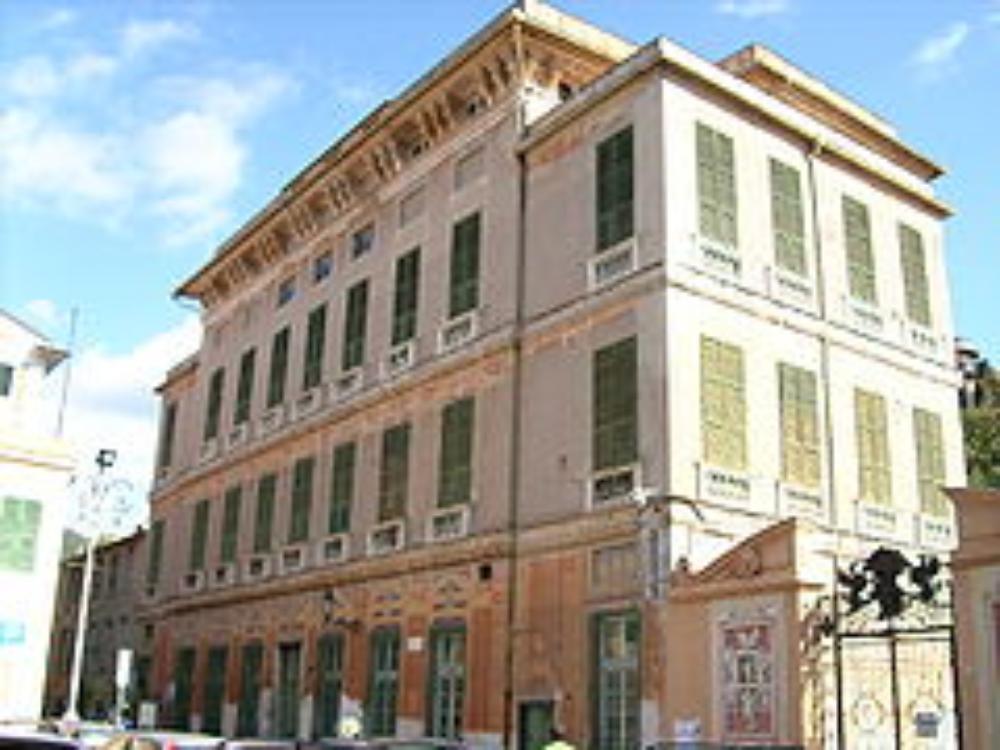
As in all Jesuit colleges, the Genoese one had at least two libraries: the “domestic” one for school use, and the actual “Library” housed in the so-called “Third Room,” which still preserves the monumental section with shelves veneered in burl wood, dating back in design to the mid-17th century.
During the 18th century, the Library underwent several renovations: around the middle of the century, the wooden decor was renewed in the Genoese baroque style, and in 1777 the shelving was raised to the ceiling by constructing the gallery, the iron and wood railing running along the entire room, and the “small spiral staircase” leading to the upper floor.
With the dissolution, in 1773, of the Society of Jesus, the College was renamed Public University and came under the direct control of the Republic of Genoa. Thus, the Jesuit library transformed into the “Library of the Public University of strada Balbi,” where the libraries of convents and religious corporations gradually suppressed were merged. In 1778, the scholar Gaspare Luigi Oderico was appointed librarian with the task of cataloging the books of the former College. Completed in 1785, and since previous inventories have not been preserved, the manuscript volumes written by Oderico constitute the oldest catalog of the library’s book collections.
During the Ligurian democratic republic, between 1797 and 1799, it experienced further growth as volumes from the libraries of the numerous suppressed Genoese and Ligurian religious orders during the “Jacobin” period were redirected to the library, as well as manuscripts and volumes from the library of Ventimiglia belonging to the learned Augustinian friar Angelico Aprosio (1607-1681).
The extension of the ancient Jesuit library dates back to the 1830s, lengthening it from the original 15 to the current 24 meters to accommodate the increased volume of books.
Declared a National Public Library in 1801, the government established the library’s authority to receive the legal deposit from Ligurian printers. In 1815, with the transfer of Ligurian territories to the Savoy, as the “library of the Royal University of Genoa,” it resumed its close connection with the university, which it had never lost.
In 1866, with the last wave of suppressions of religious congregations, the library was further enriched with convent libraries, which explains the presence among its current collections of a substantial core of religious and theological works.
The continuous expansion of the book collections soon created a problem of insufficient space. After various proposals, the solution was to designate the former church of the Jesuit College as the new site for the library. The renovation project adopted a solution considered avant-garde at the time: the church nave was horizontally divided to accommodate the book deposit, made up of a self-supporting, earthquake-proof metal structure of four floors, and the reading room above. The new premises were inaugurated in December 1935. With the establishment of the new ministry, since 1975 the Library has been a peripheral institute of the Ministry of Cultural Heritage and Activities.
For a long time, the historic seat, albeit expanded since 2003 with some rooms at via Balbi 38b, could not guarantee enough space to house the book collections. To solve this issue, the Ministry of Cultural Heritage and Activities purchased the building opposite Piazza Principe railway station, the former Hotel Colombia at Via Balbi 40. This new and prestigious home, whose transformation is now complete, will allow the Library to expand services and gather projects and cultural forces in a fully renewed urban area in the coming years. All materials, offices, and some services previously housed at Via Balbi 38b were moved to the new headquarters in October 2013. From July 2014, even the offices based in the historic seat were transferred to the new headquarters, which became the Library’s sole and main location.
The largest bibliographic institution in Liguria, holder of the legal deposit for the Region’s publishing production, the Library owns more than 600,000 units including volumes, pamphlets, manuscripts, incunabula, 16th century prints, autographs, and periodicals. There are 34 reading rooms. The first three rooms house most of the printed book collection from the College and the Casa Professa of the Genoese Jesuits and the Religious Congregations suppressed in the 18th and 19th centuries. Among the book holdings are the so-called “Liguria” and “Corsica” rooms: the former, started in 1865 by librarian Emanuele Celesia to gather texts printed in Liguria or by Ligurian authors, includes about 6,000 volumes; the Corsica room consists of about 180 volumes and pamphlets relating to Corsica.
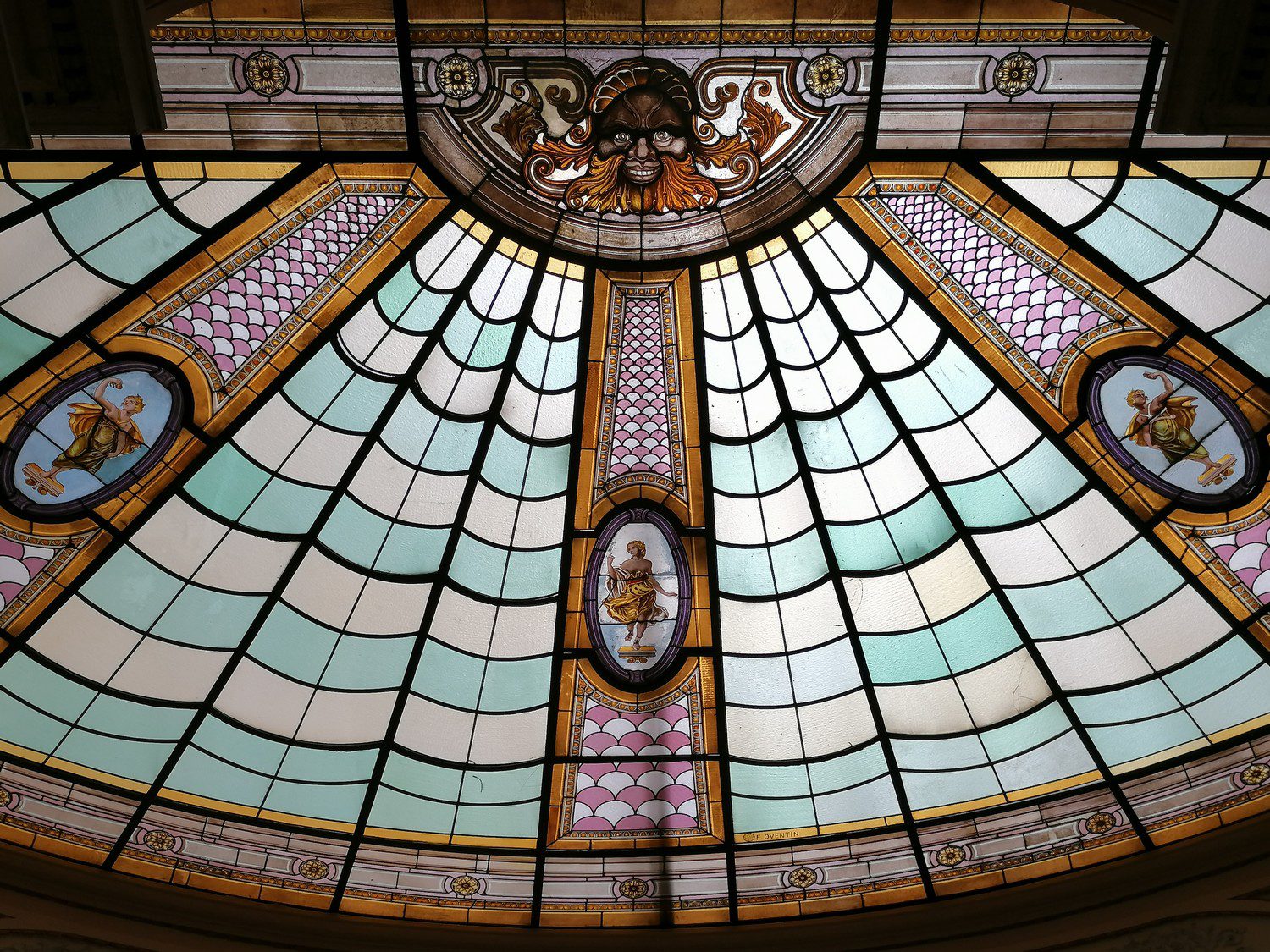
The library also holds a number of bibliographic collections arrived around the 1920s – ’30s: the Manuel Belgrano Library (a donation from Argentina, comprising 1,500 volumes on Argentine territorial history), the Geography of the American States (established by government order in 1931, including about 1,200 volumes); the Military Garrison Library (permanent transfer in 1934, composed of texts on military disciplines); the Laura Collection (consisting of 13,000 volumes and pamphlets mainly of philosophical, religious, sociological and literary nature); the Rossello Collection (a bequest from the 1930s including about 1,500 volumes, mostly legal subjects); the Gropallo Collection (about 1,750 volumes mostly of literary texts).
In the Conservation Sector of the library, which as noted safeguards the rarest relics and the entire manuscript collection, as well as precious liturgical codices and choir books, especially interesting are the large Autograph collection (about 14,000 pieces, partly incorporating correspondence from various library directors in contact with many intellectual and political figures) and the Nino Bixio Collection, known as “Autographs of the Risorgimento” (comprising fourteen boxes of correspondence and notes).
During the first half of the 20th century, many donations and bequests of both printed and manuscript materials were made. Among these are the precious donation of Gerolamo Gaslini in 1942 (60 humanistic period manuscripts and 120 incunabula), the Umberto Fracchia Collection acquired in 1982 (including literary manuscripts and printed works), and the Luigi Pelloux Collection received the same year (containing predominantly historical and military works).
The acquisitions policy has also increased the collections over the years: in 1954 a collection belonging to the De Gaudenzi family (3,700 editions mostly D’Annunzio-related and critical of D’Annunzio) was acquired from the Ministry of Public Education; more recently the acquisition of the Rodocanachi Collection has great interest for 20th-century literary history. Since 2012, through an agreement with the Municipality of Genoa, the Library has had the use of the library of the great poet and intellectual Edoardo Sanguineti.