


Arriving in this small mining town in south-western Sardinia during Easter Week means entering a microcosm of sounds, images, mysteries, flavors, and colors like nowhere else.
- The Most Striking Holy Week Processions in Sardinia
- Holy Tuesday – The Procession of the Mysteries with the Baballottis
- Holy Thursday
- Good Friday: S’iscravamentu
- The Monte Procession (morning)
- The Descenso Procession (afternoon)
- Holy Saturday: Su Incontru
- Tuesday – S’Inserru
- Holy Week in Sardinia: Home Traditions
- What to Eat and Do During Holy Week
In Sardinia, as in many parts of southern Italy, Holy Week rites draw travelers and locals looking for a blend of sacred and secular. The Holy Week processions in Taranto or those of Trapani are highlights not to be missed. But Sardinia, a land rich in ancient traditions, has its own enchanting rituals.
The Most Striking Holy Week Processions in Sardinia
Everything begins on Tuesday, when young devotees known as Baballottis, dressed in traditional penitential robes, carry the Procession of the Mysteries through the streets, bearing the Seven Statues that symbolize episodes from Christ’s Passion.
The cross of the Arciconfraternity of Monte Santo leads the procession, one of the oldest along with the Descenso. Seven living scenes recall the Passion of Jesus: the Garden of Olives, the arrest, the flagellation, Ecce Homo, the ascent to Calvary, the Crucifixion, and the Mater Dolorosa.
The Baballottis shoulder the statues; the first is particularly heavy and requires days of preparation.
In the Spanish fashion, a large olive branch is placed on the platform carrying Jesus in prayer and decorated with flowers and Mediterranean plants.
Only two children, in the Baballotti’s traditional robes, join the procession; these same children will represent St. John and Mary Magdalene on Good Friday’s Descenso procession. Other children stay back for Thursday and Friday’s processions. There are two moments of prayer and reflection held in the Cathedral.

Holy Thursday, after sunset, is marked by another procession accompanied by the beats of drums and matraccas (traditional wooden noisemakers with iron rings and nails). The statue of the Madonna, searching symbolically for her Son, is led through seven churches set up with the Holy Sepulchre.
This is one of Christianity’s most important days: it commemorates the Last Supper, the institution of the Eucharist and priesthood, and the start of Jesus’s Passion. Two holy Masses mark the day: in the morning, the Chrism Mass; in the evening, the Mass in Coena Domini.
Afterwards, church bells are silenced (until the Easter Vigil’s Gloria), and the Blessed Sacrament is placed in a richly decorated side chapel—the Altar of Repose or ‘sepolcri’. The faithful then visit the altars with the exposed Blessed Sacrament.
Decorations include cloths, carpets, flowers, and candles, along with “Su Nenniri”: pots where wheat and lentils are sown at the start of Lent. Grown in darkness, these plants turn pale yellow and either drape or stand upright, depending on the seed. The effect evokes ancient traditions, creating an atmosphere that matches the day’s reverence.
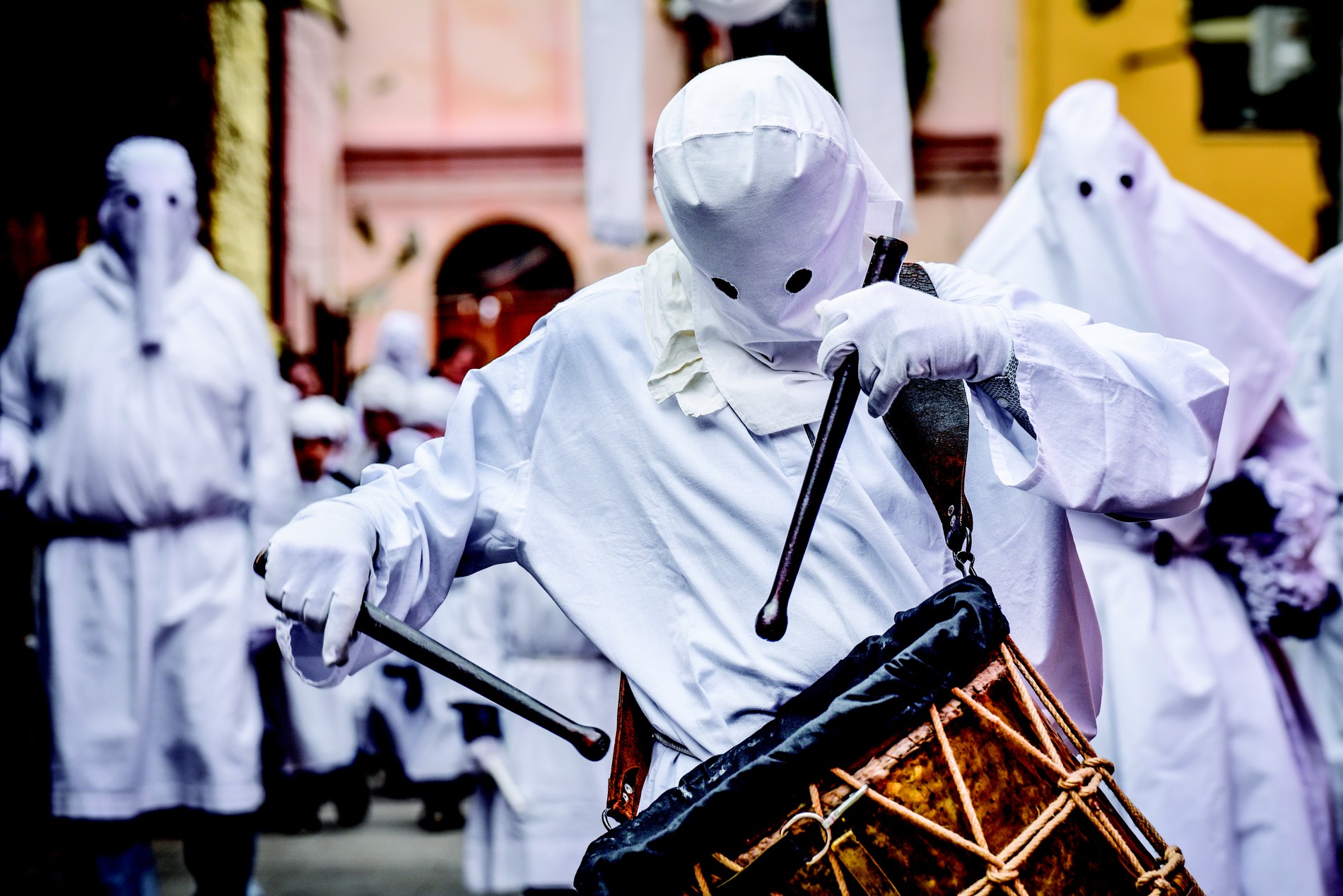
The Baballottis are the heart of Holy Week: white-robed, hooded and faceless, ageless, they reappear this day—of all ages—filling the town center streets. ‘Baballottis’ means little insect in Sardinian, though their attire closely resembles that of ancient disciplinants. In the late evening, the Addolorata procession departs from the Oratory of Santo Monte, the Church of San Michele.
The Madonna searching for Jesus before his arrest is, for locals, the reason for this ancient tradition. The cross and the statue of the Pietà stop briefly at churches in the historic center. The start of the procession is noisy, filled with matraccas and drums, then surges into deep silence as the Germani del Santo Monte and the statue of the Madonna take center stage.

On Good Friday, a third procession starts early, visiting churches along an ascending route that recalls Jesus’s way to Calvary on Golgota, with young Baballottis carrying a small cross.
In the afternoon, the Germani of the Arciconfraternity del Sacro Monte perform the Descent from the Cross with the “S’iscravamentu” ceremony. In the evening, during the Descenso procession, a dramatic funeral for Jesus is enacted, steeped in Spanish Baroque tradition, featuring numerous participants and religious symbols—among them a life-size 17th-century statue of the Dead Christ.
The Monte Procession (morning)
In the morning, the elevated “Sa Costera” quarter hosts the Monte procession, the ascent to Calvary. The “Via Dolorosa” features the statues of Jesus carrying the cross, and Our Lady of Sorrows. The procession revisits local churches, accompanied by matraccas, drums, the cross of the Arciconfraternity, Baballottis, the Sacrament Confraternity, and Germani del Santo Monte leading the statue of their patroness, the Pietà. Small Baballottis also carry a little cross.
The Descenso Procession (afternoon)
In the early afternoon, after three o’clock, the “Su Scravamentu” is repeated discreetly inside the Santo Monte Oratory, attended solely by brotherhood members. The Descenso’s servants remove the articulated 17th-century Crucifix from the cross and lay it in “Sa lattera”, the bier. Later, comes the most anticipated procession: the Descenso.
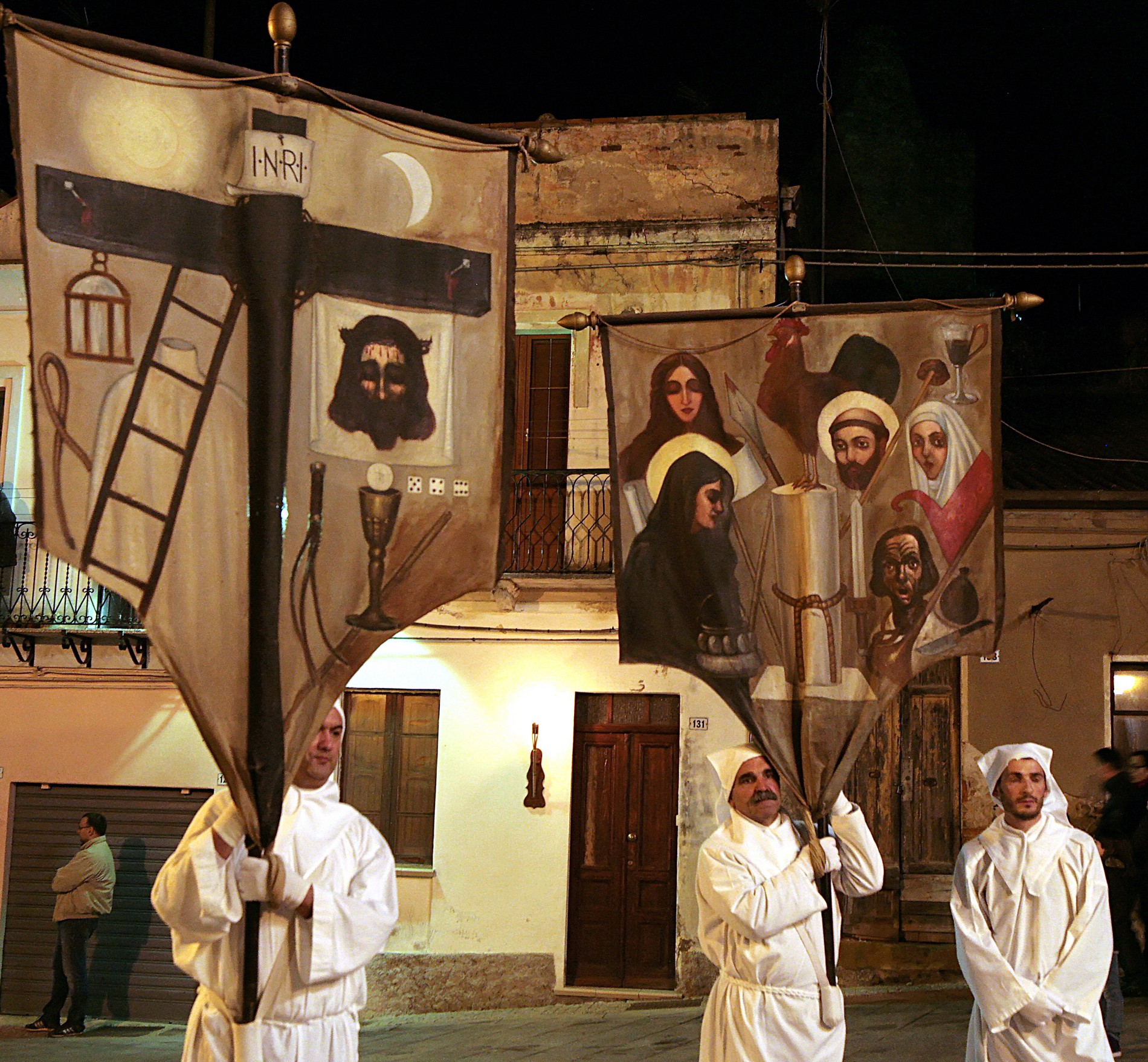
A fragment of sacred drama is integrated into the classic procession: two large banners, “Is Vessillas”, precede “San Giovanni and the Maddalena”—two boys dressed in ornate, Eastern-inspired costumes adorned with gold jewelry. Next are the nobles “Is Varonis”, Joseph of Arimathea, and Nicodemus, accompanied by servants with the descent ladders. Their style, with long beards and stately gait, gives them an imposing aura.
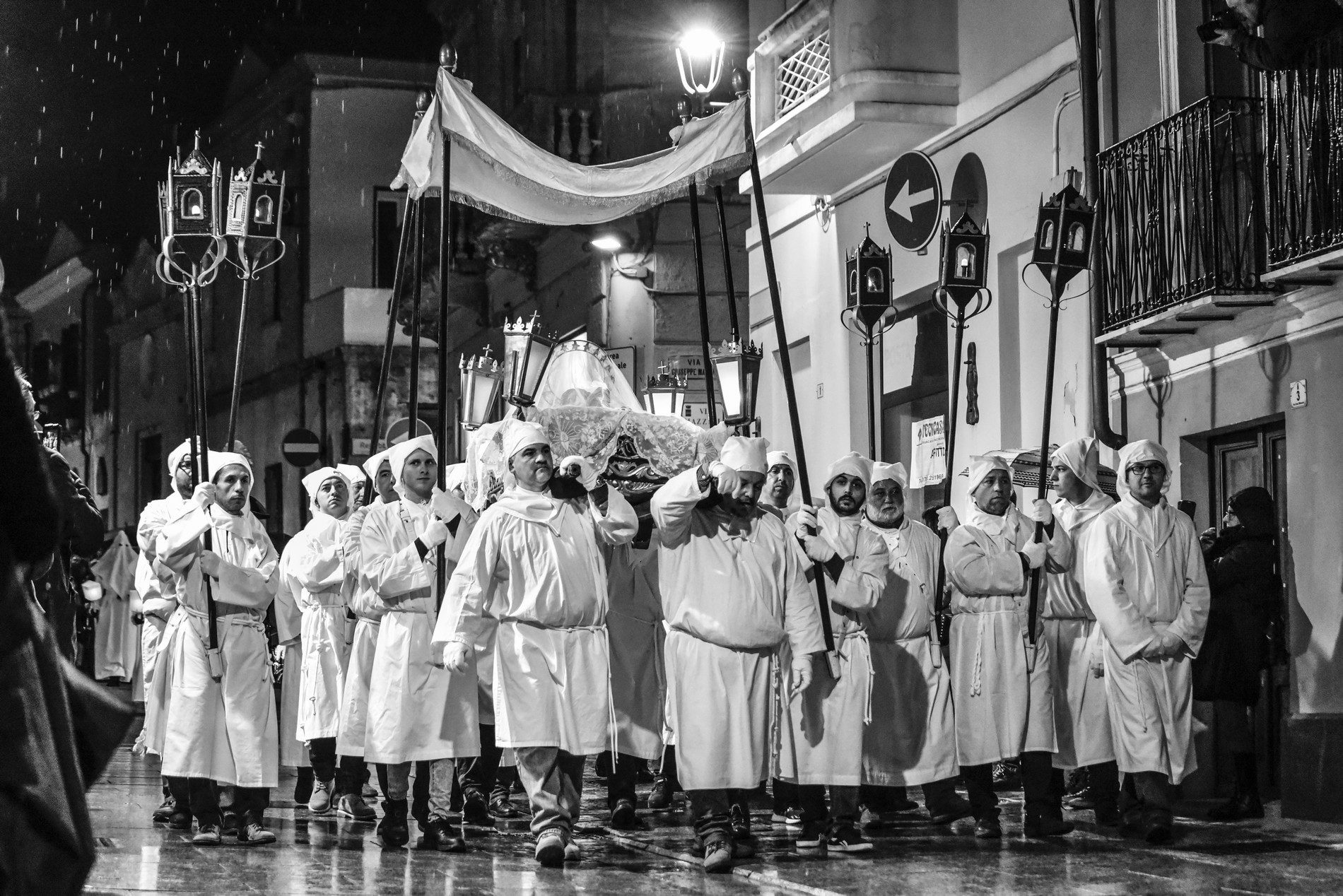
Behind them, the revered statue of the Dead Christ is carried under a white canopy symbolizing royalty, veiled with tulle. While Christ’s actual funeral was humble and swift, the Sardinian reenactment borrows Spanish Baroque splendor—full of ornaments but still marked by deep devotion and mourning. The Germani del Santo Monte follow, along with the Addolorata holding the crown of thorns; the mournful procession closes with a large black cross carried by penitents.
On Holy Saturday night, at the singing of the Gloria, the statue of the Risen Christ is brought into the cathedral. Sunday morning, bells ring out as his image triumphantly enters the city, which then sees two processions: one starts from the Church of San Giuseppe with the Madonna and young participants embodying Mary Magdalene and St. John; the other from the cathedral itself with Risen Jesus.
The two routes eventually meet at “Su Incontru”, where, as the groups approach, they bow three times before merging into a single procession returning to the cathedral. Here, the Bishop gives a solemn blessing. For the occasion, the faithful offer the brotherhood members “su coccoi de Pasca”, a votive bread typical of local tradition.
But the Holy Week rites in Iglesias don’t end here: on the Tuesday after Easter, after the Capitular Mass in the cathedral, the procession of “S’Inserru” takes place—a unique ritual marked by three bows and three farewells as the statues of the Risen Jesus and the Madonna part ways, returning to the churches of San Francesco and San Giuseppe respectively.
Holy Week in Sardinia: Home Traditions
While the public ceremonies are deeply atmospheric and full of symbolic meaning, private rituals and house traditions are equally fascinating.
On Holy Thursday, it’s customary, as an act of penance, to cook and share with the poor a dish of broad beans and pork, flavored with herbs. On Saturday, with the Gloria, people tap every object with a cane, driving out evil spirits. Drums, wooden rattles, and matraccas are the only instruments permitted during the week, as bells—the symbol of joy—return on Easter Sunday.
The rites in Iglesias, whose Spanish name literally means “churches”, are completed the Tuesday after Easter. After the Capitular Mass, the “S’Inserru” procession takes place—marked by three bows and three farewells as the statues of the Risen Jesus and the Madonna part: one to San Francesco, one to San Giuseppe. Meanwhile, in private homes, traditions and small domestic rituals continue.
What to Eat and Do During Holy Week
As is tradition on Holy Thursday, a simple meal of broad beans and pork, dressed with aromatic herbs, is shared—including with the poor. On Holy Saturday, to the sound of the Gloria, it’s common to gently tap objects with a cane, to drive away evil spirits. Throughout the week, the only music allowed comes from drums, rattles, and matraccas, as everyone waits for Easter bells to return.