


Arriving in this mining town in southwestern Sardinia during Holy Week means immersing yourself in a microcosm of sounds, images, mysteries, flavors, and colors that are unparalleled.
- The Most Suggestive Processions in Sardinia for Holy Week
- Holy Tuesday – The Procession of the Mysteries with the Baballottis
- Holy Thursday
- Good Friday: S’iscravamentu
- The Monte Procession (morning)
- The Descenso Procession (afternoon)
- Holy Saturday: Su Incontru
- Tuesday – S’Inserru
- The Holy Week in Sardinia: Homely Traditions
- What to Eat and What to Do During Holy Week
In Sardinia, as in many other parts of Italy, especially the south, the rites of Holy Week attract tourists and the curious seeking a fusion of the sacred and the profane. The Holy Week rites of Taranto or those of Trapani, for example, are absolutely not to be missed. But Sardinia, a land of centuries-old traditions, is not second to any in these particular and evocative traditions.
The Most Suggestive Processions in Sardinia for Holy Week
Everything begins on Tuesday, when young devotees called Baballottis, in traditional penitential clothes, bring to life the Procession of the Mysteries, carrying on their shoulders through the streets the Seven Simulacra, which depict seven episodes of Christ’s Passion.
The cross of the Archconfraternity of Monte Santo opens this procession which, together with that of the Descenso, are the oldest. Seven plastic tableaux recalling the Passion of Jesus: the Garden of Olives, capture, flagellation, Ecce Homo, ascent to Calvary, Crucifixion, Our Lady of Sorrows.
The young baballottis carry the simulacra on their shoulders; the first of which is particularly heavy and involves the Santo Monte with several days of preparation.
In the Spanish fashion, a large olive branch, generously offered, is raised on the litter with the simulacrum of Jesus in prayer and adorned with flowers and Mediterranean scents.
Only two children, dressed in the traditional penitential attire of the baballottis, participate; the same who will be St. John and Mary Magdalene in the Descenso procession on Good Friday. The other children are excluded from this procession: their days are Thursday and Friday. Two moments of pause and reflection with sermons will take place in the Cathedral.

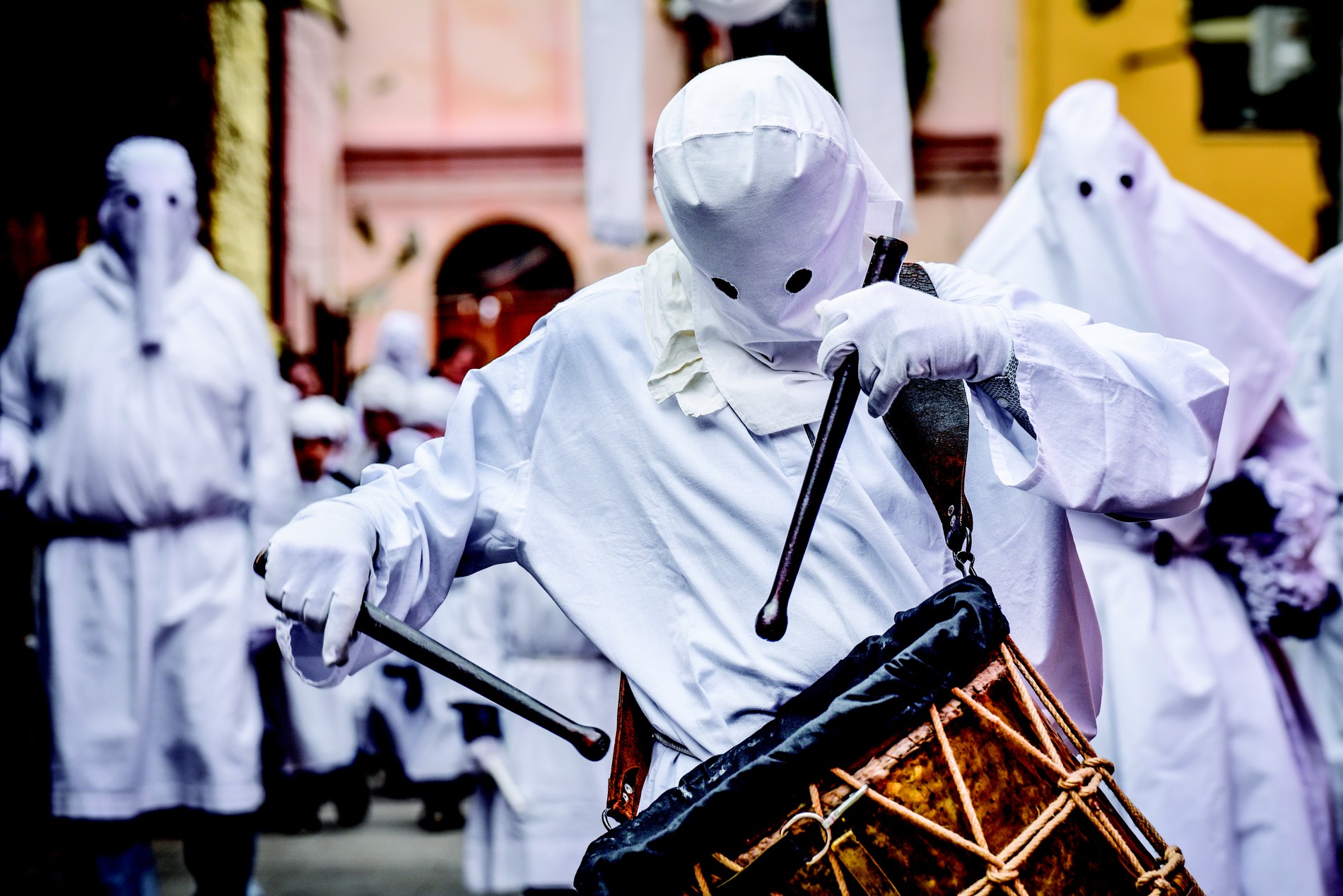
Holy Thursday, after sunset, features another procession marked by the sound of drums and matraccas (a traditional instrument made from a wooden board with nails and iron rings acting as clappers): the statue of the Madonna, who symbolically searches for her Son, is brought into the seven city churches where the Holy Sepulchre is set up.
It is one of the most important days for all Christianity: commemorating the Last Supper, the institution of the Eucharist, the priesthood; the beginning of Jesus’ Passion. It is a day full of events and meanings: two Masses mark the rhythm of this long day: the Chrism Mass in the morning and the Coena Domini Mass in the evening.
Afterwards, in all the Churches, the bells are tied (to be untied during the Gloria of the Easter Vigil on Holy Saturday), the Blessed Sacrament is solemnly placed in a richly decorated side chapel called the altar of repose or the sepulchers, as they are commonly called, and finally the faithful go out to visit the churches, or better said, these altars where the Blessed Sacrament is solemnly exposed.
The decoration, besides veils, carpets, flowers, and candles, includes “Su Nenniri”: vases in which wheat and lentils are sown at the beginning of Lent. They will grow perfectly in the dark, producing a white-yellowish, shaggy and drooping foliage for the lentils and erect for the wheat. The effect, besides the old reminiscences linking them to the gardens of Adonis, is to soften the color of flowers and fabrics, almost reorganizing their quantity and making them appropriate to the particular moment.
The baballottis are the protagonists of Holy Week: white, hooded, faceless and timeless, in penitential robes, they materialize on this day, of all ages, invading the city center streets. Baballottis means little insect in Sardinian. The meaning is shrouded in mystery but their attire closely resembles that of the ancient disciplinants. It is late evening when from the Oratory of Santo Monte, the Church of San Michele, the procession of Our Lady of Sorrows sets out.
The Madonna searching for Jesus before his arrest, thus popular piety justifies this centuries-old practice. The cross and the simulacrum of the Virgin of Piety make a brief stop in the churches of the historic center. Outside the deafening clamor of the matraccas and drums characterizes the initial part and separates it from the last part of the procession, which instead is marked by an equally overwhelming silence, where the Germani del Santo Monte and the statue of the Virgin are protagonists.

On Good Friday, a third procession begins early in the morning and visits the churches following an ascending route, recalling Jesus’ ascent to Calvary of Golgotha, with the young Baballottis carrying a small cross on their shoulders.
In the afternoon, the Germani of the Archconfraternity of the Holy Mountain enter the scene, who lay down the Crucifix with the rite of “S’iscravamentu”, and in the evening, during the Procession of the Descenso, they animate a true funeral of Jesus, in full respect of the Spanish Baroque tradition, characterized by a large number of participants and religious symbols, including a life-size sculpture of the Dead Christ dating back to the 17th century.
The Monte Procession (morning)
In the morning, the upper district of “Sa Costera” serves as the stage for the Monte procession, the ascent to Calvary. The “Via Dolorosa” features as protagonists the simulacrum of Jesus with the cross and that of Our Lady of Sorrows who accompanies Him. The various churches are revisited with a processional cortege similar to that of the previous day: matracconis, drum, cross of the Archconfraternity, Baballottis, Confraternity of the Most Holy Sacrament, simulacra and Germani del Santo Monte who precede, as in all processions escorting it, the statue of their patroness, the Virgin of Piety. The little Baballottis carry, besides the matracca, a small cross.
The Descenso Procession (afternoon)
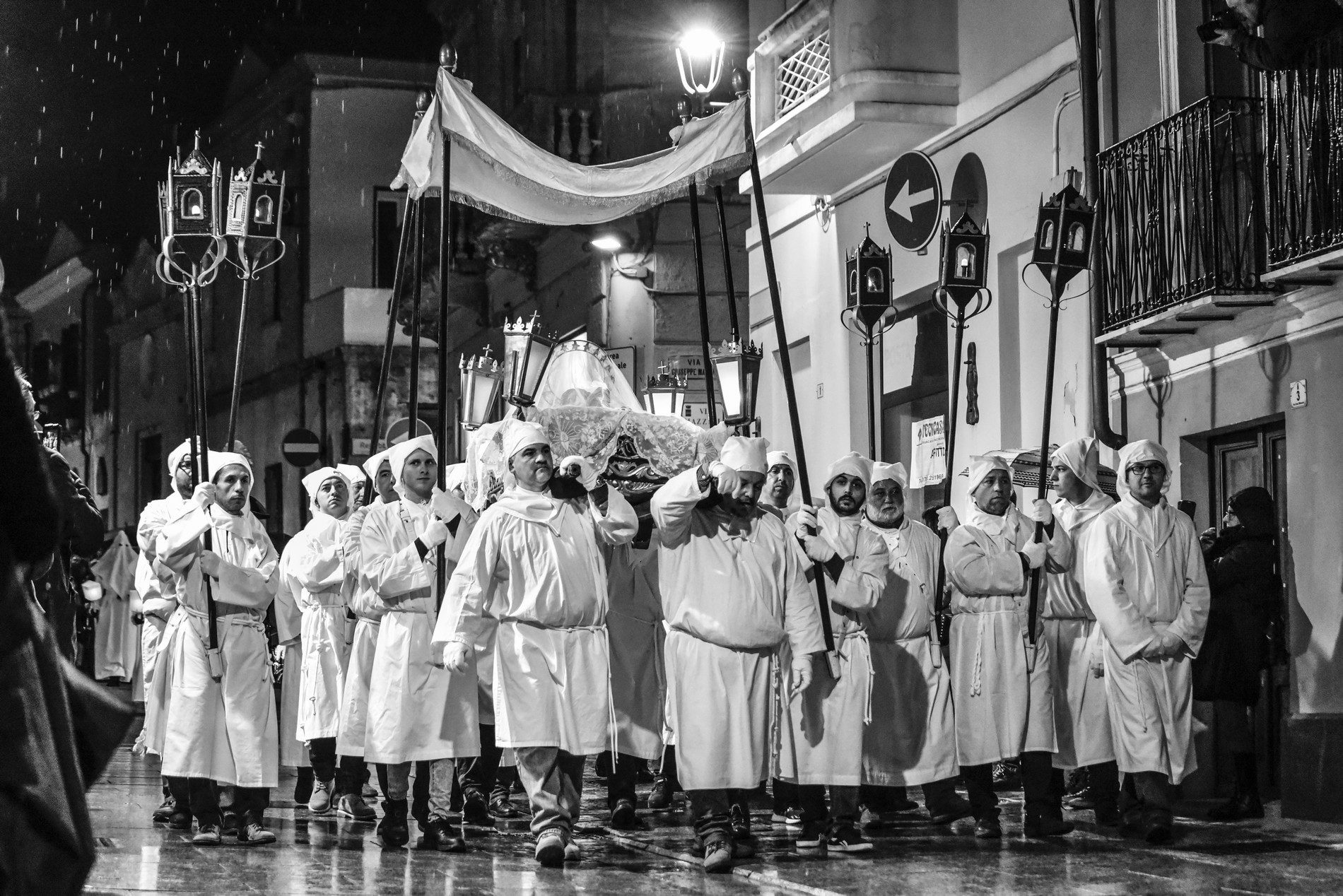
In the early afternoon, after three o’clock, the pious practice of “Su Scravamentu” is repeated in the privacy of the Santo Monte oratory and in the presence of only the confreres: the Obrieri of the Descenso unfasten the beautiful 17th-century crucifix from the cross (which is jointed) and lay it in “Sa lattera”, the litter. Late in the evening the most awaited Procession, that of the Descenso.
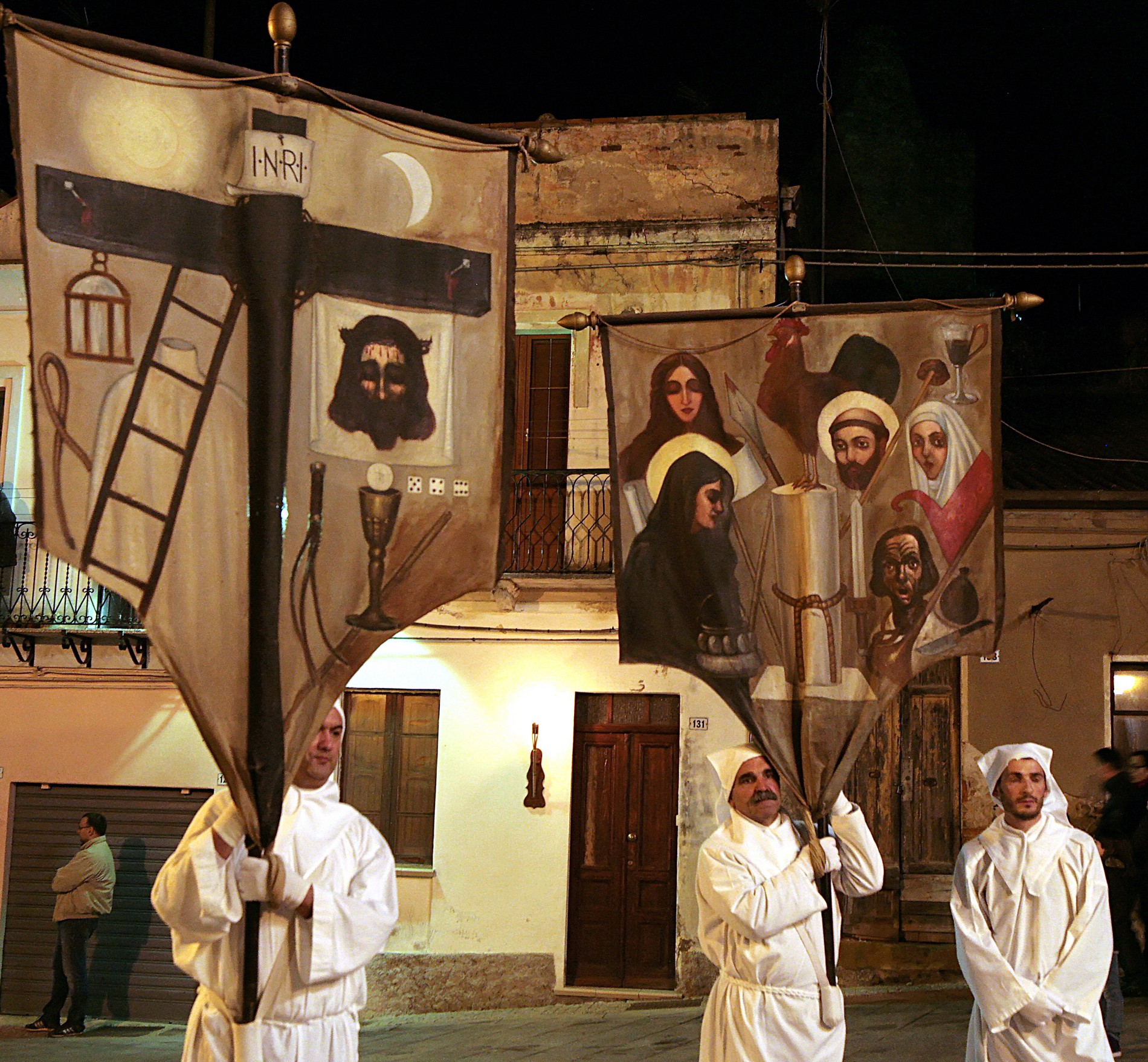
A fragment of sacred representation of Jesus’ funeral is embedded in the classic procession body: two large banners, “Is Vessillas”, precede “Saint John and Mary Magdalene,” two boys dressed in oriental-style clothes adorned with gold ornaments; followed by “Is Varonis”, the nobles, “Joseph of Arimathea and Nicodemus” with two assistants carrying the deposition ladders. Their garments are also oriental-inspired and both the thick beards and their proud walk lend them a serious, grave, and dignified appearance.
Further back, the artistic and venerated simulacrum of the Dead Jesus, among lights and lanterns, covered by a tulle veil and under a white canopy signifying royalty; the real funeral of Jesus was surely poor and swift, it is re-envisioned with Spanish-Baroque eyes, with pomp and richness of ornaments but also with faith, devotion, and mourning for the Son of Man who dies for us. Following are the Germani of Santo Monte with the Our Lady of Sorrows who tonight holds tightly to her chest the crown of thorns; then lastly, the large black cross carried on the shoulders by penitents without special robes or signs.
On Saturday night, at the singing of the Gloria, the Risen Christ is brought into the cathedral and on Sunday morning, with joyful bells, His image makes a triumphant entrance, while the city is crossed by two new processions: one starting from the church of San Giuseppe with the simulacrum of the Madonna and the boys portraying Mary Magdalene and Saint John; the other from the cathedral itself with Risen Jesus.
The processions wind along different routes until the moment of “Su Incontru”, when the two groups, as they approach, bow three times until they form a single procession, which returns to the cathedral where the Bishop awaits everyone for the solemn blessing. On this occasion, the faithful offer the Confreres “su coccoi de Pasca”, a votive bread typical of the local tradition.
But the rites of the Holy Week of Iglesias do not end here: on Tuesday after Easter, after the Cathedral Chapter Mass, the procession of “S’Inserru” takes place, a unique rite characterized by three bows and three farewells as the statues of the Risen Jesus and the Madonna separate, to be accompanied, respectively, to the church of San Francesco and that of San Giuseppe.
The Holy Week in Sardinia: Homely Traditions
If the public ceremonies are so evocative, rich in mystery and symbolism, no less interesting are the small rituals and customs in private homes.
It is tradition, on Maundy Thursday, as a sign of penance, to cook and also give to the poor a dish made with fava beans and pork, seasoned with herbs and fresh spices. On Saturday, instead, at the sound of the Gloria, it is customary to beat everything with a cane to drive away any evil spirits. And throughout Holy Week, the only musical instruments allowed are drums, ratchets, and matracas, awaiting the bells, symbols of joy, on Easter day.
But the rites of the Holy Week of Iglesias, whose Spanish name means churches, do not end here: on the Tuesday after Easter, after the Capitol Mass in the cathedral, the procession of “S’Inserru” is held, a unique rite characterized by three bows and three salutes, as the statues of the Risen Jesus and the Madonna separate, to be accompanied, respectively, to the church of San Francesco and that of San Giuseppe. If the public ceremonies are so evocative, rich in mystery and symbolism, no less interesting are the small rituals and customs in private homes.
What to Eat and What to Do During Holy Week
It is tradition, on Maundy Thursday, as a sign of penance, to cook and give also to the poor a dish made with fava beans and pork, seasoned with herbs and fresh spices. On Saturday, instead, at the sound of the Gloria, it is customary to beat everything with a cane to drive away any evil spirits. And throughout Holy Week, the only musical instruments allowed are drums, ratchets, and matracas, awaiting the bells, symbols of joy, on Easter day.