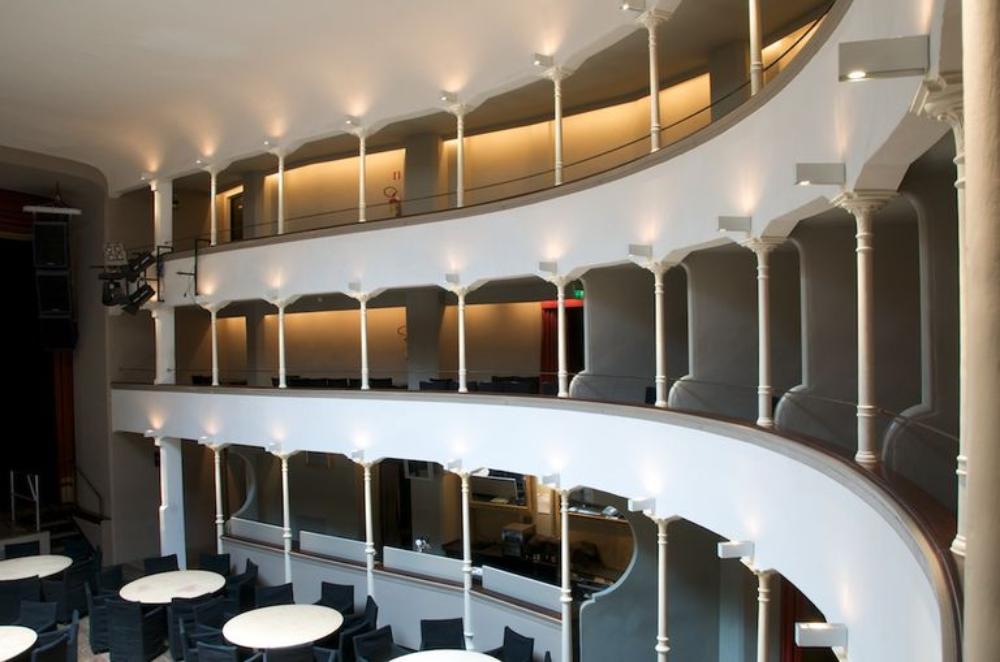


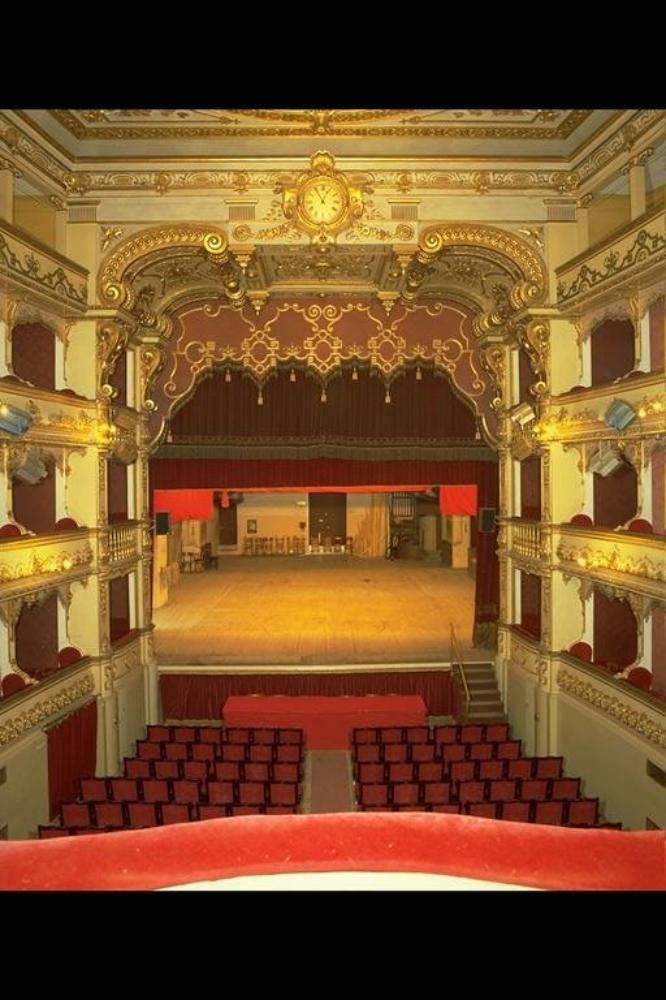


In Fidenza, before the 18th century, rooms for theatrical performances were set up only on special occasions – such as for the carnival of 1597 in Palazzo Zuccheri or in 1609 in a room of the Farnese Fortress. But around the early 1700s, at least two theaters must have been established: “one of modest size and built largely of wood, located near the old [bishopric] seminary for the use of local amateur dramatists and humble buffoon companies” (Allodi 1969, p.217), the other next to the San Giorgio hospital, near the Cathedral and belonging to the ducal family. While the first vanished over time, the small ducal theater retained some fame in the city’s historical memories. It was already out of use in 1725 because the elders requested permission from the duke for “instruction and entertainment of the youth,” to use the old theater that had been converted into a “stable and hayloft” (Aimi-Copelli 1982, p. 194). The theater continued to be used, though, because two years later, for the wedding of Antonio Farnese with Enrichetta d’Este, “masked balls, Berber races, horse games in the theater, and dances in the court” were held (Aimi-Copelli 1982, p. 195). From then on, thanks to the duchess’s interest, the small theater enjoyed a long period of fortune that soon required restorations. In 1737 the carpenter Francesco Negri was called to redo the stage and boxes, while master Ippolito Pinozzi renovated the walls and floors. But even in the Fortress, the ducal family residence, court performances with ephemeral sets continued throughout the 18th century and beyond; for example, in honor of Carlo Goldoni in 1725, “the small court of the former duchess staged one of his plays in the Fortress” (Aimi-Copelli 1982, p. 227). Two years later, a record mentioned the grant “for service to Enrichetta d’Este” of a pension awarded on merit to Pietro Zani “as an actor in her private theater” (Aimi-Copelli 1982, p. 232), once again attesting to the long and uninterrupted activity of the ducal theater. In the 1791 notes, the Council of Elders, highlighting the very serious condition of the now century-old building, also provided a rare description of the interior of the small theater: “the old timbers supporting the two-story gallery […] had to be replaced” (Aimi-Copelli 1982, p. 235). It was then decided to build a new theater, and after purchasing the Granelli house (formerly the San Giorgio Hospital), master builder Angelo Rasori from Parma was commissioned to design it. However, the work seems to have been abandoned because about ten years later, the council received a request for an expert assessment of improvements to be made to the ducal small theater, and a group of young people wanted to rent it for a while. In 1812, twenty-eight citizens united in a society, represented by sub-prefect Giacomo Locard, decided instead to buy another plot to build the new theater. The choice fell deliberately on the area occupied by the Church of San Francesco, in today’s Piazza Verdi. After the Napoleonic suppressions, the square with the church and the adjacent San Giovanni convent had completely lost their urban role as a religious hub. “The only area elevated compared to the rest of the city [the square] had in the past considerable importance and was perhaps one of the pivots of the oldest nucleus and later the center of the medieval city” (Ferrari, Jemmi, Pedrelli, Ponzi, p. 47). The church was thus demolished and the building framework erected based on the design by Nicola Bettoli, architect of the ducal theater of Parma. Again, work was suspended due to lack of funds, and in 1831, the society proposed handing over the property to the Municipality, but met opposition from Maria Luigia, who believed that the local administration alone would have to bear an excessively heavy financial burden. Complicating matters, in 1835, a tornado destroyed the roof, compromising the stability of the shell. In 1848, the Municipality finally obtained ownership of the theater, which was on the verge of collapse, but construction didn’t resume for six more years. For the construction management, in 1854 the municipal engineer Antonio Armarotti was called, who had to try to adhere, with some cost savings, to Bettoli’s original design. For the masonry, material from the Church of San Giovanni, which had collapsed suddenly in those months, was used. The renowned set designer Girolamo Magnani, a native of Fidenza, closely followed the progress of the work, giving valuable advice to architect Armarotti. “Relying on the help of his best students, such as Giuseppe Giacopelli […] and Francesco Spada, Magnani completed the decorative cycle of Fidenza’s theater: very simple in the Atrium with faux marble panels and grilled lunettes, with two allegorical figures, Music and Poetry, anticipating those of the halls for which preparatory sketches have survived” (p.47). Magnani also decorated the “jewel box foyer, where amid the delight of flowers, the Apollonian play multiplies in the large gilded wooden mirrors specially brought from the ducal court of Parma.” For the ceiling decoration of the stalls, Magnani modeled golden stuccos, precious like clock mechanisms. Behind them, he painted the sky with allegorical figures, creating an effective final effect of openness, in harmony with an ancient and festive 16th-century Po Valley tradition. The rich yet balanced use of gilding gives the entire hall a somewhat French-influenced aura. Magnani also designed and painted the scenes for the performance of Il Trovatore on the occasion of the theater’s inauguration on October 26, 1861. The stalls plan is horseshoe-shaped with three tiers of boxes and a gallery. Each tier is divided into eighteen boxes. There are also three boxes per side in the proscenium and above the entrance a large royal box. The stage (rebuilt in reinforced concrete in 1953) has a large backstage area and ten dressing rooms. There is also a hall with a musicians’ gallery. Some stage machinery and five precious chandeliers from the Parma court, like the mirrors in the foyer, are still preserved. The facade is porticoed with five openings topped by medallions. Above the central window is a decorated pediment and the coat of arms of Fidenza. Between 1870 and 1871, a ballroom with a balustrade for carnival balls was built above the stage, and seven years later the theater became home to a theatrical music school. Upon Girolamo Magnani’s death (1889), the Municipality decided to dedicate the theater to his memory. Alongside occasional maintenance work, an important restoration of the tapestries, gilding, stuccoes, and the velarium took place in 1932-1933. Since 1910, the theater has been fully lit electrically and since 1964 boasts a modern heating system. Recently, the facade has been restored. In 1988 the theater was reopened after a three-year closure required to upgrade the main structures of the building to safety standards, but the seating and boxes furnishings have not yet been replaced with suitable materials. The theater is active, hosting seasons of drama, opera, and symphonic music. Occasionally, dialect plays and shows for children are performed. Though not systematically, the Magnani Theater has hosted in the foyer spaces on special occasions such as the Gran Fiera of Borgo San Donnino in October and the ‘Giostra di maggio’ Theater Festival, exhibitions of contemporary art or photography. A small group of paintings by the artist Oreste Emanuelli is still displayed in the theater café; shortly before his death in 1977, he donated over 1,300 paintings to the Municipality of Fidenza, most preserved at the Leoni Civic Library. (Caterina Spada – Lidia Bortolotti)
Information about Girolamo Magnani Theater
Piazza Verdi,
43036 Fidenza (Parma)
Source: MIBACT