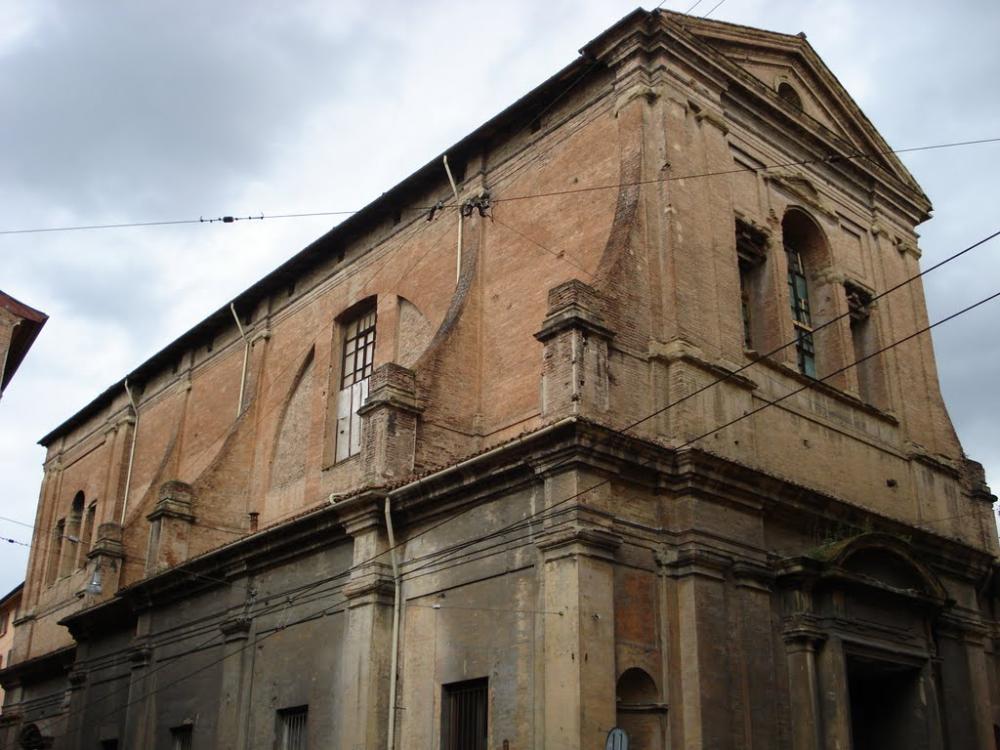


Following the Napoleonic suppressions, the palace passed into private ownership. Only in 1873 did it become the seat of the current college, previously located in Via de’ Chiari and known as the College of Nobles, directed by the Barnabite fathers since 1773, the year these religious took over from the suppressed order of the Jesuits.
It is quite likely that the room currently used as the Alessandro Guardassoni Theater was originally a private residence’s elegant ballroom and reception hall, where the balcony was used to host the orchestra. However, it should be recalled that Ricci mentions a “small theater built at Collegio Montalto,” where an opera was performed during the 1709 carnival, without further details.
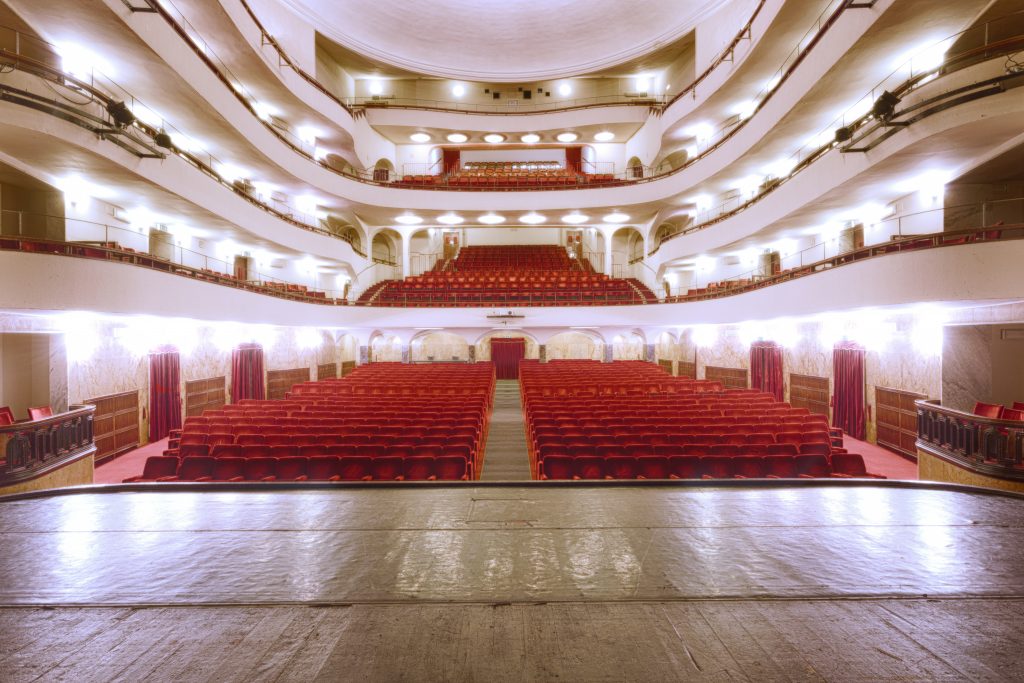
The need for a suitable space to practice what can be defined as the gymnastics of the spirit led the Barnabite fathers to entrust architect Francesco Gualandi with the design of a true theater, to be adapted within the reception hall of the new location. The work was completed on February 15, 1879. The theater has a rectangular plan with a continuous balcony supported by volute brackets running along three sides. On the short side opposite the stage, it takes the form of a loggia (which encloses the gallery now no longer accessible) characterized by slender columns supporting five full-arched openings.
The small stage, equipped with the original rigging, suffices for the college’s needs, which uses this space for educational support activities, conferences, performances, theater workshops, and occasionally for charity shows. The eclectic decoration, made up of stucco elements and painted decorations, is very rich and elegant, especially on the ceiling, where three oval medallions with flower bouquets stand out and in the center the allegory of Fame, a work by Gardassoni who, together with Guglielmo Minelli, authored the painted sections.
Also the creator of the historic curtain (in a precarious state of preservation), depicting the meeting of Dante with Virgil, and the two young figures flanking the College emblem (placed at the center of the band above the stage), Alessandro Guardassoni, to whom the theater is dedicated, was an artist of undeniable importance in 19th-century Bologna. Lastly, the Venetian-style floor is the work of Costantino Diana, and the walnut painted doors are by Antonio Sacchetti. (Lidia Bortolotti)