


In the collective imagination, the Venice Carnival is often associated with the splendor and transgressions of the 17th and 18th centuries, aided by the famous paintings of Francesco Guardi and Pietro Longhi, as well as the theatrical works of Carlo Goldoni and the writings of Giacomo Casanova. In reality, the 17th-18th centuries are just one moment in the long and complex history of the Venice Carnival, which today is perhaps the most famous and spectacular festival of the lagoon city, turning 1600 years old in 2022.
Ritual of the Serenissima
First appearing at the end of the 11th century, the Venetian Carnival quickly became one of the key episodes of an important ritual aimed at celebrating the political and economic success of the Serenissima; its celebratory and festive dimension was refined over time until it became, in the 18th century, the quintessential symbol of urban carnivals throughout Europe. Across the centuries, no one remained immune to the changing charm and mystery of the millenary Venetian Carnival, especially not Professor Gilles Bertrand, a professor of modern history at the University of Grenoble Alpes, and one of the foremost experts on the history of the Venice Carnival.
Although the etymology, the Latin “carnem levare” meaning “to remove meat“, is of Christian origin, the roots of the carnival tradition date back to an even more ancient time when the passage from winter to spring was celebrated. Already the Dionysian cults in Ancient Greece and the Saturnalia in Roman times indicated a period of the year when it was permitted to overturn the rigid social order.

First records
The first record of Carnival in Venice is a document from Doge Vitale Falier dated 1094, which mentions public amusements, while in 1296 the day before Lent officially became, thanks to a decree by the Senate of the Serenissima Republic, a public festival. However, documents are not very numerous during the Middle Ages, and it seems that the Venice Carnival resembled that of other Mediterranean European cities, at least until the 13th century. At that time, the festival lasted six weeks, from December 26 to Ash Wednesday, although celebrations sometimes started as early as the first days of October.
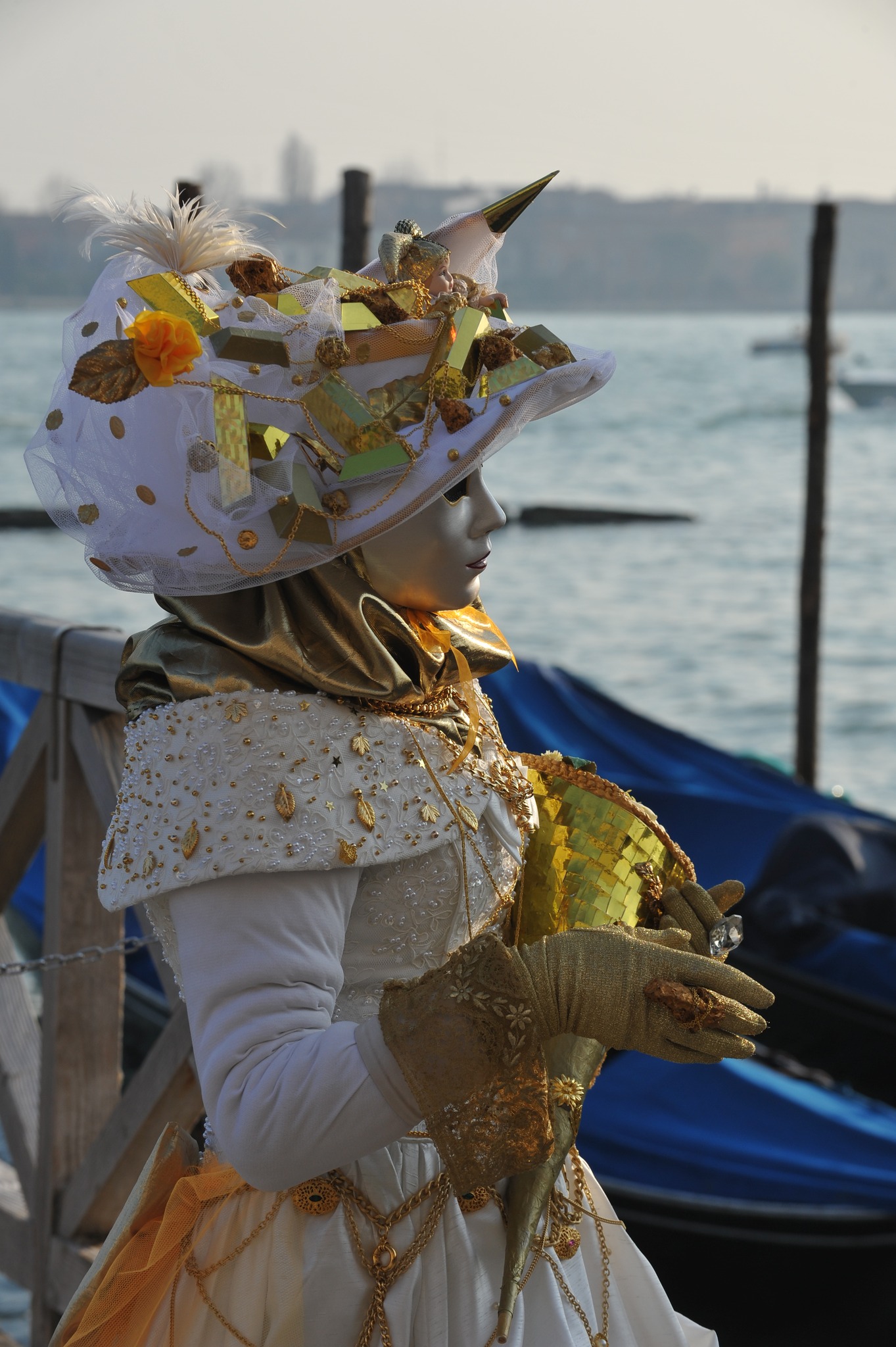
The Venice Carnival among the neighborhoods
It is only from the 14th century that a properly Venetian Carnival began to be developed, embedded in a clearly political and economic context. “Besides the religious aspect,” explains Professor Bertrand, “Carnival served at least two other functions. One of these was political: since medieval times, Carnival was used to reinforce the aggregation and cohesion of the population of the neighborhoods, by invoking the memory of historical or legendary events aimed at recalling the successes and the progressive extension of the Republic’s domain. But there was also, at a certain point, an economic survival dimension linked to the ability to present itself as a luxurious and attractive city to which people from all over Europe flocked. This third function, it could be said, extended from the beginning of the modern era, that is from the mid-16th century, the time of Titian and Veronese, until the end of the Republic in 1797. This meaning began to gain prominence as Venice’s economic and diplomatic prestige, at its peak in the 14th and 15th centuries, weakened. Venice then sought to maintain itself as a prestigious, wealthy, and splendid capital in the eyes of monarchs, aristocrats, merchants, and artists from all over Europe.”
Entertainment for all social classes
The Venice Carnival is a time of entertainment for all social classes, both for the common people and the nobility, although certain distinctions remained in place. “Everyone had fun,” recounts Professor Bertrand, “and for certain carnival spectacles, such as regattas, bull hunts, or the Fat Thursday festival, the people and nobles could come together. Everyone could mingle in Campo Santo Stefano or St. Mark’s Square. But overall, a real divide prevailed even on those occasions. With the practice of the liston, the nobles displayed themselves before everyone, emphasizing their difference from the common people. Even disguising in bauta masks did not equalize conditions, as the quality of lace or the way the tricorn hat was worn were clear signs of status. The common people in the modern era, and perhaps even more so in the 19th century, enjoyed Carnival as a time for culinary pleasures, while the fear of crowds drove nobles to retreat to their villas outside Venice to escape the noise.”
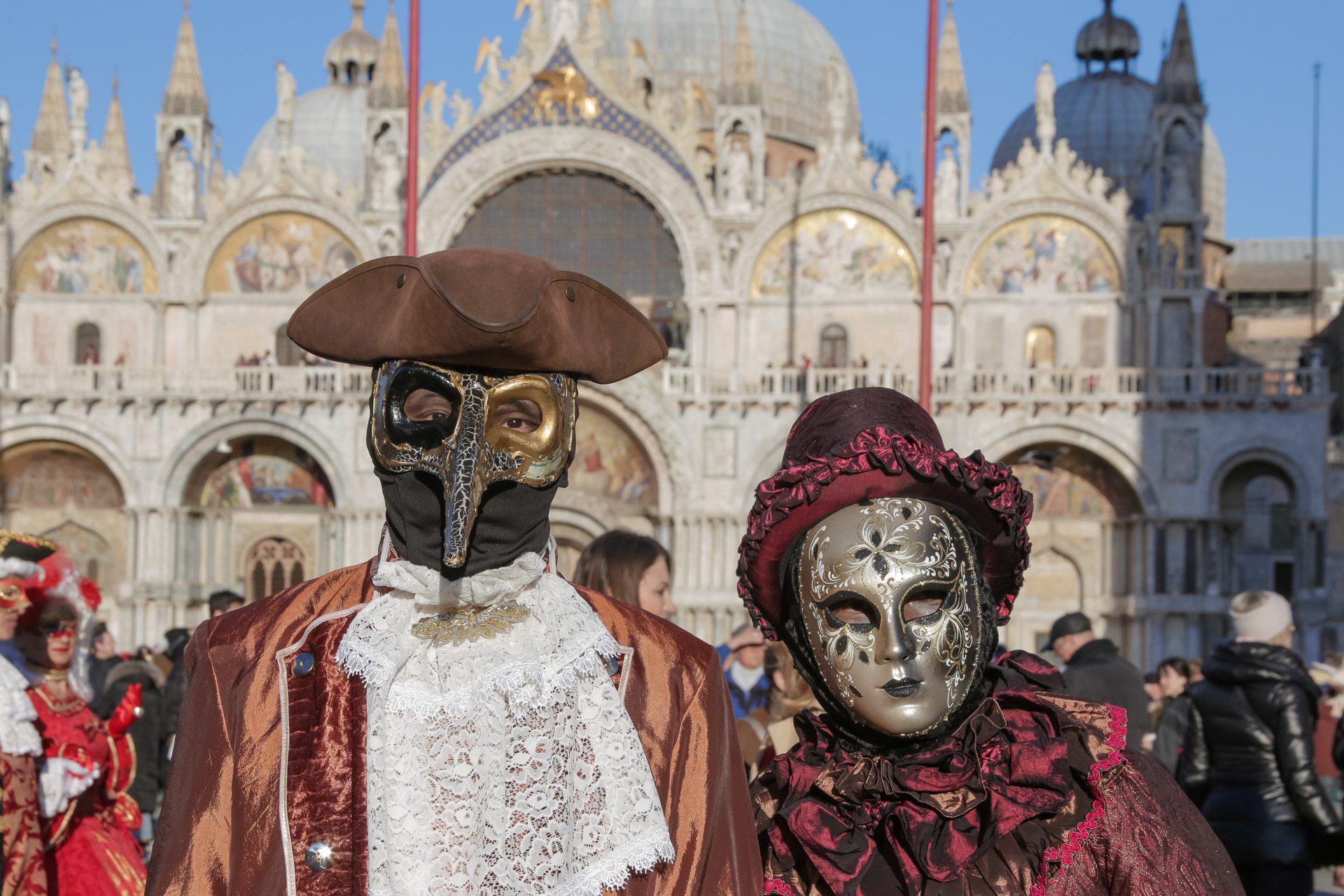
Transformations of the Venice Carnival over the centuries
Carnival celebrations in Venice underwent profound transformations over the centuries, encompassing countless events, some more refined, others more popular. “Certain games, rituals, and celebrations popular among the people during the Middle Ages gradually disappeared because they were considered too violent. First, by the mid-16th century a more refined Carnival was established in its costumes and way of dressing up, more controlled by the government, with private parties on one side, separated from the popular ones, and collective celebrations on the other, meant to dazzle Venetians and foreigners alike, emphasizing the virtues and magnificence of the setting, particularly St. Mark’s Square and the Grand Canal. Second, the military and protective aspect against hostile natural elements had given rise to acrobatic exercises or fights among groups of young men or with animals: the government tried to maintain these to please the people, but they were gradually discontinued.”

Some Venice Carnival spectacles disappear
Among the events that disappeared were the fist fight between Castellani and Nicolotti, abolished in 1705, the bull hunts (1802), and in 1816, the popular spectacle of the Forces of Hercules with human pyramids in Piazzetta San Marco. Unfortunately, with the fall of the Serenissima and the French and Austrian occupation of 1797, the very long tradition of the Venice Carnival was interrupted for fear of rebellion and popular disorder. “The need for Venice to appear beautiful in the eyes of all Europe disappeared,” says Professor Bertrand, “and to use Carnival as a showcase to proclaim that it remained independent, wealthy and splendid as in the times when it dominated the Mediterranean, in the 14th and 15th centuries. Also, the French arrived with a suspicion typical of revolutionary times against masks and disguises; then followed the Austrians’ wish to reorganize this ancient capital as a simple provincial center. Few theaters, few pleasures: Carnival first disappeared, then after the Napoleonic era, and under the second Austrian domination, its manifestations were limited to theater openings, some balls, regattas, and street masquerades, until its complete disappearance with Italian Unification. For decades Carnival mostly consisted of nostalgic parties in private palaces with artists’ involvement”. Only in the lagoon islands of Venice, such as Murano and Burano, celebrations continued with vigor and joy.

The Venice Carnival today
Festa delle Marie and the Flight of the Angel
The revival of this millenary tradition came almost two centuries later, in 1979, initiated by the Municipality of Venice and some city associations. Masks, costumes, parades, dances: the Venice Carnival, now celebrated every year in the ten days before Lent, largely draws inspiration from the baroque atmosphere of the 17th century, as well as from the splendor of the 18th century. Often marked and dedicated to an underlying theme, the new editions of Carnival have also been enriched with numerous events inspired by the history and traditions of the lagoon city, such as the Festa delle Marie and the Flight of the Angel.