


Dig, dig. There you go… good job… bring it here!” Their tails wagging, dogs push their truffle—yes, that’s what a dog’s nose is called—through layers of humus and fallen leaves, searching for the prized tuber. The most skilled can sniff out a truffle meadow even half a meter underground, under twenty centimeters of snow, or beneath a thin layer of ice.
Truffle Dogs
With surprising speed, these dogs dig holes deeper than themselves to gently retrieve their aromatic “prey” and dash back for a treat. If the truffle is too large or the dog can’t quite reach it without risk of breaking it, the truffle hunter steps in, extracting it with a special pick designed to avoid damaging tree roots.
What may seem like a charming woodland stroll is actually the result of years of hard work between truffle hunters and their dogs.
Everything begins with the tough training of the dog. To sharpen their sense of smell and teach them not to damage the truffle, training must start early and requires plenty of patience. If all goes well, man’s best friend becomes a valuable business partner—and earns plenty of treats for each truffle found.
Training starts when the dog is still a puppy, using artificial truffles or even tiny chunks of parmesan, with their intense smell, instead of a ball. Later, to get them used to the real thing, actual truffles (less prized varieties) are thrown for them to retrieve. Each time the dog brings one back, it gets a well-earned treat. Bit by bit, the dog learns not to eat or break the truffles but to deliver them—intact—to its owner.
A well-trained truffle dog, at three or four years old, can be worth more than three thousand euros, thanks to the abundance of truffles they can uncover, translating into significant profits. Most truffle hunters train their own dogs; otherwise, you’d turn to specialized breeders. The selection is made in the field—or rather, the woods. The breeder brings a group of dogs, lets them loose, and whichever finds the most truffles often wins a new owner.
Generally, breeders prefer mongrels to purebreds, as their noses are more sensitive. Some claim that puppies born from already-trained truffle dogs are especially skilled. There’s also the Lagotto Romagnolo, a breed not yet officially registered but considered especially talented for truffle hunting.
How Much Does a Truffle Cost?
So, is truffle hunting lucrative? Domenico Azzaro, a hunter who knows the local beech woods by heart, explains: “It all depends on the season, the quality, the size of the truffle, and market demand. For example, white truffles (most prized) and uncinato are found from October to December, bianchetto from January to April, and estivum from May to November.
Retail prices start at €15 per 100g for Masentericum Uncinatum, an accessible black truffle with high phenic acid content. To be sold, it undergoes a chemical process kept secret by the industry. But white truffles easily reach €200 per 100g—the going rate for the acclaimed White truffle of Alba while we write this article.
Truffle hunting can be lucrative but is governed by specific laws. There’s a mandatory test to obtain a license. Additionally, you’re limited to two dogs at a time, and night harvesting is prohibited. Weight limits, for now, don’t exist. So if you find a productive white truffle spot and your dog performs, you could literally be digging up gold.
Every year in Alba—the truffle capital—a major fair takes place throughout October, ending on November 10 with the award for the best truffle. Another can’t-miss event is the extraordinary World Truffle Auction, also on November 10, in Grinzane Cavour Castle.
This is when connoisseurs from around the globe compete to buy the finest truffles from Alba, as well as Norcia, Spoleto, Acqualagna and other secret locations kept by hunters.
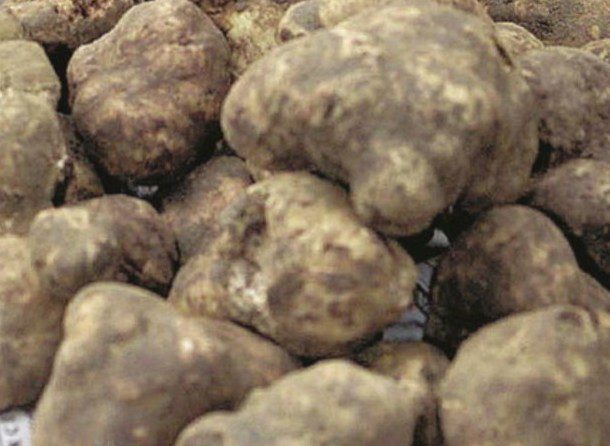
For the rest of us, the tuber magnatum, or truffle, grows between zero and seventeen hundred meters in altitude, thriving in the mycorrhizae at the roots of oaks, beeches, and Turkey oaks, in calcareous soil. They await those who find them.
Good to know…
To enjoy fresh truffle, clean it gently with a brush and rinse under running water. Slice it thinly and eat raw over simple dishes—like pan-fried eggs or butter and sage risotto—so the fragrance stands out.
To preserve truffle for a few days, wrap it in a cotton cloth and store it in the fridge at 2°C, or place it in a jar filled with rice (which will absorb the moisture and can be cooked later). This prevents mold from forming.