

Il nome Provence derives from it having been a Roman province. Indeed, the current French regions of Languedoc-Roussillon and Provence-Alpes-Cote d’Azur formed in Roman times the province of Gallia Transalpina or Gallia Narbonensis, named after its capital Narbonne. The territory was annexed in 121 BC after the military victories of the consuls Quintus Fabius Maximus and Gnaeus Domitius Ahenobarbus over the local populations of the Allobroges and the Arverni. In 58 BC, the beginning of a migration of the Helvetii towards Gaul gave Julius Caesar the pretext to intervene militarily in the region. The exploits of Caesar, narrated in the De Bello Gallico, lasted until 50 BC and definitively established the Roman conquest of all Gaul.
The Gallia Narbonensis has always played a crucial role in the development of the Roman Empire: its annexation guaranteed the protection of land communications with Spain, conquered about a century earlier after the Second Punic War, and, at the same time, protected Italy from Gallic incursions. The ports of Narbonne and Marseille were strategic for trade in the Mediterranean, and the Rhône River, which runs through the entire province, was the preferred route to transport metals coming from the Rhineland and the rest of Gaul.

Going in search of the Roman remains of the South of France offers the opportunity to discover archaeological sites of great artistic value, often able, because of their grandeur, to inspire amazement and emotion. Here is a road and motorcycle itinerary in 10 stages.
1 The Trophy of Augustus in La Turbie
Arriving in France by car from Liguria, near the Principality of Monaco, the view is captured by the remains of an imposing monument: it is the Trophy dedicated to Augustus for his victories over the Alpine tribes. The monument, built in 6 BC, rests on a square pedestal 38 meters on each side, on the front of which is the inscription listing the 46 Alpine tribes defeated by the emperor. On the sides are carved the typical symbols of triumph: enemy weapons hung on a tree and the defeated Gauls in chains. Above the pedestal stands a majestic colonnade that gives the Trophy an overall height of about 35 meters.
Located on the border between Italy and Gaul, the monument represented the power and unity of the Roman Empire. It was part of a larger complex dedicated to Hercules Monoikos, with whom Augustus was associated, and from which the Principality of Monaco took its name.

2 Frejus
The town of Frejus is located on the site of the Roman city of Forum Iulii. The name reveals its commercial vocation (also favored by its position at the crossroads between the via Iulia Augusta and the via Domitia) and its founding by Julius Caesar. It was the only military port of the Roman fleet of Gallia Narbonensis. During the reign of Emperor Tiberius (14-37 AD) its main public works were built. The most impressive is the amphitheater, capable of hosting about 12,000 spectators. Although it was extensively rebuilt after being submerged due to the break of the Malpasset dam in 1959, the original structural part of the stands can still be admired.
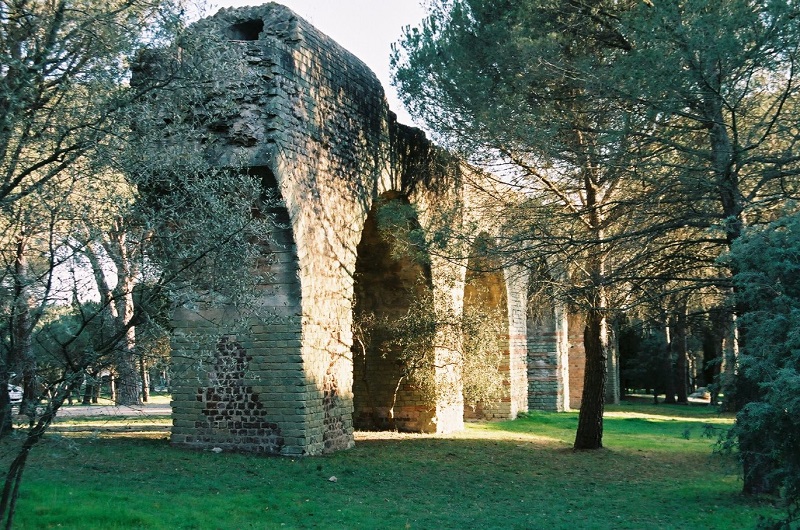
Some sections of the aqueduct, the walls, and the harbor lighthouse (known as Lanterne Auguste) are also visible. Finally, the columns of the cathedral’s baptistery, dating back to the 5th century AD, were reused from a previous Roman-era construction.
3 Marseille
Massalia (devenue ensuite Massilia) était une colonie grecque. Marseille a été alliée de Rome dès l’époque de Tarquin le Ancien et en a tiré de grands avantages pour ses commerces en Méditerranée, au détriment des Carthaginois et des Étrusques. À l’époque romaine, c’était une civitas libre, c’est-à-dire une ville indépendante du gouverneur provincial, mais néanmoins soumise à Rome. Pour s’être alignée avec Pompée lors du premier triumvirat, elle fut assiégée et reconquise par César : elle conserva son statut juridique, mais perdit la flotte et toutes ses possessions en Gaule qui furent transférées à la voisine Arelate (Arles).
Le Musée d’Histoire de Marseille expose une sélection de vestiges archéologiques de l’époque grecque et romaine et présente des reconstitutions 3D de l’urbanisme antique. La zone archéologique adjacente de la Bourse fait également partie du parcours muséal, où l’on peut voir certaines structures du port et des murailles grecques.
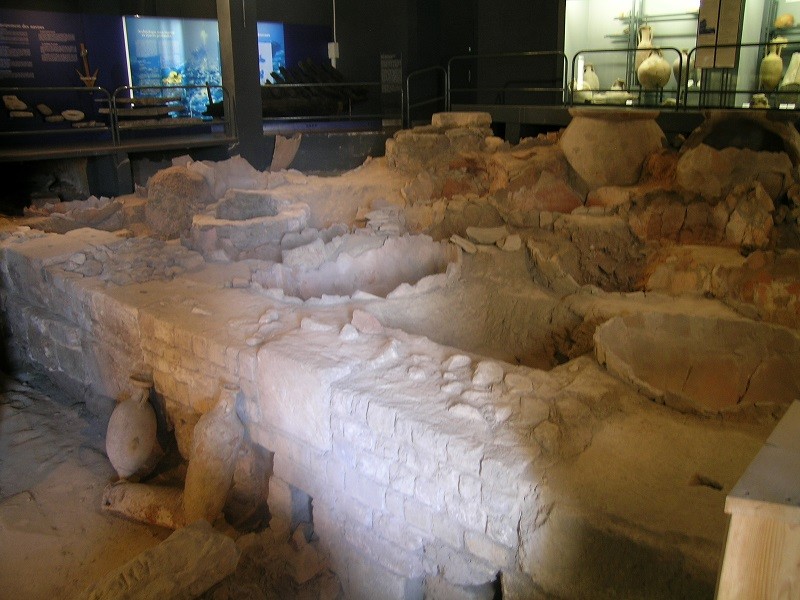
Le Musée des Docks Romains, quant à lui, conserve certaines structures liées au port romain. Il s’agit de silos en pierre et de grandes jarres en céramique enterrées qui servaient de chambres frigorifiques.
4 Arles
The Roman Arelate (today Arles) preserves numerous remains that, together with the Romanesque monuments, have been included in the list of UNESCO World Heritage Sites. The two entertainment buildings, the amphitheater and the theater, are particularly spectacular. The first, built in the 1st century AD, could hold about 21,000 spectators, divided into four tiers of seats, depending on their social class. From the theater, built in the 1st century BC, comes the famous statue of Venus of Arles, now kept at the Louvre, and many valuable architectural fragments visible on site. Both buildings were fortified in the medieval period, and most of the stones from the stands were reused for subsequent constructions. In fact, houses were built inside them that completely altered their appearance and function. Only from the early 19th century did a process of restoration and preservation begin that has returned them to their original appearance.
The only currently visible external part of the Roman forum consists of two columns and part of the pediment of a temple in the Place du Forum. In reality, the forum of Arles was built on a slope; therefore, to level the paving, it was necessary to build a cryptoporticus, a series of underground corridors that served as supports. This environment, particularly fascinating, is today accessible from the Jesuit chapel. Inside it are also notable Roman architectural pieces, probably extracted in the medieval period from other monuments and stored there.
Arles was a city dear to Emperor Constantine, who established a residence there and who in 314, shortly after the recognition of the Christian religion, convened the first council there. The Constantinian era dates back to an important thermal building, partially incorporated into the surrounding houses, an early Christian basilica, and the necropolis of Les Alyscamps, which received the burials of Saints Trophimus and Genesius.

5 Saint-Rémy-de-Provence
Near the town of Saint-Rémy-de-Provence are the remains of the Roman city of Glanum. Originally founded by the Greeks from nearby Marseille, it prospered in the republican era and became a Roman colony under Augustus. It is possible to visit a large part of the ancient city, including public buildings, houses, and the thermal spring district, considered sacred and therefore monumentalized and accompanied by the temples of Valetudo, Roman goddess of health, and Hercules, as well as numerous votive altars.
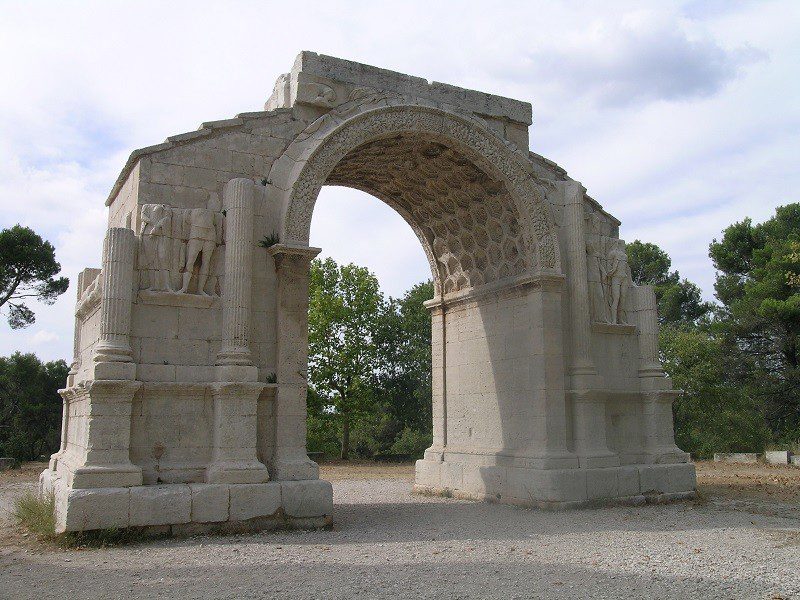
About 200 meters from the archaeological area stand two other remarkable monuments. The first is a perfectly preserved mausoleum from the Augustan age, whose inscription tells us it was dedicated by the brothers Sextus, Marcus, and Lucius of the gens Iulia to their parents. Next to it are the remains of a triumphal arch which, like the monument of La Turbie, celebrated Augustus’ victory over the Gauls.
6 Nîmes
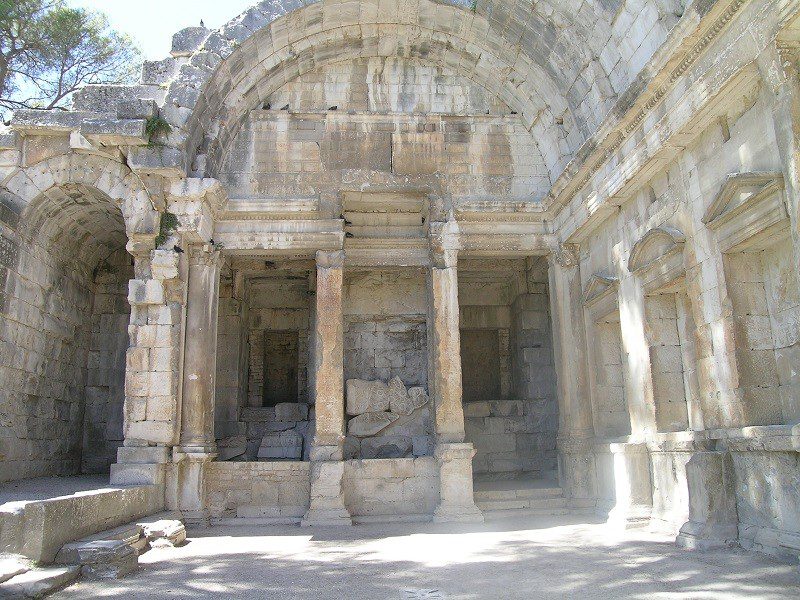
L’ancienne Nemausus était l’une des plus grandes villes de la Gaule. Encore aujourd’hui, elle est riche en monuments romains, au point de lui valoir le surnom de « Rome française ». Au centre de la ville se trouve le puissant amphithéâtre, dont l’histoire est très similaire à celle de l’amphithéâtre d’Arles. En excellent état de conservation se trouve la Maison Carrée, temple romain du Ier siècle après J.-C., unique vestige restant du forum de la ville. Le temple était dédié à Caius et Lucius César, petits-fils d’Auguste et désignés par l’empereur comme ses héritiers, mais tous deux décédés en jeune âge. Le monument est très bien conservé car il a été réutilisé au cours des siècles comme église catholique. Dans le parc public des Jardins de la Fontaine, il est possible de voir les restes du soi-disant temple de Diane, dont la plan basilicale suggère plus probablement une fonction civile (une bibliothèque a été supposée).
De l’enceinte murale originelle, longue d’environ 6 kilomètres, il ne reste que la massive Tour Magne, la Porte d’Arles (ou Porte d’Auguste) et un arc de la Porte de France, encastré entre deux habitations. Un peu en dehors du centre se trouve le Castellum aquae, infrastructure de la partie finale de l’aqueduc local, célèbre pour le Pont du Gard.
7 The Pont du Gard
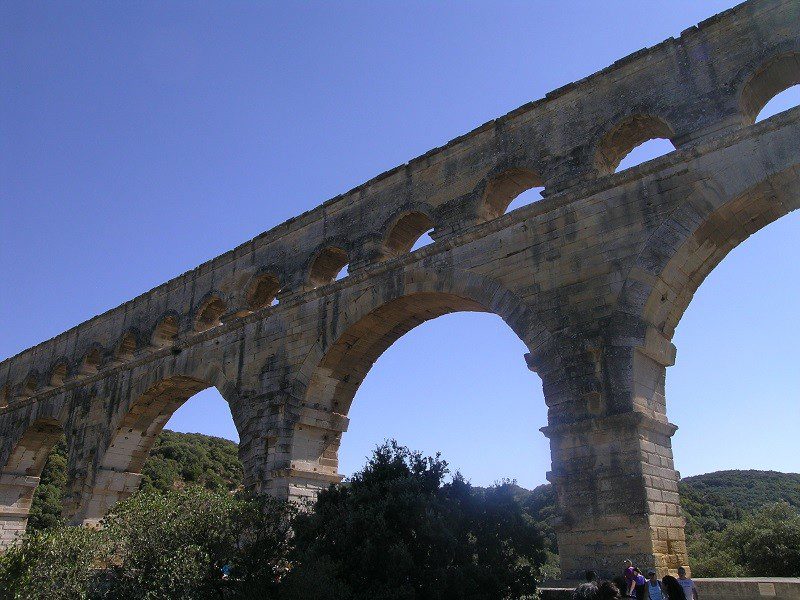
About 30 kilometers from Nimes stands the imposing Pont du Gard, a UNESCO World Heritage monument. The structure was part of the aqueduct that brought water from the Uzés spring to Nimes and allowed the crossing of the Gardon river. Built in the 1st century AD, it is 275 meters long and 49 meters high and has three levels of arches: the first was passable by vehicles, while the water flowed on the third.
The Nimes aqueduct as a whole is an extraordinary feat of engineering. It is 50 kilometers long, with a slope of 34 centimeters per kilometer, for a total height difference of only 17 meters. To make the water flow more smoothly, the aqueduct conduit was coated with a mixture of pork fat, olive oil, and fig juice. The Pont du Gard site, in open countryside with a calm and swimmable river, is also very suitable for a pleasant day trip.
8 Orange
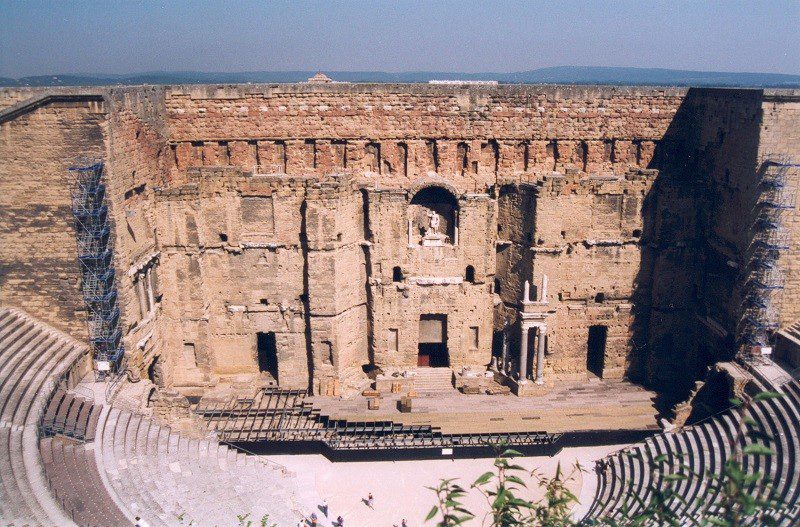
The Roman settlement of Arausium, today Orange, is especially known for the beautiful theatre from the Augustan era. Not only is it of considerable size (it could hold about 9,000 spectators), but above all it is one of the very few in the world to preserve in its entirety the impressive stage wall, 103 meters long and 37 meters high. The wall, which ensured the building’s acoustic quality, was originally covered with colored marbles and was divided into three tiers, decorated with niches, columns and statues. The doors of the lower tier served as entrances for the actors on stage. Above the main door, intended for the protagonists’ entrance, there was a frieze depicting Centaurs, now kept in the local archaeological museum. The central niche of the second tier houses a grand statue of Augustus with the attributes of the victor; this statue probably replaced a previous one of Apollo, protector of the arts, to remind the audience of the value of the pax romana. On the sides of the stage, two towers were used to store stage equipment.
The other great monument of Orange is the triumphal arch. Located at the entrance to the city for those arriving from the road that connected Lyon with Orange, it is the oldest known three-arched arch. It was erected in 20-25 AD to celebrate the victories of Germanicus and the legio II Gallica, whose veterans founded Arausium, and later rededicated to Tiberius in 27 AD. The Roman monuments of Orange, due to their historical and artistic value, are included in the UNESCO World Heritage list.
9 Vaison-la-Romaine
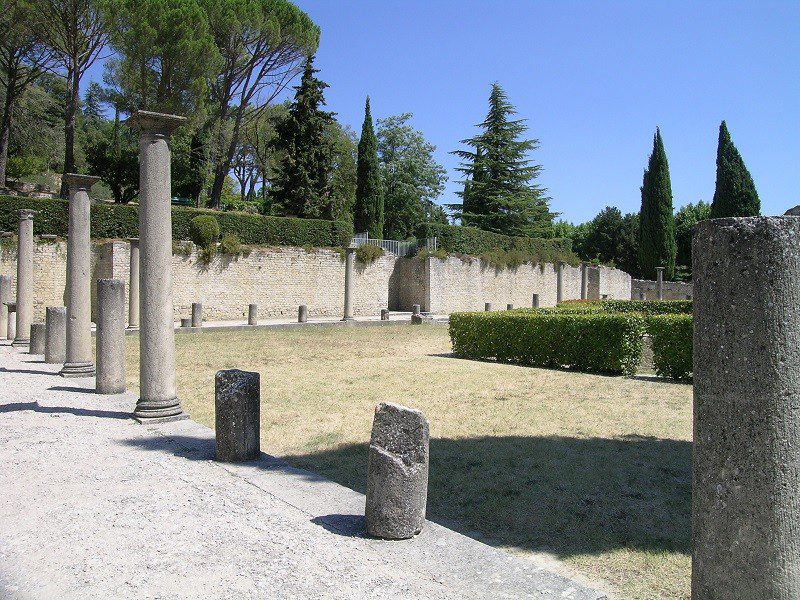
Vaison-la-Romaine was originally one of the main cities of the Vocontii tribe, who maintained relative independence even during Roman rule, when the city took the name Vasio Julia Vocontiorum. The Roman city is located along the left bank of the Ouvèze River, while the medieval city developed on the hill on the right bank, as it was more easily defensible. The river is crossed by a lovely Roman bridge from the 1st century AD.
The Roman remains are found in two adjacent areas within the current town, Puymin and La Villasse. The Puymin site is characterized by several large villas, whose mosaic decorations can still be appreciated today. Among these stand out the House of Apollo crowned with laurels and the House of the Pergola, which developed over the years from a modest rural house to reach an area of 3,000 square meters. In the same area is the theater, whose cavea has been completely rebuilt, but whose internal galleries preserve the original atmosphere, and a small antiquarium, with a significant selection of artifacts from the city.
In La Villasse public areas prevail, such as shopping streets, baths, and fountains. The architectural and urban quality shows that it was a very wealthy center. In this area too are some sumptuous villas: the House of the Dolphin, which was also a farm, and the House of the Silver Bust, the largest in Vaison (5,000 square meters) with an attached thermal complex initially public and then integrated into the villa.
10 Vienne
Originally the capital of the Allobrogi tribe, Vienne was transformed by Caesar into a colony named Colonia Julia Viennensis. Following the late imperial administrative reorganization initiated by Diocletian, Vienne assumed a central role in the diocese that included Gallia Narbonensis and Aquitaine and was chosen as a residence by various emperors, including Constantine, Flavius Claudius Julian, and Valentinian II.
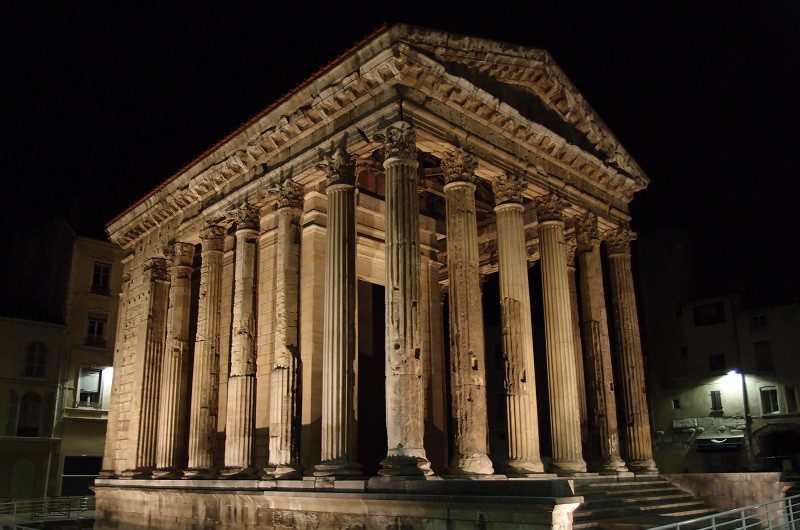
The city preserves significant monuments from the 1st century AD. The temple, as the inscription tells us, was dedicated to the goddess Roma, Augustus, and Livia, wife of Augustus, deified after her death. It is therefore a temple dedicated to the imperial cult, following the canons of Augustan political propaganda. The Garden of Cybele is an archaeological park where it is possible to admire the remains of the ancient forum area. The theater, which annually hosts the renowned Jazz à Vienne festival, stands near a smaller Odeon, as is the case in Lyon. The circus dates back to the late antique period, of which one of the obelisks placed at one of the circuit’s extremities remains. Due to its shape and being built with Assuan granite, this monument is known as La Pyramide. On the opposite bank of the Rhône River is the site of Saint-Romain-en-Gal, formerly a residential and artisan area of Vienne. The site also houses the interesting Gallo-Roman Museum.