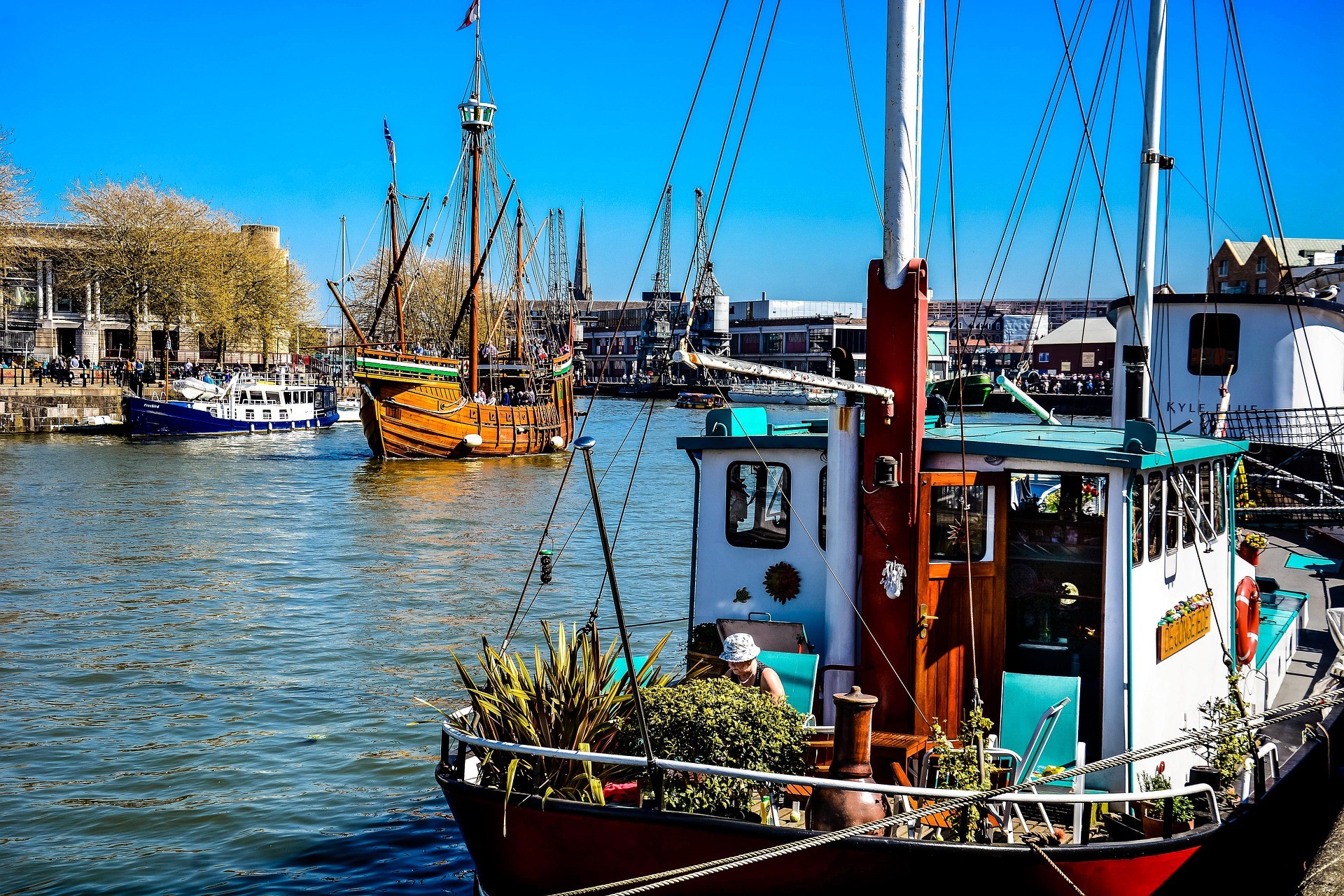

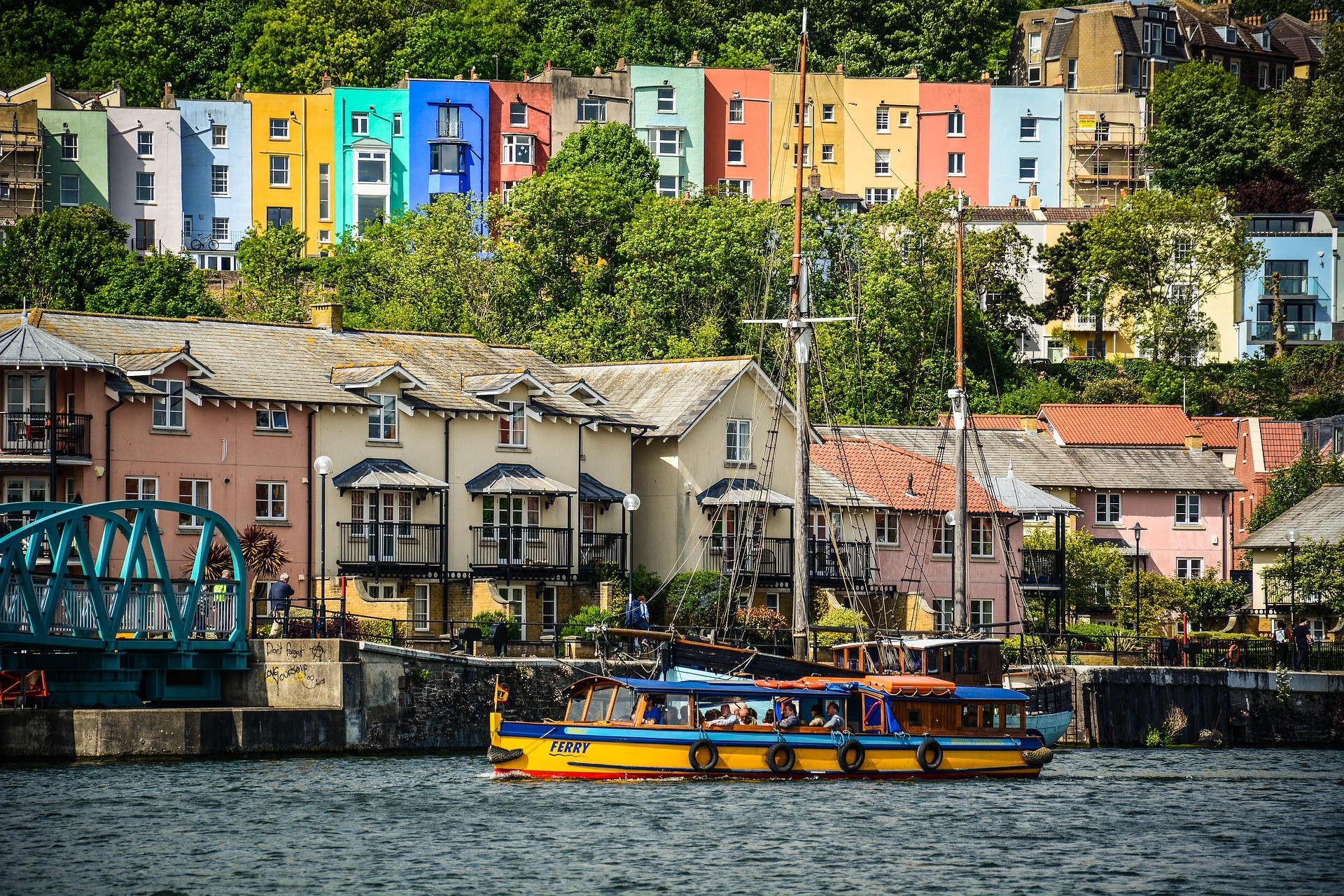
Bristol is the most important city in the South West of England. It overlooks the mouth of the Avon River, at a point where river and sea become one. Its port has been, over the centuries, the focal point of the city’s history and culture.
Bristol: Places of Interest in the English City
The Port of Bristol
In 1497, John Cabot set sail from the Port of Bristol towards the New World and, even though he thought he had reached the northeastern tip of Asia, he was the first to discover Canada, effectively marking the beginning of English colonial activities in North America. Henry VII, the promoter of Cabot’s expeditions, laid the foundations to transform Bristol into a monopolistic port, concentrating all the wealth derived from trade relations, unfortunately also from morally unacceptable ones, between England and the New World.
Initially, trade was mainly with Spain and its colonies. With the development of the English colonies in North America, starting from the 17th century, Bristol played a crucial role in the slave trade. The commerce operated through a triangular route: goods produced in England were sent to West Africa and exchanged for slaves. The slaves were transported and sold in North America; here the ships loaded plantation products (tobacco, sugar, and cotton) to take back to Bristol and restart the cycle.
From the early 20th century, migrants who are now an integral part of the population also arrived through the port. According to the latest demographic data, 16% of the population belongs to black or minority ethnic groups. Among these, the most represented are those of African and Jamaican origin. The union of the migrants’ musical culture with the English one created original “made in Bristol” genres that have spread worldwide.
Therefore, whether you want to visit Bristol in a traditional way or discover it through its underground culture, the port is always the main point of reference, real or symbolic.
Brunel’s Works
In Bristol, any tourist spot displays photographs or illustrations of the city’s two symbols: the ship Great Britain and the Clifton Suspension Bridge. Both are the work of Isambard Kingdom Brunel, the brilliant civil engineer best known for the first tunnel under the Thames.
The Great Britain, launched in 1845 and currently converted into a museum ship, dominates the port of Bristol. At 98 meters, it was the longest passenger ship in the world for nine years. It was intended for the transatlantic route Liverpool-New York which it typically covered in fourteen days. Brunel, who had already worked successfully in Bristol on the Great Western, decided to apply two technological innovations to this ship: the iron hull instead of the traditional wooden hull, and propeller propulsion instead of paddle wheels.
The study and application of these two solutions on such a large ship caused a delay of about 5 years compared to the planned launch date, compromising the financial viability of the project. Additionally, some costly repairs were needed due to navigation incidents. Therefore, the ship was sold the year after its launch and changed function, becoming an emigrant transport ship to Australia, coinciding with the gold discovery in the State of Victoria. After being fully converted into a sailing ship, it was used to transport coal and later as a storage and quarantine ship until it was deliberately sunk in 1937 near the Falkland Islands. In 1970, a herculean recovery and restoration effort began that now allows us to visit and discover it in all its parts in the same dry dock where it was built.

The Clifton Suspension Bridge connects Clifton, a suburb just outside Bristol, with Leigh Woods in North Somerset. If you follow the pedestrian and cycle path that, running along the river, leads from the port out of Bristol, when the landscape changes from urban to hilly, at a certain point the bridge will appear before you, pleasantly surprising with its 75 meters of height and 412 meters of length. The original project, as mentioned, is by Brunel but was reworked and completed in 1864, five years after his death, by William Henry Barlow and John Hawkshaw. Had Brunel’s design been followed exactly, we would now see ten sphinxes atop one of the towers, a very popular decoration of that era.

The Warehouses
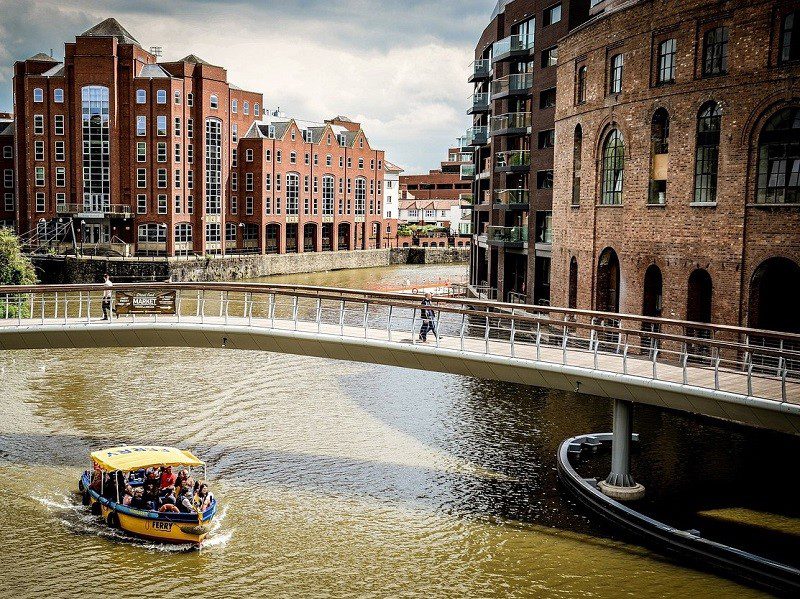
From Bristol’s thriving commercial activity remain the warehouses, the storage buildings for goods. Some have undergone transformations and, thanks to their new function, have helped preserve the port area from decay. The Bush House, dating from the mid-19th century, originally a tea warehouse, currently hosts the Arnolfini, an international art center with a rich program of exhibitions, performances, cinema, and conferences. The Watershed Media Centre, with its three cinemas and multimedia production center, occupies the E and W Shed on Canon’s Road. Architecturally, the Arnolfini was the first example of Bristol Byzantine style, a peculiar style of this city developed between 1850 and 1880, mainly used for warehouses and industrial buildings. It is characterized by Byzantine and Moorish influences, the use of arches, and stones of different colors, predominantly red, yellow, white, and black. Although many buildings in this style no longer exist, some remarkable examples remain both in the port area and other parts of the city, such as the Granary, the Robinson’s Warehouse, the building at 35 King Street, and the Clarks Wood Company Warehouse.
Bristol’s Music Scene
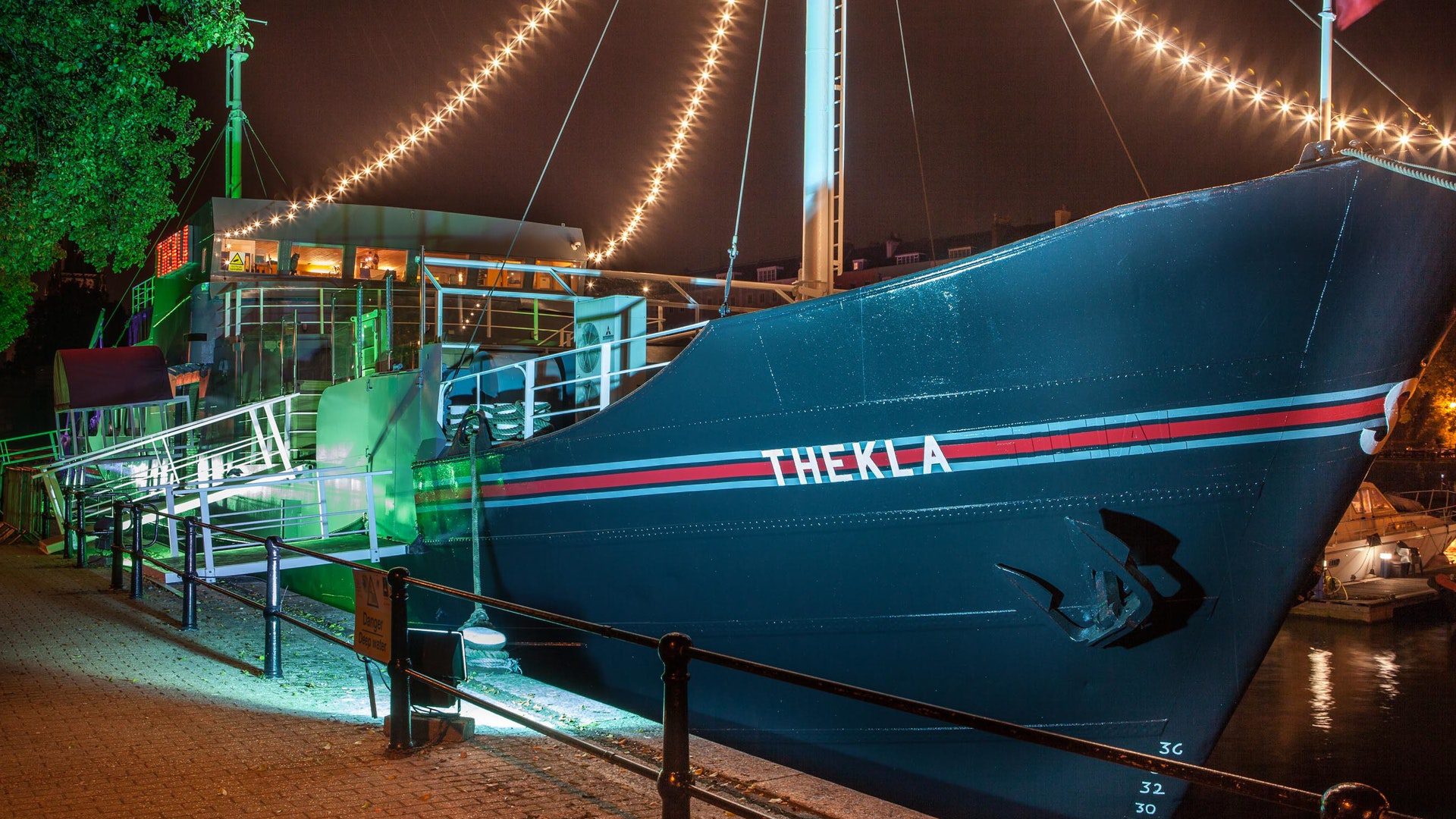
Bristol is a city with a lively music scene where it’s easy to find every night a selection of quality live concerts and club nights. Some venues are almost legendary, like the Thekla, a party boat moored in the port or Motion, the largest club in Bristol located in a former skatepark near Temple Meads station. But there are also many pubs and bars, like Canteen, offering excellent live music.
All of this did not arise out of nowhere but is the result of a cultural ferment that started about half a century ago. Bristol’s underground scene was largely influenced by the Caribbean ethnic component of the city’s population, which introduced the sound system culture to England in the 1970s: these are impromptu musical performances led by DJs and MCs held on the streets, in disused warehouses, or clubs. Police often raided and confiscated the equipment. This led to social tensions, fueled also by massive use by police of arbitrary searches especially against people of color. All this culminated in the 1980 St Pauls riot, ending with 130 arrests and 25 hospitalizations. Since then, there was greater tolerance and equipment was no longer seized.
The meaning of sound systems goes beyond unauthorized parties: for Jamaicans, it was a way to maintain a connection with their roots in the land they had emigrated to. Music was also a vehicle to voice social hardship issues and spread pacifist messages.
Originality defined the success of individual sound systems. So over time, they not only played reggae, hip hop, and funk, but also sampled and remixed these musics creating something new. When the new tracks had very fast breakbeats and strong bass presence, it was drum’n’bass. When the rhythm was slow and the sound enriched with suspended, dreamy electronic sounds, it was trip hop. Both these genres were born in Bristol and some of their representatives (Massive Attack, Portishead, Tricky, and Roni Size) starting from the city’s clubs became international stars.
Banksy and Street Art
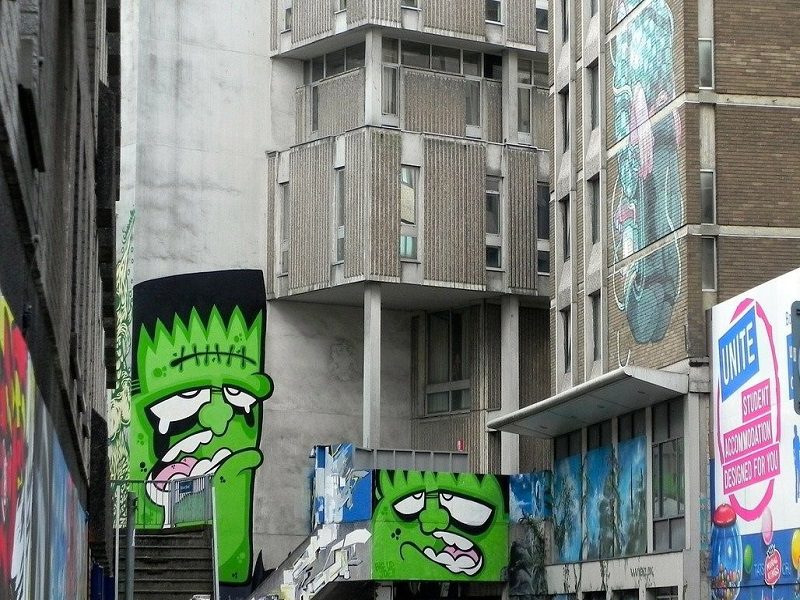
Music has always had a close relationship with art, particularly street art, which often conveys political and social messages. Robert Del Naja of Massive Attack was also very active as a graffiti artist. But the best-known name is Banksy, the famous artist whose identity is unknown, although one hypothesis is that he is Del Naja himself.
Unfortunately, many of Banksy’s works are no longer visible, and some are no longer in their original location (such as “The Grim Reaper”, which was moved from the hull of Thekla to the M-Shed museum). Still, some very significant pieces remain, like “The Girl with a Pearl Earring” in the port area, where the earring is the external unit of an alarm system; “The Well Hung Lover” on Frogmore Street, on the wall of a sexual disorder clinic; “Mild, Mild West”, near The Canteen, showing a teddy bear throwing a molotov at police officers; and the graffiti of Saint Valentine in Barton Hill, where the artist spent much of his youth.
Many of Banksy’s works are site-specific, conceived especially for a place that enhances their meaning. In some cases, it’s as if Bristol’s graffiti want to add a layer to walls built with money obtained from the slave trade and ask questions to us walking down the street. The recent episode of the statue of the slave trader Edward Colston thrown into the port is the result of this continuous questioning. And, once again, the origin and answer lie in the port.