


Mosaic of lands and waters, Cervia is rich in historical memories. Until the 17th century, old Cervia was located further south. Starting in 1698 it was dismantled piece by piece and literally rebuilt further north, near the marina’s seaside, a much healthier area. Today it represents one of the most renowned towns of Emilia Romagna along the riviera.
1 Old Cervia and the Salinari village
Walking along via Salara, which soon becomes via Martiri Fantini, you quickly reach the old village of Cervia, a small architectural gem, with sturdy quadrilateral walls, corners oriented to the cardinal points and sides occupied by the old houses of the salt workers, with pastel facades and small balconies decorated with flowers. The feeling is to find yourself in a place a little magical and a little naive.
The heart is Piazza Garibaldi, dominated by the eighteenth-century silhouettes of the Town Hall and the Cathedral. On clear summer evenings, the square is the meeting point of the whole city, helped by the notes of a small orchestra or the rich program of cultural events. An extension of old Cervia is the “Salinari village”, contributed by the salt workers themselves salinari who thus acquired the right, transferable from father to son, to enjoy free accommodation until 1953, when the State Monopoly management eliminated all privileges.

2 Municipal Theatre of Cervia
In the southwest bastion of the city walls nestles the beautiful nineteenth-century Theatre, small, intimate, with perfect acoustics. The Municipal Theatre of Cervia is located near the tinman’s house Trucolo, a figure very dear to the people of Cervia and beyond; Grazia Deledda, who lived here for a long time and became familiar with the people, affectionately called him the lucky hunchback and the little man with the drop of tin. The gem of the village, however, is Pisacane square, which looks from the ancient seaside gate at the elegant Viale Roma, a prelude to the beach. Framed by beautiful plane trees, the square is a constant bustle around the café tables and the fruit, vegetable and typical product stalls.

3 San Michele Tower
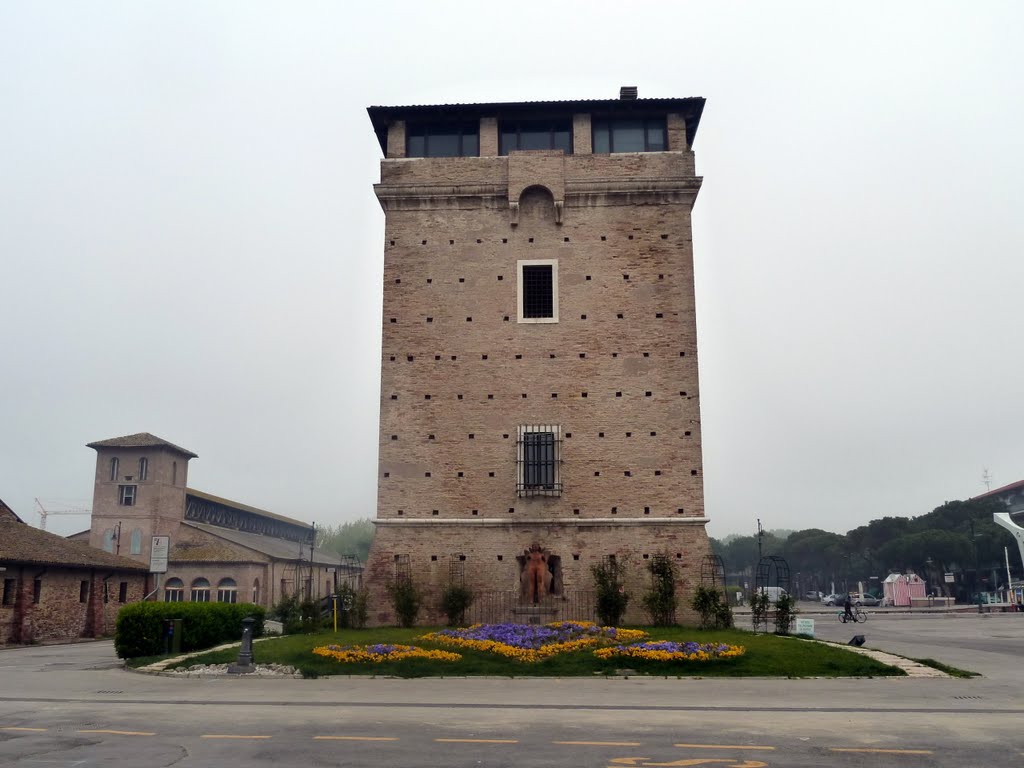
Leaving the village, it is worth walking towards the canal port, admiring the splendid San Michele Tower, from the seventeenth century, perfectly restored, and the nearby Salt Warehouses, home of the beautiful museum by the same name, the MUSA. Once, here, salt was stored, which arrived from the salt pans transported on flat-bottomed iron boats called burchielle, pulled by a rope by the salt workers who walked along the canal bank.
4 Paratorie Bridge of Cervia
The Paratorie Bridge is also known as the “new bridge” or “tower bridge” for its proximity to the San Michele Tower, perfect for an evening walk in Cervia. Built in 1862, it was destroyed by German mines on October 21, 1944. Rebuilt a few meters away from the previous one, the bridge was further replaced in December 2000 to meet the ever-growing needs of the city. It is a huge movable bridge, which arrived in Cervia by sea on a barge, as it was not transportable by land.

5 The Carpet Fountain by Tonino Guerra
Behind the San Michele tower, after the bridge, there is also the “carpet fountain” that Tonino Guerra dedicated to the salt workers, an original mosaic carpet suspended on the water, with white piles of salt, recalling the colors and environment of the salt pans.

6 Salt Museum, MUSA
What to do in Cervia if it rains? We suggest visiting the Salt Museum. Housed in a wing of the large seventeenth-century warehouse, the Cervia Salt Museum is divided into nine thematic areas, illustrating the rich and complex relationship between the city, salt pans, and the sea; the extraction techniques of the white gold. The importance of salt in history and culture; the naturalistic and environmental aspects of the salt pan; the life of the salt workers, documented with materials and tools, an original large burchiella (the flat-bottomed boat used to transport white gold from the salt pans to the warehouses) and a rich collection of photographs, documents, and memorabilia.