


Nestled between Trentino and Valtellina, carved from north to south by the Oglio river and home to the ancient Camuni people who etched thirteen thousand years of their history into the rock, the Val Camonica is not only a paradise for skiers and hikers (the Stelvio Park and Adamello-Brenta parks, Passo Tonale, and the Presena glacier are considerable natural treasures), but also a treasury of generous traditions, cultures, and flavors, still too little known.
Gastronomy in Val Camonica
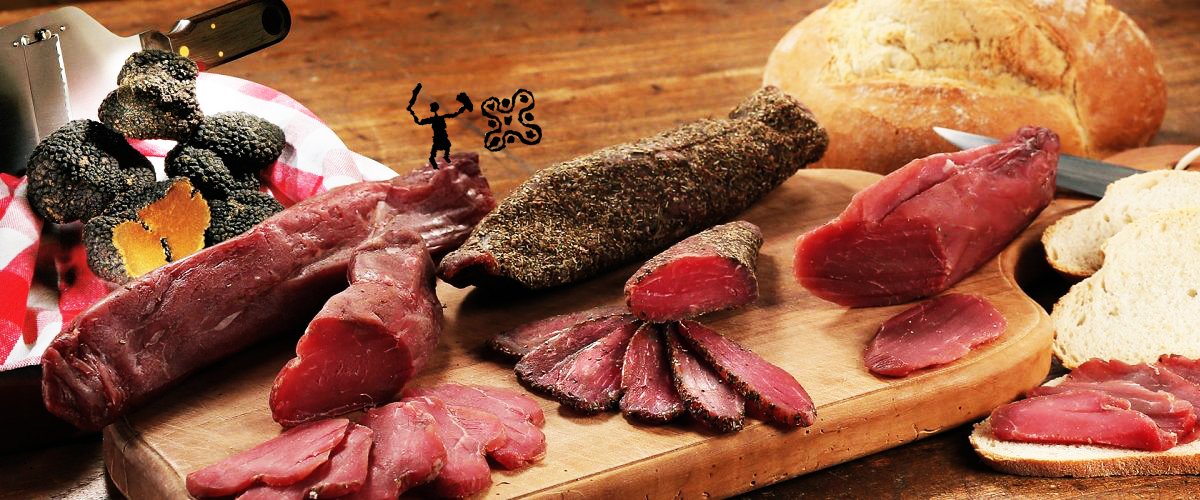
Specialties such as caicc and castrated lamb sausages from Breno, Rosa Camuna and Casolet from Capo di Ponte, the sheep’s violin from Berzo Demo, the ricottina fatulì from Cevo, the spongada and rye bread from Malonno, the cuz from Corteno Golgi, are just a few of the many exquisite companions for a trip or a stay in the valley, exploring fascinating churches and early medieval buildings, frescoes and rock carvings, traditions, and millenary stories.
Breno
Breno, an ancient and welcoming village in the middle valley, overlooked by its millennial castle, deserves a stop not only to admire the enticing frescoes by Romanino (master of 16th-century Brescia painting) in the church of St. Anthony or the wild surroundings of Pizzo Badile and Concarena, but also because it offers a vivid introduction to the rich heritage of Camuni flavors. In the heart of the historic center, there is, for example, the Domenighini Gastronomy, housed for over half a century in an ancient stone shop, where you can find the caicc from Breno, large ravioli with a curious wrapping and a sumptuous filling of meats and cold cuts that for decades represented the festive dish. A few steps along the cobbled streets and you encounter the Pedersoli Butcher, a symbol of very particular salamis, such as castrated sheep sausages with a light color and soft texture, made from the leanest parts of sheep raised in the valley; fragrant pork sausages called strinù; and a savory salami, served cooked with potatoes, polenta, or boiled vegetables.
To taste these and other specialties, you can sit at the tables of the nearby Taverna Trattoria, Piera Ducoli’s family-run restaurant, which never fails to offer customers carne salada, casonsei (square ravioli filled with meat) homemade; “dirty soup,” “tripe in broth,” “Breno-style sirloin,” and a flavorful turta de porsel (prepared with boiled pig’s blood mixed with bread, cheese, milk, then baked in the oven), the flagship dish of rich winter snacks, washed down with the best local and Franciacorta wines.
Val Camonica, Local Agriculture
Up to 50 years ago, viticulture in Val Camonica was a significant part of local agriculture, with merlot, sebina, and marzemino as the top grape varieties. The frantic rush toward industry in the following decades led to the abandonment of large areas and the forgetting of ancient knowledge until, in recent years, some have decided to return to the origins, reviving traditional wines. Thus, a gentle Baldamì, a red wine suitable for any meal, whose name in dialect means marzemino, and a full-bodied Camunnorum, made from dried grapes and aged in oak barriques, emerge from the barrels of the small winery Rocche dei Vignali in Cerveno, a few kilometers outside Breno towards Capo di Ponte, opened four years ago by Gianluigi Bontempi and a group of friends organized as a cooperative.
Capo di Ponte, Val Camonica
Once back in the valley floor, you can head to Capo di Ponte and its impressive archaeological area, a true mecca for generations of archaeologists who studied and deciphered a vast amount of rock carvings here that tell 13,000 years of history of the ancient Camuni. On the rocks smoothed by a prehistoric glacier, from the Paleolithic to the early Middle Ages, men skillfully carved an astonishing series of scenes of hunting and farming life, war, and religiosity. Much of the graffiti, which locals have always called pitoti (puppets), are concentrated in the Naquane National Park, the most important and extensive in Europe dedicated to rock art.
Meanwhile, in the hamlet of Cemmo, there are two famous Boulders that launched Camunian art research in the early 20th century: on one, there is the oldest known representation of a chariot so far discovered. Making the area even more evocative are the small Romanesque parish churches of San Siro and San Salvatore, considered among the most interesting early medieval buildings in northern Italy. In terms of flavors, Capo di Ponte offers some of the most acclaimed valley cheeses, produced by the CISSVA Dairy (with a sales point also in Edolo): Rosa Camuna, a semi-fat sweet cheese whose shape reproduces a famous rock carving; the “Casatta di Corteno Golgi”, made with raw cow’s milk; Casolet, also based on partially skimmed raw milk; Silter, a hard and aged cheese, among others.
Il Castagnolo, Chestnut Brandy
In nearby Paspardo, seat of the Val Camonica Chestnut Consortium, it’s almost mandatory to stop and taste a unique product in Italy: Castagnolo, a fragrant chestnut brandy obtained through a special fermentation process of the fruit. Heading towards Berzo Demo, you can stop at Forno d’Allione to enjoy the specialties of the Ancient Vivione Trattoria, passionately and professionally managed by brothers Claudio and Mauro Bernardi and their families.
A feature is the small dining room with white vaults, decorated with wooden statues carved by Mauro himself, where platters with appetizers such as sheep’s violin, berna (strips of seasoned and dried sheep meat dating back to prehistoric times), smoked beef with toasted walnuts are served; first courses like “chestnut maltagliati tossed with alpine cheese and chamomile flowers”, “ricotta and nettle malfatti with porcini mushrooms”; calsù (large ravioli) filled with potatoes, cotechino, and cheese; and main dishes such as game stewed or polenta e osei.
A short excursion in the nearby picturesque Val Saviore leads to Cevo, where Arturo Maffeis’ Farm stands, raising Bionda dell’Adamello breed goats at nearly a thousand meters altitude, from whose milk he produces a smoked ricottina called Fatulì and a series of exquisite small cheeses that smell of alpine pasture. Back in the valley floor and having reached nearby Malonno, you are captivated by the aromas of Forneria Salvetti, famous for over a century for its fragrant spongade (a traditional pandolce shaped like a small loaf), rye breads (an ancient valley crop) and chestnut breads naturally leavened, made with stone-ground flours in an ancient local mill, flavorful cookies and grissini with chestnuts and walnuts.

Liqueurs in Val Camonica
At the gates of Edolo, a stop is almost mandatory at the Liquorificio Alta Valle Camonica, run by the Tevini family, which, among many specialties, also offers a prestigious Genepy, obtained by cold maceration of plants gathered over 2000 meters altitude and an aromatic Amaro Alpi, which condenses the virtues of 15 types of mountain herbs.
Edolo is the gateway to the upper valley, a village with character, where even in winter months, amidst the colorful comings and goings of skiers, it’s pleasant to enjoy a walk along the Oglio river or stroll through the streets lined with shop windows full of goods. A few kilometers away, towards Passo Aprica, is Corteno Golgi (birthplace of Camillo Golgi, Nobel Prize winner in medicine in 1906), home of the cuz, an ancient and succulent shepherds’ dish worth tasting at Ristorante Parco’s tables.
From Stelvio National Park to Adamello
From Edolo, the state road winds through the snowy and stunning landscapes of the Adamello Natural Park and passes through quiet villages such as Vezza d’Oglio and Temù, comfortable, well-equipped bases in every season not only for the Park and Val Grande but also for summer skiing on the Presena glacier.
Ponte di Legno, at the foot of Tonale, between the Stelvio National Park and the Adamello, is the northeastern terminus of Val Camonica and of our itinerary. The sun, which bathes it for much of the day, the liveliness and animation of the historic center, especially during winter ski weeks or summer, invite exploring its gourmet spots, such as Salumeria Salvetti on Corso Milano, specializing not only in typical cold cuts and cheeses like Bagoss, but also in dried and marinated mushrooms (porcini, chanterelles…), the latter presented in attractive glass jars with wooden lids.
Or the San Marco Restaurant in Piazzale Europa, where the host is an energetic chef: Marco Bessi, proposing refined and skillfully reinvented local cuisine, featuring dishes such as: “Risotto with Fatulì“, Gnocc de la cua, “Tortelli with Bagoss and butter noisettes”, Minestra de Scandela (a vegetable and barley soup), “Guinea fowl breast with pickled vegetables”, “White braised venison” and “Caramelized pears in red wine”.