

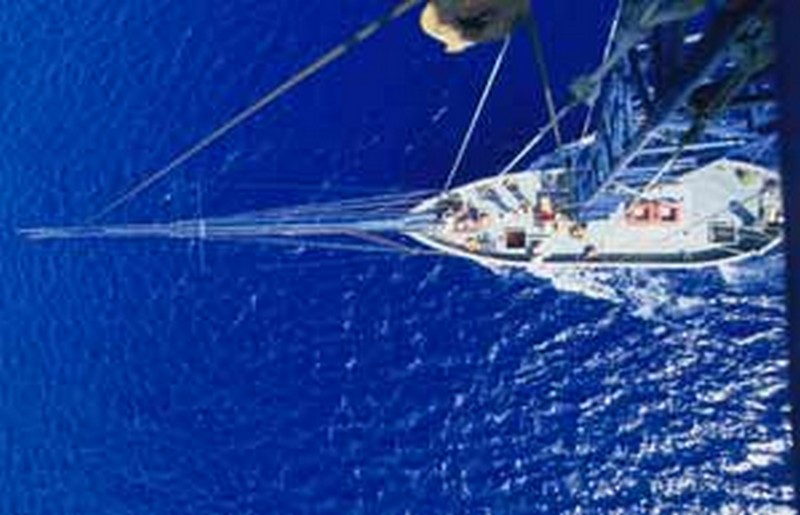


The boat is just over 15 meters long and was completely rebuilt ten years ago, following the ancient wooden boatbuilding techniques. The felucca has a long bow gangway from where the harpooner catches his prey and a tall central mast at the top of which the helmsman and lookouts stand. The two iron structures measure 25 and 28 meters and are supported by a spectacular tangle of steel cables nearly one and a half kilometers long.
From April to September every morning, when the city is still sleepy, the crew of “Peppe” meets on the small beach of Ganzirri, just a few kilometers from Messina. The mild breeze gives hope for another day of good weather and, if the sea is calm, a new day of fishing—actually swordfish hunting—is about to begin.
The six fishermen board a small rowing boat that silently glides into the tiny harbor of Ganzirri to transport them from the beach to the felucca moored there at anchor. The silence of dawn is broken only by a few brief words among the men, perhaps to ease the tension that will accompany them throughout the working day.
As soon as they board, each one attends to their duties, and with swift and precise actions the crew prepares the gear for the imminent fishing expedition. The harpoon lines stored below deck are arranged on the bow to then be spread in festoons along the sides of the long gangway, and the harpoon shafts are fitted with various types of tips. For the fishermen, the favorite prey is the swordfish, but if large tunas or Atlantic bluefish are encountered, they must be ready to use harpoons of various shapes with one or multiple points.
The engine operator lets the 400 horsepower of the two powerful engines warm up and checks that everything is functioning properly. Meanwhile, someone else prepares coffee in the ship’s style, with sugar whipped into a foam that gives the beverage a dense and tasty crema. After drinking the coffee and making a quick sign of the cross with the hand, the skipper and the two lookouts climb to the crow’s nest, 28 meters high, to start the hunt. The men climb nimbly and with great assuredness to the top of the very tall structure from where they can scan the sea for over a hundred meters radius. By noon, when the sun is overhead on the water, their trained eyes can easily distinguish the dark shapes of fish swimming even ten meters deep. From up here the skipper controls the helm and engines and steers “Peppe”‘s winding course in the Strait, giving the necessary orders to his crew down on deck for capturing the spotted prey.
The moorings are released and the felucca heads toward its fishing zone. The lunar phase is at the first quarter and probably the day will be fruitful.
Nino explains that this is the best condition for fishing. The deep swordfish, the bigger ones, enter the strait using the incoming or outgoing current, which during the first and last quarters of the moon can exceed four knots in speed. During slack water and with the sea so warm, the fish probably come to the surface to mate or feed and become the “easy” prey of the harpooners.
Nino works at the University of Messina, collaborates with WWF for the census of sea turtles, and also organizes nature excursions aboard his felucca. But he has always been a fisherman, and in all these years working at sea he has developed the intuition and skill needed to become a good skipper. On board he is the director, and from the height of the crow’s nest together with the other two lookouts he attentively observes all the surrounding sea. In the distance, in the current cut, some splashes catch the three men’s eyes and then a sudden leap reveals the shape of a fine specimen of xiphias gladius, better known as “swordfish.” It’s only 7:30 and the hunt has already begun. The big fish has dived again and Nino must immediately guess its direction to anticipate it. Meanwhile, with a shout, he alerts the harpooner standing watch on the gangway and the crew on deck. And with engines full throttle, he launches “Peppe” at more than 15 knots toward the prey, which can reach 100!
The bow rises and the tip of the long gangway lifts alarmingly. And with it the harpooner who is standing guard there. The man has very little time to act: he must understand the size and type of fish, choose and grab the right harpoon, in this case the two-pronged one, and be ready to shoot. Suddenly, the helmsman stops the engines to remain silent and wait. With another sighting, this time deeper but much closer to the boat, the fish weighing at least 150 kilos is glimpsed. The felucca moves again to get closer and, following an ever-tighter spiral, circles until the tip of the gangway is very close to the prey. After a few minutes, the maneuver pays off and the harpooner finds himself exactly over the fish. Without hesitation, with a single thrust he drives the harpoon into the back of the great swordfish. The battle begins between the big fish desperately trying to free itself from the point that almost pierced it and the fishermen who must not lose it. The fish dives and then jumps, then dives again and jumps again, trying to free itself from the harpoon while the sailors onboard barely control it and work their arms with the long line holding the harpoon. To tire it out they retrieve and pay out several tens of meters of line in an unpredictable fight. After much effort the fishermen prevail, and the exhausted fish is finally hauled aboard.