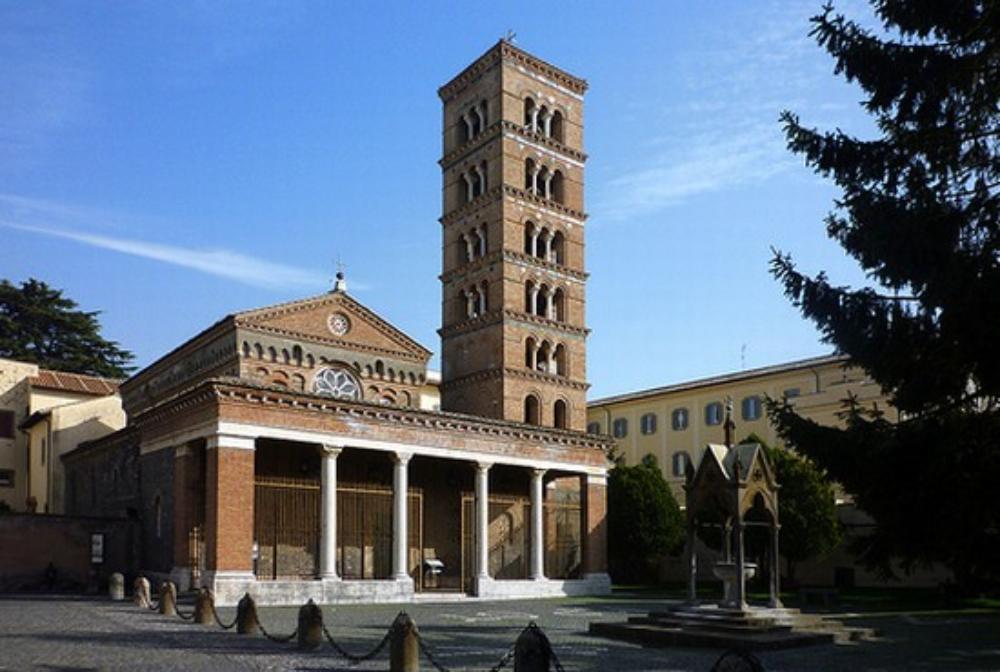
The library owes its origin to St. Benedict, founder of the first Subiaco monasteries and their guide for nearly thirty years.
The Rule of the holy Founder requires that there be books (manuscripts) in the monastery for private and communal reading.
No books from the time of St. Benedict have survived due to the devastations suffered by the monasteries in the 7th-10th centuries. At the end of the 9th century, with the revival of monastic life, the library was also restored, as reported by the Chronicon Sublacense.
Abbot Umberto (1050-1069) expanded the book collection. Subsequently, the records become more explicit and abundant.
The monastery’s scriptorium received a significant boost during the tenure of Abbot Giovanni V (1069-1121).
Some manuscripts copied in the monastic scriptorium ended up in other libraries; only two remain in ours: Codex LXIII, containing the Letters of Saint Augustine, and the so-called Psalter of Saint Jerome, rich in precious miniatures.
Giovanni V also purchased manuscripts for the Library. His successors followed his example so that by the late 1300s, the Library held about 10,000 volumes.
The oldest dates back to around the 10th century. It contains precious miniatures. It is a miscellany. It features brief biographical notes on various saints, an extract from the second book of the Dialogues of St. Gregory the Great, and some liturgical rites.
Other folios that once belonged to this manuscript are now preserved separately. They are from the same period but written by different hands.
They contain passages from the Rule of St. Benedict. Several miscellany-type manuscripts have come down to us.
Of exceptional importance are the manuscripts of Holy Scripture, commentaries, and studies on Holy Scripture. The oldest Holy Scripture manuscripts date to the 14th century.
Among collections of Homilies, those of Origen from the 13th century are particularly interesting.
The manuscript became famous because the German printers who established the first Italian printing press in our monastery were inspired by the typefaces of this manuscript to cast their own, which are therefore called Sublacense.
Of notable importance are the liturgical codices: missals, lectionaries, breviaries, embellished with artistic miniatures. Manuscripts containing treatises on philosophy and theology are also preserved.
St. Augustine’s De Civitate Dei has gained considerable importance because it served the first Sublacense printers as the text for the homonymous incunabulum.
Many are monastic-type manuscripts, particularly those on the Rule and related commentaries. Several have been irretrievably lost.
Mention should also be made of the seals that many diplomas preserve and which help establish the authenticity of the document.
Between 1464 and 1467, the Library was enriched with the first books printed in Italy, “in venerable monastery of Subiaco.” Here were certainly printed the Small Latin Grammar by Donatus; Cicero’s De Oratore; three works by Lactantius: Divine Institutions, On the Anger of God, On the Workmanship of Man; and St. Augustine’s De Civitate Dei.
The printers, Conrad Sweynheym and Arnold Pannartz, Germans, established the first Italian printing press in our monastery and in June 1467 moved to Rome, leaving much of the printing equipment in Subiaco, but after their departure, it seems the monks did not print any further books. Subsequently, other incunabula were purchased in Rome from these printers and also from others.
Particular mention should be made of the Codex Justiniani printed in Venice in 1478; Pope Gregory IX’s Decretals of 1474; and the Concordantia Discordantium Canonum by Gratian.
Incunabula with works by Aristotle, Cicero, Lucretius, Martial, and Seneca are preserved.
Many works have been lost and many were removed, especially during the commendam; perhaps the greatest losses occurred during the monastery’s invasion in the years 1789-1799 and 1810-1815.
Before 1848, the reorganization of the Library and Archive was carried out, and works of Holy Scripture, ecclesiastical history, and series of Latin and Greek classics were acquired.
The years 1848-1868 were not all prosperous for the monastery. “When Garibaldi’s volunteers,” recalls Federici, “restlessly roamed the Roman countryside, eager for Rome, around 1867, the monks, fearing for the treasures preserved in the monastery, secured the manuscripts outside the cloister, in a place unknown to us.”
Then came the suppression. The public domain confiscated the assets and auctioned them off.
It declared the monasteries national monuments and entrusted their custody to some monks.
Don Leone Allodi was appointed superintendent, tasked with organizing the library and manuscript collection, a task that Allodi completed with uncommon expertise.
A new expansion and better arrangement of the library occurred under Abbot Salvi; during his long administration (1909-1964), it was housed in a more worthy location and stocked with both ancient and modern collections and various journals, thanks also to the financial support of the Ministry of Cultural Heritage and Activities.
Information about State Library of the National Monument of Santa Scolastica
Via dei Monasteri, 22
Subiaco (Rome)
(+39) 077485424
[email protected]
https://www.scolastica.librari.beniculturali.it/
Source: MIBACT