

London is the political capital of the United Kingdom, but it is also its literary capital. Here is a proposal for some literary-themed walking itineraries in London. The literary places in London number in the hundreds. Let’s try to discover some of the most significant with these walking tours through the different neighborhoods of London.
William Shakespeare’s London
The beginning of William Shakespeare’s career is linked to the Shoreditch area. This area, now renowned for its nightlife, hosted since the Middle Ages an important monastery dedicated to Saint John the Baptist.
With the dissolution of the religious orders under Henry VIII, in 1536 the monastery was cleared, becoming one of the so-called liberties: monasteries were not subject to normal laws and this custom continued to be applied in their areas even after they were no longer under the jurisdiction of the religious orders. The liberties attracted two categories of people: those living on the edge of the law and artists, who here could not be censored.

Thus, along today’s Curtain Road (named after the curtain wall of the Saint John the Baptist monastery), two rival theaters were built: the Curtain Theatre and The Theatre. The Theatre was home to the Lord Chamberlain’s Men, the theatrical company in which Shakespeare was both author and actor. The owner’s son, Richard Burbage, who was the lead actor, performed here roles such as Hamlet, Othello, and King Lear. When the lease on the area was about to expire, a dispute arose between the owners and the Lord Chamberlain’s Men. The theater was temporarily closed and the company had to be hosted at the Curtain Theatre.
Burbage, fearing he would lose the theater, organized a nighttime brigade of men who dismantled it piece by piece and moved it to Southwark. And so the Globe Theatre was born.

Globe Theatre
The area was chosen because it was outside the City’s jurisdiction, which banned theaters. Next to the original Globe site, on what is now Park Road, stood its rival, the Rose Theatre, whose foundations can be seen on guided tours. Today, visitors can explore the Shakespeare’s Globe Theatre, a faithful reconstruction of the seventeenth-century theater, located a short distance from the original, and perhaps relive the atmosphere of Elizabethan theaters by attending one of its summer performances.
Because of its vocation as a theater district, many actors lived in Southwark. Their parish was the Southwark Cathedral, originally the oldest Gothic church in London (9th century AD). About half the actors listed in the First Folio, the first printed edition of Shakespeare‘s works, are recorded in the church registers, including the Bard himself, who is honored with a monument inside. Edmund Shakespeare, William’s brother and also an actor, is buried in Southwark Cathedral.

The Bloomsbury and Fitzrovia Districts: Virginia Woolf and Charles Dickens
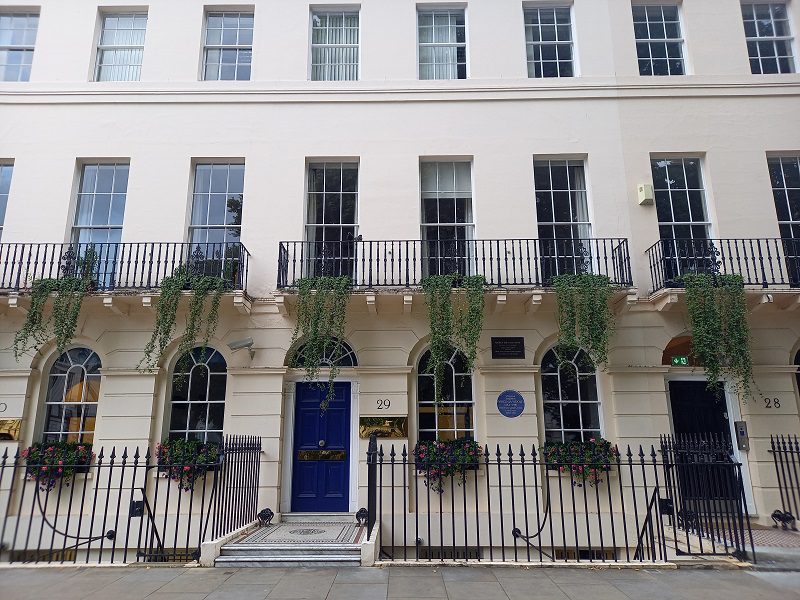
Not far from the British Museum is the Fitzrovia district, historically associated with the bohemian artist group who populated it in the early 20th century. The most famous was Virginia Woolf, who lived between 1907 and 1911 at number 29 Fitzroy Square (where previously the playwright George Bernard Shaw had lived). Virginia Woolf, together with her brothers Thoby and Adrian, founded the Bloomsbury Group in this house, an association of artists originally from Cambridge University and famous for their decadent lifestyles.
There was a saying identifying this group: couples who live in squares and have triangular relationships. Indeed, the beautiful square gardens characterize this area, and Virginia Woolf also lived at number 46 Gordon Square and number 52 Tavistock Square. In this last apartment, she wrote some of her most famous works, including Orlando and The Waves.
The place where local artists used to go drinking (almost never moderately) was the Fitzroy Tavern on Charlotte Street. This pub was particularly popular between the 1920s and 1940s and counted among its regular patrons George Orwell, Dylan Thomas, and the Satanist Aleister Crowley, who also invented a drink for the pub. Toward the late 1930s, some artists preferred the nearby Wheatsheaf pub on Rathbone Place. Both the Fitzroy Tavern and the Wheatsheaf remain very popular today, still retaining the atmosphere of their bohemian period.
In beautiful Doughty Street, at number 48, is the Charles Dickens Museum, set in the only surviving London house where the writer lived. Here Dickens wrote Oliver Twist and Nicholas Nickleby and witnessed the death of his sister-in-law Mary Hogarth, just seventeen years old. This episode, which deeply disturbed him, is recounted through the death of Little Nell in the novel The Old Curiosity Shop. In London there are many places linked to the life and works of Dickens, and the museum also organizes themed walking tours to the locations of some of his novels.
The Chelsea District: Oscar Wilde
The aristocratic Chelsea district has hosted many artists and, naturally, among them are numerous writers. At number 34 Tite Street, between 1884 and 1895, lived Oscar Wilde, where he wrote his masterpieces The Picture of Dorian Gray and The Importance of Being Earnest. However, this house also marked the beginning of his downfall: during a dinner held here, Wilde met his future lover, Lord Alfred Douglas. The father, the Marquis of Queensberry, disgusted by their relationship, sued Wilde for indecency, and the writer was convicted and imprisoned, forced to sell the house to pay part of the legal expenses.
The most significant Chelsea street for its residents is Cheyne Walk. Its row of elegant houses overlooking the Thames has hosted many celebrities, including painters Rossetti and Turner and Rolling Stones members Mick Jagger and Keith Richards. Among the writers who lived there are George Eliot (at number 4), Bram Stoker (at 27), and Ian Fleming, the creator of James Bond, who lived with his mother at number 118-119 (previously home to the great painter JMW Turner) and later moved to the Carlyle Mansions, the apartment complex between numbers 50 and 60, where poet T.S. Eliot and Henry James also lived. In his Carlyle Mansions apartment, Fleming wrote the first James Bond story, Casino Royale.
The Carlyle Mansions are named after a notable figure who lived until his death at number 24 Cheyne Walk, Thomas Carlyle, a 19th-century Scottish writer and essayist. The Thomas Carlyle’s House, where Charles Dickens was a regular guest, is open to the public and worth visiting to get an idea of what these beautiful townhouses were like.

The British Library
Finally, an unmissable destination for literature enthusiasts is the British Library, a true temple of knowledge. On the ground floor, there is an exhibition hall with some priceless treasures. Among the literary works, limiting ourselves to the writers mentioned in this article, stands out the First Folio of Shakespeare, the first collection of all his works curated by some friends and colleagues of the Bard immediately after his death. Without this edition, eighteen plays, including Macbeth and The Tempest, would have been lost. The prestigious folio format was reserved for theological and historical works and was used here for the first time for a literary work.
Visitors can also admire manuscripts by Charles Dickens, Oscar Wilde, Ian Fleming, and a notebook containing a draft of Mrs Dalloway by Virginia Woolf, with a different ending from the published work.
The British Library’s exhibition spans many fields of knowledge. Alongside literature, there are autograph scores by great composers (including Handel, Mozart, and Mahler) through to the Beatles; maps, illuminated sacred texts, scientific and historical treatises, anatomical drawings by Michelangelo and Durer, and set design sketches by Leonardo da Vinci. There are also law codes, including two of the four surviving copies of the Magna Carta.