

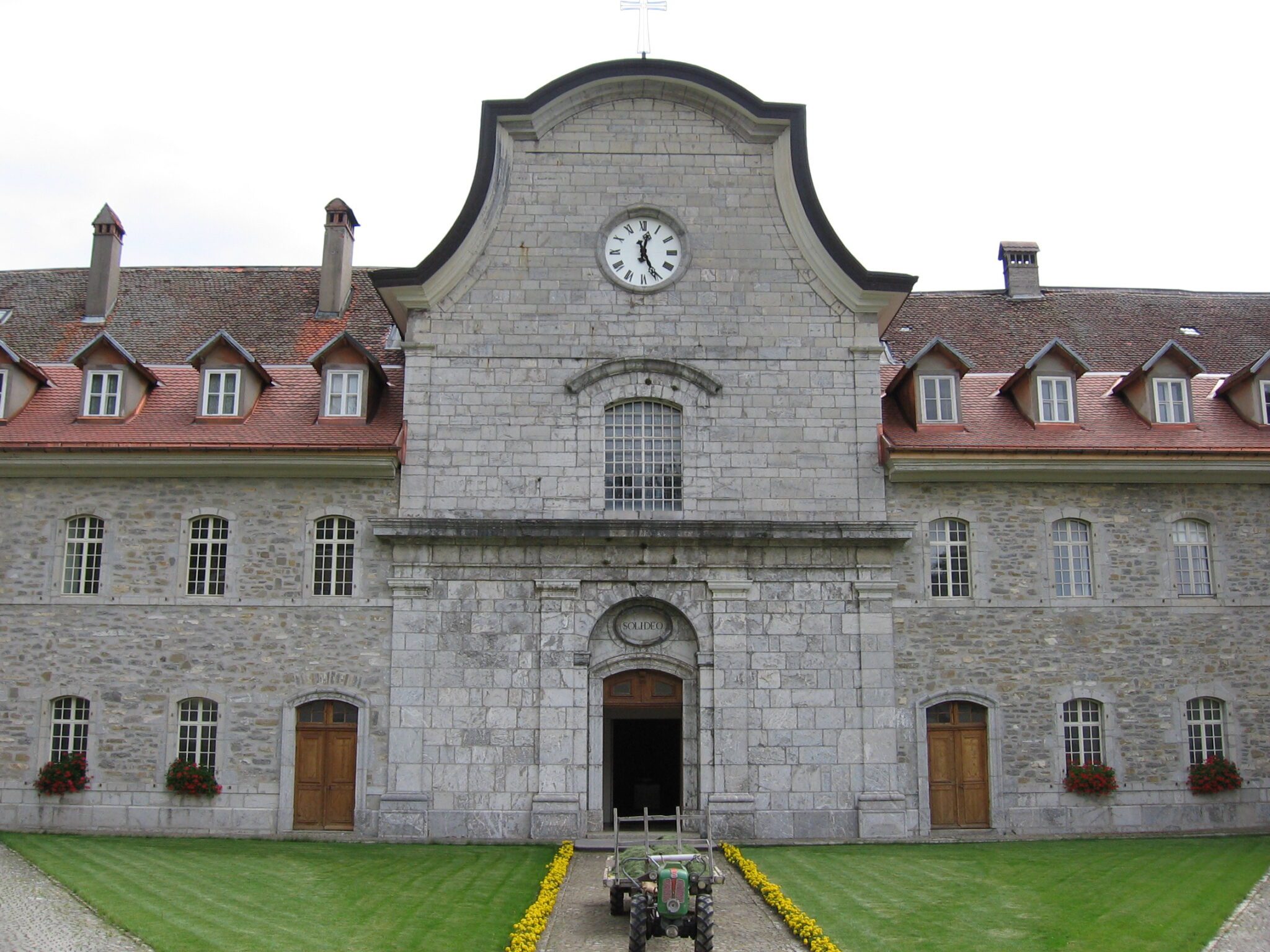


The Charterhouse of Valsainte was originally made up of 12 cells built around the church and cemetery. It remained active for five centuries and, at the end of the Middle Ages, came under the authority of Fribourg, triggering a difficult era marked by repeated civil interference in religious affairs.
After the Reformation, the Bishop of Lausanne, deprived of his Cathedral and expelled from the city, took refuge in Fribourg and found himself without resources. Rome asked the government of Fribourg to support him; their answer to the Holy See was to suppress one of the two charterhouses in the canton and assign its confiscated assets to the Bishop and other struggling religious institutions in the city.
For two centuries, the Papal States resisted this request. Eventually, in 1778, they yielded to government pressure and agreed to the suppression. The monks of Valsainte were transferred to the Charterhouse of Part-Dieu near Bulle, and all assets passed to the Canton of Fribourg, which closed the monastery.
During the French Revolution, the monastery served as a temporary refuge for Trappist monks and later Redemptorists, but was eventually abandoned and left to decay. In 1848, the Charterhouse of Part-Dieu was also suppressed. By 1861, the former monks of Part-Dieu were permitted to reunite and tried to reclaim their former home, but that proved impossible. They instead directed their efforts to the Charterhouse of Valsainte.
They successfully acquired part of the property, which had since become private, along with a section of the old complex and the northern part of the main building. The state granted them half the church, which functioned as a chapel for locals (the other half was nearly ruins), and the southern wing. The Charterhouse was rebuilt on its original foundations. Monastic life resumed regularly in 1863 and continues uninterrupted to this day.
In 1861, threats of expulsion loomed over monks in France, so a new wing with seven cells and another building was erected to host them. When the expulsion took place in 1901, it was so significant that further cells had to be constructed, and the church, refectory, and cloister were expanded. Today, the Charterhouse of Valsainte can house 38 Fathers and 25 Brothers; the church interior was restored in 1971.
The Charterhouse of Valsainte is part of the Order founded by St. Bruno in the mountains of the Chartreuse near Grenoble in the 11th century. Carthusian monks lead a hermit’s life while sharing community with their brethren. They spend most of their time in their rooms, which typically consist of a cell and a garden. At Valsainte, however, the monks’ cells are spread over two floors and divided into several rooms: one for spiritual exercises, one for study, a small workshop for manual work, and a rest area. This ensures each monk has a spacious environment to nurture both body and spirit.