

La Valsainte Charterhouse consisted of 12 cells grouped around the church and the cemetery. It had 5 centuries of active life and, when at the end of the Middle Ages it came under the rule of Fribourg, it began a very troubled period due to repeated interference by civil power in religious affairs.
Following the Reformation, the bishop of Lausanne, deprived of his Cathedral and expelled from his city, took refuge in Fribourg where he remained without resources. Rome asked the government of Fribourg for intervention in his favor; the latter replied to the Holy See to suppress one of the two charterhouses located in the canton in order to assign the confiscated goods to the Bishop and the ecclesiastical institutions of the city, which were in difficult waters.
For two centuries the Papal State opposed this request, but in the end it yielded to the government’s demands and in 1778 granted the suppression decree. The monks of Valsainte were thus sent to the Part-Dieu charterhouse near Bulle and all the goods passed into the hands of the canton of Fribourg, which closed the monastery.
During the French Revolution the charterhouse became a temporary refuge for the Trappist monks and then the Redemptorists, then it was abandoned and fell into ruin. In 1848 the Part-Dieu charterhouse was itself suppressed. In 1861 the old monks of Part-Dieu, authorized to reunite in community again, tried to regain their seat but it was not possible and so they turned their attention to the Valsainte charterhouse.
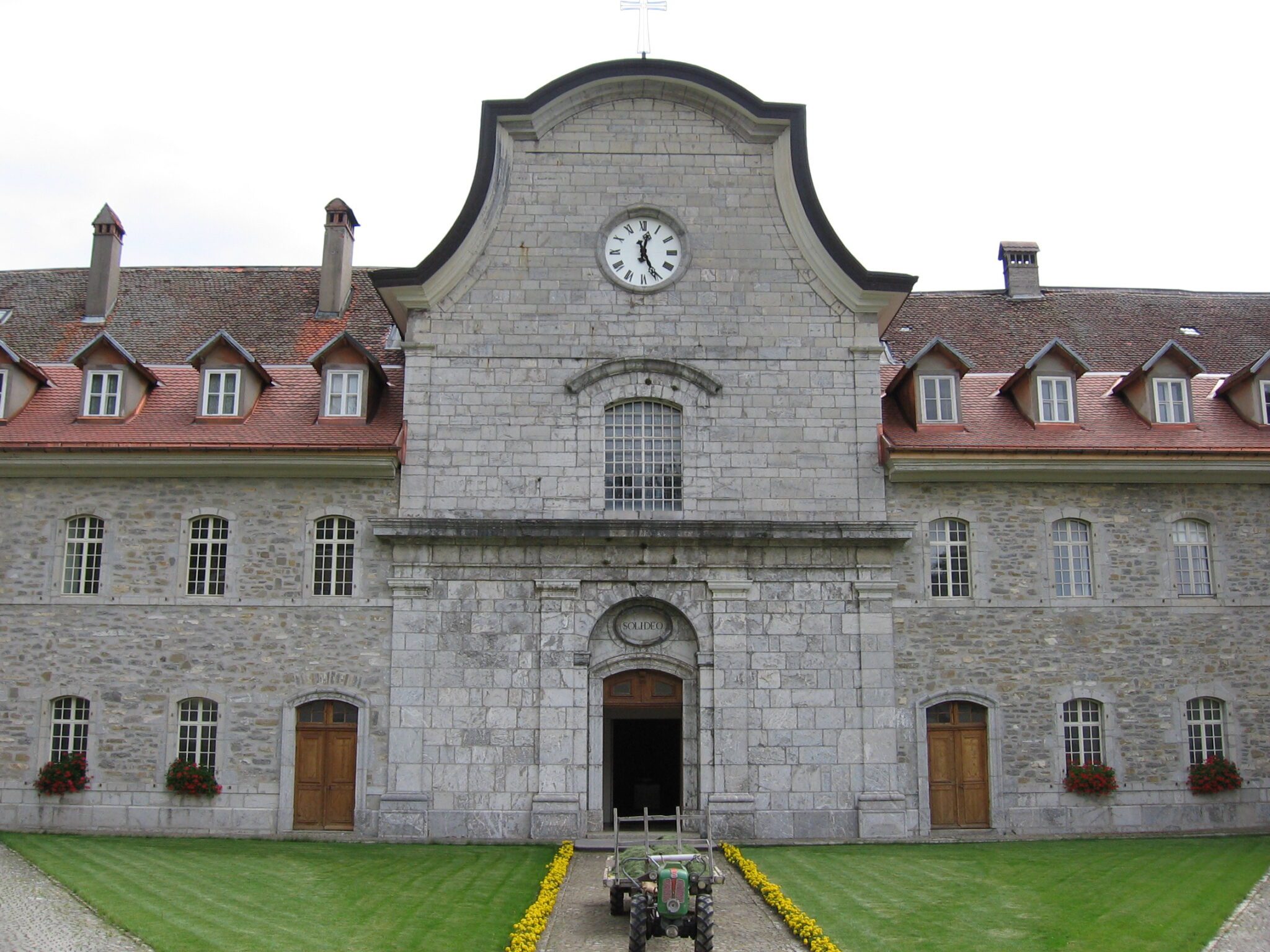
They managed to occupy both the part which in the meantime had become private property, as well as part of the ancient settlement and that to the North of the palace. The state donated to them half of the church which served as a chapel for the local people (the other half was almost in ruins), and the South part of the palace. Thus the charterhouse was rebuilt on its own foundations. Monastic life resumed regularly in 1863 and since then it has never been interrupted.
In 1861 the religious from France were threatened with expulsion, and to accommodate them a new sector of 7 cells and a new palace were built. The expulsion took place in 1901 and was of such magnitude that it was necessary to build more cells and enlarge the church, the refectory, and the enclosure. Currently the Valsainte Charterhouse can accommodate 38 Fathers and 25 Brothers and the interior of the church was restored in 1971.
The Valsainte Charterhouse is part of the Order founded by St. Bruno on the mountains of the Chartreuse near Grenoble in the 11th century. The Carthusian leads the life of a hermit, while living together with his fellow brothers. He spends most of the time in his room, generally composed of a cell and a garden. At Valsainte, however, the monks’ cell is on 2 levels and is divided into several rooms: one for spiritual exercises, another for study, then there is a small workshop for manual work and a small room for rest. Each monk therefore has a very large room to physically and spiritually relax.