


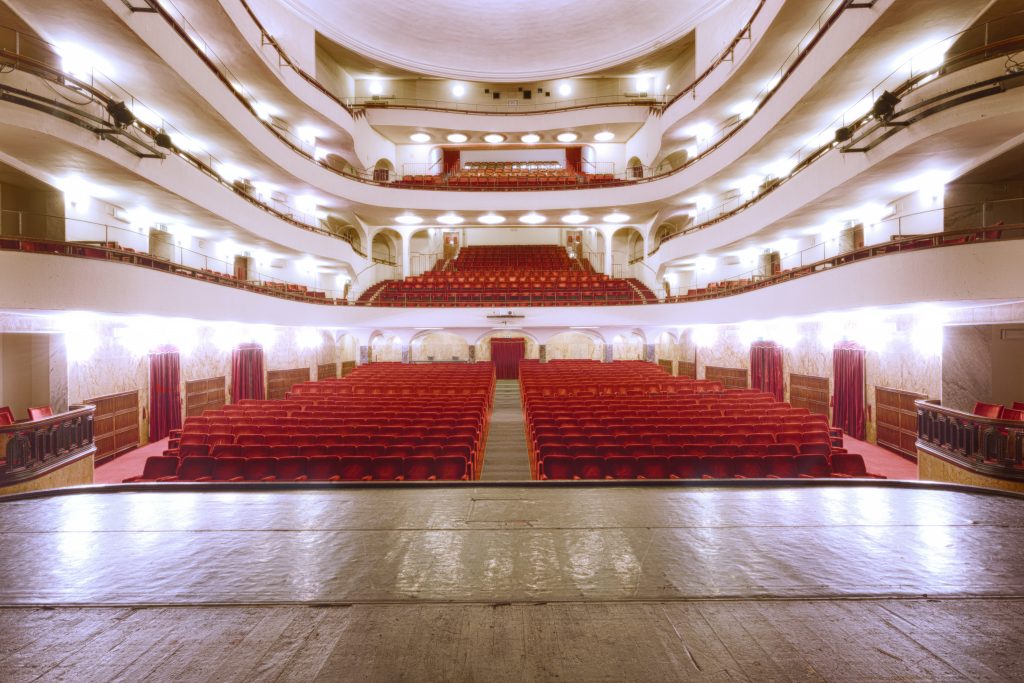


In a modern and sumptuous style for those times, the Duse Theater was reopened on November 7, 1904. Very little remains today of Colliva‘s intervention. On December 25, 1945 (with the performance of Rigoletto) it reopened to the public in its current form, quite simple and lacking the original decorations; moreover, the elegant balconies were transformed to make room for two large galleries. However, on this stage all the most famous drama and revue companies, as well as classical and light music singers and famous dancers, have continued to perform, maintaining the successful season initiated by Emilio Brunetti.
The History of the Duse Theater of Bologna
Since the mid-seventeenth century, there existed, in the ancient Palazzo del Giglio located on via Cartoleria Vecchia, a theatrical hall used by the boarders of the College of Nobles dedicated to St. Francis Xavier. The students staged carnival performances and year-end academies there. Marina Calore states in the most recent and comprehensive essay produced on this theater: “For all these performances held before a qualified audience of guests, it is reasonable to suppose that a theatrical hall (and for ‘martial arts’ also a ‘riding hall’) was used, spacious and well-equipped, since performances in particular, we deduce from the printed ‘arguments’ or ‘scenarios’, involved many characters on stage, the use of complex and varied stage sets, and the accompaniment of a small orchestra” (cited from Calore 1990, p. 88). No description of this hall has come down to us, suggesting it was rather unremarkable.
The theater (under the name of S. Saverio) appears in 1806 in the list compiled by order of the Prefect of the Reno Department, along with three other private Bolognese halls used by amateur companies: the Taruffi Theater, the Felicini Theater, and the Legnani Theater. In 1822 it was purchased by Antonio Brunetti, who evidently found it still usable as he rented it out for puppet shows, very fashionable at the time. In the spring of 1830, the owner, a professional engineer, undertook radical restoration and expansion of the theater. His intention was to change its status and put it in conditions that would allow charging admission to the public attending the performances. That is, to obtain the qualification of “venal”, for which the theater had to meet certain requirements.
The work ended by the end of that year and the inauguration took place with the drama Amore e crudeltà. A periodical chronicle of the era reports that the theater had a rectangular plan, with fourteen boxes (arranged on three tiers facing the stage), four of which served as entrances to as many railings placed on the two sides of the hall at the same level as the boxes (see Calore 1988, p. 88 and note 6). The interiors of the boxes, the parapets, railings, and theater ceiling were reportedly painted with good taste and elegance. The stage was equipped with a good number of sets by skilled artists, whose identities remain unknown. Despite Antonio Brunetti’s costly efforts, the theater did not obtain the “venal” qualification. The inspection by the municipal technician and the representative of the Noble Deputation for Shows was positive regarding the structures but received unfavorable opinion from the Deputation. The location was criticized firstly, and then it was noted that opening another theater was not appropriate as the city already had enough. Meanwhile, charitable performances were given in this hall by amateur companies, particularly active in that period (1831), marked by insurrectional movements and civic engagement.
Notable among these were a Filippo by Vittorio Alfieri brought on stage by Antigono and Agamennone Zappoli and an Antigone performed by Annina Ghirlanda. Meanwhile, Brunetti obtained some exemptions from the Deputation’s ban on paid performances. In particular, the theater was managed for four years by the famous puppeteer Onofrio Samoggia, who had reached a quite high-quality level in this art form. After various events (the theater had been inherited by Antonio Brunetti’s nephews: Cesare and Emilio) we reach the threshold of 1860. The changed political situation was decisive for the fate of this theatrical venue.
The provisional Government Committee was much more favorable toward theaters, therefore the renewed request for venal operation was favorably accepted, subject to urgent restoration works that were completed quickly, allowing the theater to reopen on the evening of February 11, 1860, with an opera. The entire venue, however, required comprehensive intervention as it was too modest, dirty, poorly lit, and lacking adequate ancillary facilities.
Therefore, in 1863 construction began. Emilio Brunetti, passionately fond of the world of entertainment and already deeply committed to lifting the artistic fortunes of the family theater, invested substantial resources to make the new hall modern and comfortable. The theater reopened on the evening of February 18, 1865, with a masked ball that won unanimous approval from attendees. The hall had two tiers of galleries and a gallery supported by slender iron columns; the painted decorations were the work of Valentino Solmi and Gaetano Lodi. Additionally, a movable crystal skylight opened in the ceiling of the stalls; it was equipped with a modern gas lighting system (the first theater in Bologna to have one), a heating system with radiators located in the basement, and a sounding board placed beneath the orchestra. It also featured a large foyer on the first floor.
Starting from March 25 of that same year, performances followed in rapid succession, first with the acrobatic company Ciniselli, then with operas: Norma, Un ballo in maschera, Barbiere di Siviglia until the end of summer, thanks to the presence of the movable skylight. In those years, the theater enjoyed considerable success mainly due to Emilio Brunetti’s dynamism, who knew well how to choose shows aimed at a popular audience to entertain and educate at the same time. In 1873 the theater was again closed for rather costly renovations, sparking a quarrel between the two brothers owning the theater, resulting in the whole thing being placed under controlled administration.
Nonetheless, the theater entered a very prestigious phase. In 1873, the operetta season began, destined to have the most significant space. Later, from 1879, so-called popular concerts were held, during which competent conductors introduced the public to advances in European instrumental music (see Calore 1990, p. 93). On November 6, 1878, King Umberto I and Queen Margherita, at the invitation of the Workers’ and Artisans’ Society of Bologna, attended a show at this theater. Moreover, lectures by illustrious figures such as Crispi and Carducci were also held here. Finally, in March 1882, the great Sarah Bernhardt performed, winning over the audience with La Dame aux camélias and Frou-Frou. At the end of the century, the theater was purchased by Cazzani and Lambertini (the latter also owner of the Teatro del Corso), who wisely decided to rename it after Eleonora Duse. The ceremony took place on June 12, 1898, with a famous speech by Enrico Panzacchi, followed by performances of D’Annunzio’s Il Sogno and Goldoni’s La locandiera.
Shortly thereafter, Lambertini died, and the theater was purchased by King Riccardi, then again restored according to architect Lorenzo Colliva‘s project. During this intervention the building was raised to enlarge the upper galleries, the proscenium was restructured, new stairs were constructed for greater comfort and safety for the public, the electrical system was installed, and the decorations were redone by Trebbi and Bazzani. (Lidia Bortolotti)


opened on November 7, 1904.)