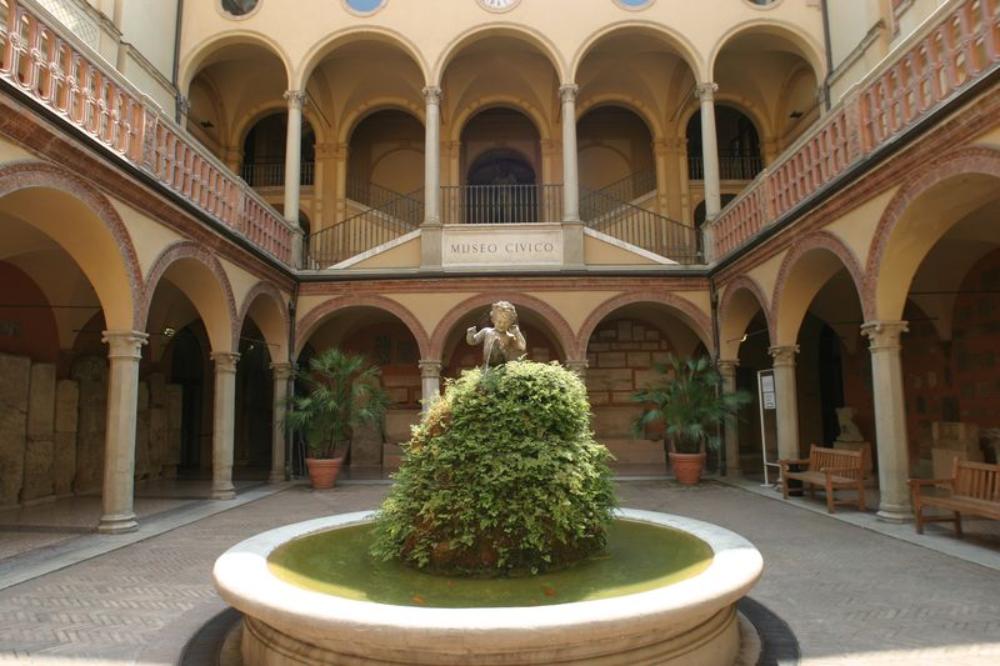
The convent complex of Saints Nicolò and Domenico, home to the Art Gallery, has undergone careful and complex restructuring work over recent years aimed at housing the Civic Museums of Imola in one location. The current exhibition route allows visitors to exclusively explore the rooms of the Municipal Art Gallery, whose collection consists of about a hundred works, mainly from the Bolognese area, dating from the 15th to the 21st century. The core of the collection has been enriched with the display of additional collections, including ancient drawings, medieval and modern ceramics, coins and medals, and stone materials. The new exhibition layout will also foresee the reopening of the historic Giuseppe Scarabelli Natural History Museum, an exemplary case of 19th-century museographic setup, which has been closed to visitors for some years except for a section set up for educational activities, and the setup of the Archaeological Museum which will highlight and enhance the results of over a century of research conducted in the Imola area. Lastly, the Risorgimento Museum, previously housed in the former San Francesco convent, was dismantled in 2001 for necessary structural adaptations of the premises, and the relics are currently stored at the Civic Museums’ depot.
MUNICIPAL ART GALLERY
The first core of the Civic Art Gallery dates back to the Iconoteca of illustrious Imolese citizens, a gallery of portraits arranged by the Imola doctor Luigi Angeli in 1819 and still visible in the upper corridor of the Municipal Library. However, the official birth date of the Art Gallery is 1868, after Mayor Giovanni Codronchi Argeli initiated the collection of paintings and sculptures owned by the municipality, private owners, and suppressed religious orders, with daily openings lasting about a decade. The current setup in the former San Domenico convent dates from 1988 and presents the collection, composed of artworks from various periods and schools, of different sizes and qualities, in a route connecting the museum’s works with the city’s heritage of buildings and artistic documents. The visit begins with a group of notable 15th-century frescoes; noteworthy are the St. Christopher by Tommaso Cardello dated 1469, the Madonna enthroned with Child and St. Anthony by Cristoforo Scaletti, and an interesting fragment of the Annunciation uncovered during restoration work in the San Domenico convent. After passing through a long gallery that houses reproductions of paintings once in Imola but now in other cities following dispersals and sales, visitors enter the ancient dormitory of the convent exhibiting religious-themed works: 15th-century artists like the “Master of the Imola Triptych” and the Venetian Pelosio stand alongside 16th-century local artists such as Innocenzo da Imola and Gaspare Sacchi. The Bolognese school is represented by the Martyrdom of Saint Stephen by the Mannerist Samachini, a 17th-century canvas by D.M. Viani, and a small painting by Ubaldo Gandolfi. The sacred-themed panorama is completed by some paintings by Lavinia Fontana (1522-1614) and the Forlivese G. Zampa (1731-1808). Small monastic cells now host works from private collections; highlights include two still lifes by Codino (early 17th century) and four landscape canvases by G.G. Santi from 1685, the Portrait of a Young Gentleman by B. Cesi (1556-1629), and a sketch by Ubaldo Gandolfi. A series of portraits, including one of two children from the Gommi family by G. Zampa, complete the private collections section. At the end of the route is the contemporary art section: local Imola artists such as A. Montevecchi, T. Dalla Volpe, A. Margotti, M.G. Dal Monte, and G. Sartelli are presented alongside works by Guttuso, De Pisis, Casorati, Cantatore, and Tilson. Temporary exhibitions of the Art Gallery take place between the cloistered quadrangle and adjacent spaces known as the San Domenico Cloisters and the nearby Rocca Sforzesca: exhibitions such as New Presences in Italian Art (1970), Around the Sixties. Aspects of Italian Art after Informalism 1958-1964 (1988), Andrea Raccagni. Informal and Liberi 1945-1965 (1993), Germano Sartelli 1954-1994 (1994), Salgado. The Hand of Man (1996), Eccentric (1999), Italo Zuffi. Profiles (1999), Sabrina Torelli. Complanari (2000), Sabrina Mezzaqui. Thoughts in the Background (2000), Tonino Gottarelli. Poetry Becomes Image (2000) have been organized in the Cloisters. The Cloisters also hosted one of the series of workshops dedicated by Renato Barilli to Emilia Romagna, Italy, and North America. Other notable events include Ink. Selezione Artenati 2005, and the Mission: possible series of meetings with public art artists and curators Roberto Daolio, Mili Romano (Heart of Stone) for Ad’a in 2006, with participants over time including Maurizio Bolognini, cocacolascompany, Michael Fliri, Globalgroove, Michela Ravaglia, Antonio Riello, Petar Stanovic, Luca Vitone, Marco di Giovanni, and Gian Domenico Sozzi. 2009 was the year of the exhibition “Mario Guido Dal Monte. From Futurism to Informalism, to Neoconcretism, through 20th-century artistic avant-gardes” curated by Enrico Crispolti, while in 2010 Eva Marisaldi revisited the inaccessible spaces of the Museum with the project “Cantiere/Never Seen Things”. In 2011 the exhibition “Square Contest. The Space Under the Sky” took place, presenting to the public five proposals for a new artwork to be placed in Piazza Matteotti in Imola. Among the five (by Alfredo Jaar, Studio Azzurro, Grazia Toderi, Luca Vitone, and Krzysztof Wodiczko), only two (those of Studio Azzurro and Krzysztof Wodiczko) were finalists, and the exhibition aimed to allow Imola citizens to choose the most deserving and suitable project. The final phase of the project will be the creation and inauguration of the new artwork, planned for 2012.
GIUSEPPE SCARABELLI ARCHAEOLOGICAL AND NATURAL HISTORY MUSEUM
The Civic Natural History and Archaeology Museum was founded around the mid-19th century by the joint initiative of a group of scientists from Imola led by geologist and paleontologist Giuseppe Scarabelli. The museum collections, notably the ones resulting from Scarabelli’s investigations on Imola soil, despite adjustments over time, have maintained a museographic style true to the cultural climate in which it was established. The original naturalistic collections were integrated with archaeological, ethnographic, and non-European culture artifacts. Though diverse, the museum’s character remains strongly naturalistic, as the segments dedicated to natural sciences are the most significant. Among highly valuable collections are the ornithological collection mainly from local bird species, the Pirazzoli entomological collection with over eight thousand species, the Tassinari herbarium, and a fascinating collection of ethnographic objects from around the world. The naturalistic section also includes numerous taxidermied birds, beetles, reptiles, a collection of mollusks from local, Mediterranean, and Red Sea waters, and various samples of minerals, fossils, and precious stones from Italy and abroad. The geological and paleontological collection assembled by Scarabelli is extensive. Significant scientific specimens include examples from the Marche region’s geological formations and the Tuscan-Romagna Apennines, the fossil flora and fauna from the phyllites of Senigallia, and the famous “Imola Fauna” of Quaternary terrestrial mammals. Important archaeological collections are tied to Scarabelli’s explorations in the Imola territory. He discovered and excavated the Grotta del Re Tiberio and famous Bronze Age sites at Monte Castellaccio and San Giuliano di Toscanella. Starting in 1995, coinciding with the 90th anniversary of Scarabelli’s death, a restoration project began that, respecting the founding vision, restored exhibitions, allowed scientific revision of the geological and archaeological heritage, organized exhibitions, and published collection catalogs.
ARCHAEOLOGICAL MUSEUM
The Archaeological Museum will be housed in the exhibition spaces of the San Domenico Museum. The new layout will highlight over a century of intensive research results conducted not only in the Municipality of Imola but throughout the area between the Senio and Sillaro rivers, part of the Roman-era Forum Cornelii center. Excavations have yielded considerable materials enriching documentation of the area’s ancient habitation from prehistoric times through the Early Middle Ages. The oldest core comprises items found during 19th-century excavations by Giuseppe Scarabelli in the Grotta del Re Tiberio, Monte Castellaccio, and San Giuliano di Toscanella, supplemented by later discoveries. The last thirty years have delivered a distinguished and important archaeological find complex, including discoveries at Pontesanto revealing a Villanovan culture aristocratic residential and burial complex, and at the former Modernissimo cinema site, revealing the Roman forum and sacred area. Additional findings improve understanding of the past, including craft and commercial installations, urban road traces, water resources, and public and private structures evidenced by Roman domus in the historic center. The late antique and Early Medieval periods are documented by ecclesiastical materials.
RISORGIMENTO MUSEUM
Opened in 1938 through the initiative of Romeo Galli, librarian and curator of the city’s civic art collections, it was located on the ground floor of the former San Francesco convent, which also housed the Municipal Library and Theater. The initial core consists of materials donated by Count Antonio Domenico Gamberini (1831-1910), patriot and 1859 deputy of the Romagna Assembly, along with weapons, uniforms, letters, iconographic evidence, edicts and proclamations documenting Imola residents’ participation in Risorgimento events. The chronological route begins with the French occupation (1796-1814) and includes documentation about Pope Pius VII Chiaramonti, former bishop of Imola. It continues through the early uprisings and the first War of Independence (1821-1849) with relics and documents concerning Giovanni Maria Mastai Ferretti, bishop of Imola and later Pope Pius IX. Garibaldian events are widely illustrated, and later materials concern Imolese contributions to colonial wars and World War I. Some significant artifacts from the Fascist era and World War II are also preserved.
Information about the San Domenico Museum of Imola
Via Sacchi, 4,
40026 Imola (Bologna)
0542602609
[email protected]
Source: MIBACT