

L’antique salt marsh of Cervia is an open-air museum, from which you can embark on a discovery of a highly charming wetland area, the southern gateway to the Po Delta Park, and a welcoming and sunny little town, like Cervia, whose history has been written precisely by the “white gold.”
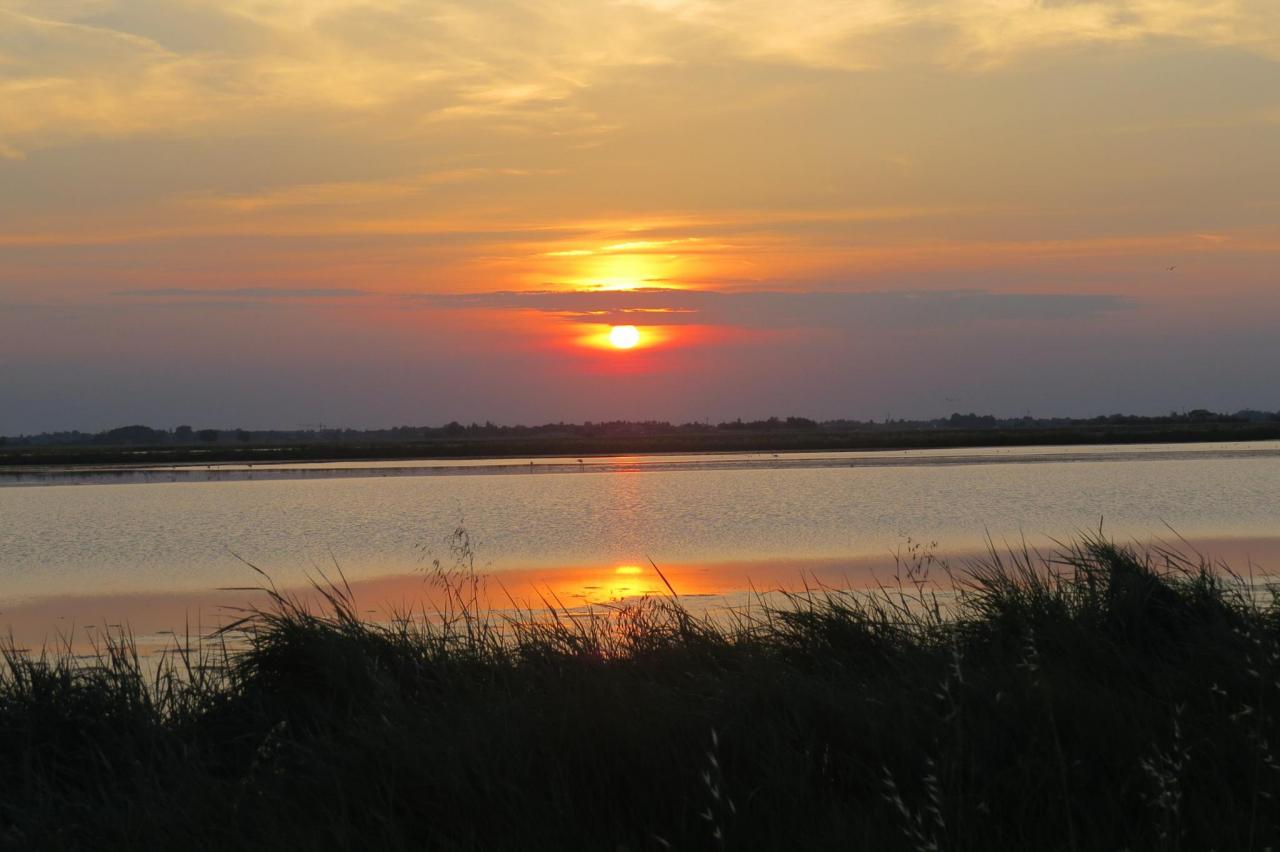
The sunset lights up the salt marsh with a thousand shades of red; seagulls and swallows tirelessly circle above the water mirrors, and the spectacle almost leaves one speechless. But Africo Ridolfi, born in 1935, fourth generation of a well-known family of salt workers, seems not to notice it; his eyes and hands are all for his gavaro, the ancient wooden rake, with which he piles up the salt on the edges of the last basin, waiting for one of his companions to come and collect it with a sturdy shovel and place it in the paniera, the typical basket of the salt workers, to transfer it to a creaky carriolo and deposit it on the white pile, the result of the daily harvest.
Every year, from June to September, in Cervia, on the Romagna beaches, where the classic bathing rituals take place, Africo and the volunteers of the “Civiltà Salinara” group spend the summer carrying on, with traditional tools and methods (the “multiple harvesting,” practiced already in Etruscan times, in which the sea water, passing from one evaporation basin to another, becomes pure white salt), the last artisanal salt marsh that has survived time, a true open-air museum, from which is obtained a white gold called the “sweet” salt of Cervia.
“The salt we harvest here at Camillone, the curious name of the salt marsh, has the characteristic of having a low concentration of potassium and the more bitter salts, which leave that typical slightly bitter aftertaste on the palate,” explains Africo, with understandable pride. “For this reason, it is particularly appreciated in catering and in the preparation of cured meats and cheeses. It is also an integral salt, because it is naturally dried, retaining all the trace elements (iodine, zinc, copper, manganese) present in the sea water.”
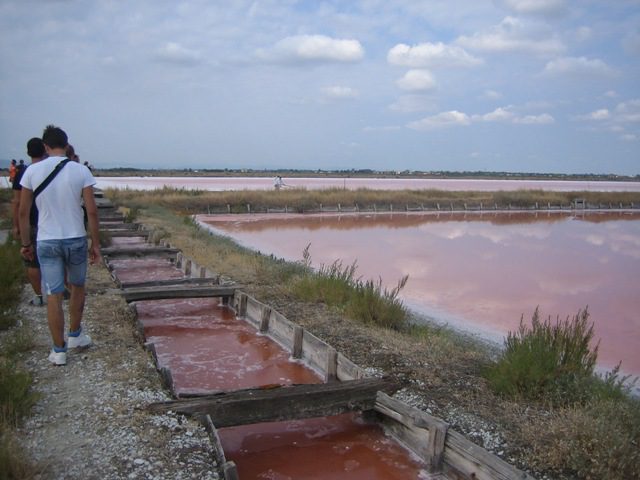
Salt has written the history of its city; Africo remembers very well the 144 private salt marshes that thrived until the late 1950s, when the Monopoly transformed them into a single, large salt marsh of 827 hectares, sparing only the small Camillone, whose sweet salt today enjoys a moment of glory, with the awarding of a Slow Food presidium.
Not far away, beyond the Adriatic state road, rises the yellow mass of modern Salt Plants, where most of the Cervia salt production takes place, about 60 thousand quintals per year. Decommissioned by the Monopoly in the late ’90s, the plants continue to produce today thanks to the creation of the company “Parco della Salina di Cervia“, which also manages the nearby Visitors Center, from where you can start to explore the southernmost part of the Po Delta Park, a wetland area of great charm and richness, home to foxes, terns, avocets, royal and coral gulls, flamingos, black-winged stilts, and many other resident and migratory bird species.
Inside the plants, there is an interesting shop area, where you can find salt packaged in cloth bags or in fine ceramics with traditional decoration; aromatic herb salts from Romagna, excellent for seasoning meats and fish; chocolate bars with sweet salt, whose flavor recalls bread and old-fashioned chocolate; relaxing and toning bath salts, traditionally used for body care, together with mud and mother water, as has been happening for centuries at the local spas.