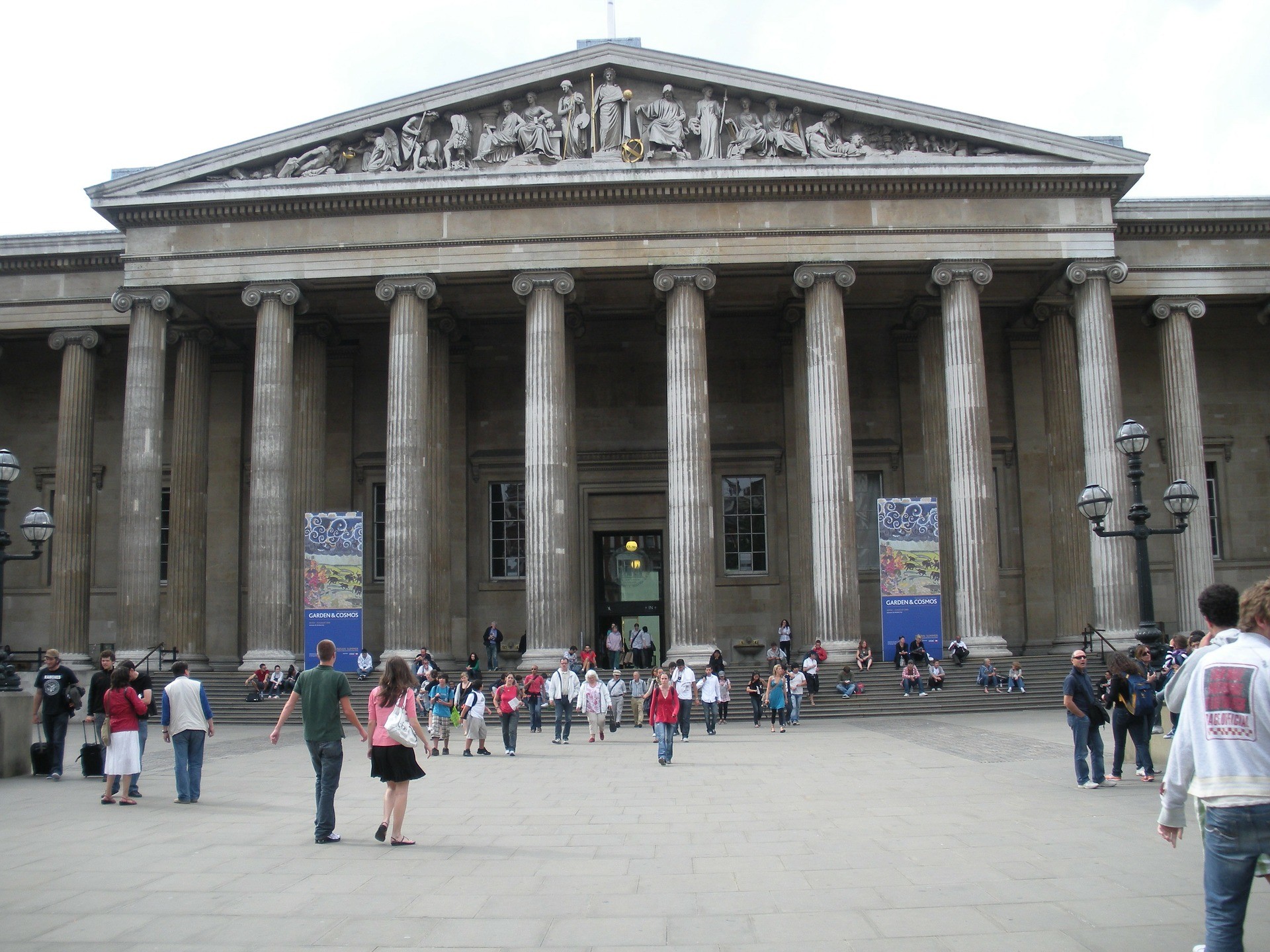
La National Gallery of London has about 2,300 paintings. Although larger collections exist in Europe, its value lies in having an encyclopedic collection that covers the period from the 13th century to the early 20th century. All the major artists are represented, sometimes with works so significant that they are also featured in art history textbooks.
- National Gallery: the origins
- National Gallery: the period from 1200 to 1500
- Battle of San Romano by Paolo Uccello
- The Baptism of Christ by Piero della Francesca
- The Arnolfini Portrait by Jan Van Eyck
- The Virgin of the Rocks by Leonardo da Vinci
- National Gallery: the 1500s
- The Ambassadors by Hans Holbein the Younger
- Bacchus and Ariadne by Titian
This proposal allows you to visit the museum through fourteen of the most famous and significant works, to have a comprehensive overview of the main moments in the history of Western painting.
National Gallery: the origins
The National Gallery in London was established in 1824 with a particular history. At the end of the 18th century, royal collections across Europe were being nationalized for various states: for example, the French royal collection was the origin of the Louvre. The English monarchs did not follow this trend and preferred to retain full ownership of their collection. However, intellectuals and politicians felt the need to create a collection that could serve to educate the public. The opportunity arose when the English government acquired thirty-eight paintings from the heirs of the entrepreneur John Julius Angerstein. From there, the collection has expanded to count approximately 2,300 works today.
To build the museum, Trafalgar Square was chosen: while it would have been more functional to place the building in the South Kensington museum district, the choice to display the collection near centers of power (Buckingham Palace and Parliament) has a specific political meaning. However, space has always been limited, and the building has undergone several modifications, in line with the growing collection. The latest extension is the Sainsbury Wing, from where our visit begins.
National Gallery: the period from 1200 to 1500
Battle of San Romano by Paolo Uccello
Religious painting is the main subject of the first rooms, and in this context Paolo Uccello, with his Battle of San Romano, is an exception. In fact, it is a work intended for a commission from the merchant bourgeoisie of Florence in the fifteenth century. The painting was part of a series of three paintings (the other two are on display at the Louvre and the Uffizi) in which, more than traditionally representing the battle, the aim is to emphasize the victory of Florence and the figure of the condottiero Niccolò da Tolentino. What characterizes the art of Paolo Uccello is the research on perspective, which had been discovered by artists in this period and is experimented with here using the grid of broken lances on the ground.

The Baptism of Christ by Piero della Francesca
Room 61 is dedicated to two great masters of the fifteenth century: Raphael and Piero della Francesca, whom Raphael himself admired for his great ability to integrate geometric rhythms with nature. It is no coincidence that Piero della Francesca was also a mathematician. The Baptism of Christ is the oldest of the few surviving works by this artist. In it, mathematical principles are used both to harmoniously balance the composition and to create perspectival effects. The landscape in which the scene is set is that of Borgo Sansepolcro, where the work was destined: in this way, the spectators were directly involved in the evangelical episode.

The Arnolfini Portrait by Jan Van Eyck
Among the foreign works of this period stands out the famous The Arnolfini Portrait by Jan Van Eyck, the first Dutch work acquired by the National Gallery. It is an enigmatic painting, showing the wealth of the couple, but without too much ostentation. The most mysterious element is the image reflected in the mirror, showing two men entering the room. The presence, above the mirror, of the inscription “Jan Van Eyck was here. 1443” may suggest that the two men are the painter himself and his assistant.

The Virgin of the Rocks by Leonardo da Vinci
The tour in the Sainsbury Wing concludes, in Room 66, with the famous Virgin of the Rocks by Leonardo da Vinci. The work had been commissioned by the Sforza family of Milan at a time when there was a heated debate on the Immaculate Conception. Supporters of the doctrine claimed that Mary had been created by God before the creation of the world and therefore before original sin. Hence the choice of the primitive landscape, made of only rocks, where even the few flowers that appear do not exist in nature, but are invented. In this painting, Leonardo also applies his studies on aerial perspective and on the differences in color perception according to the distance of the observer.

National Gallery: the 1500s
The 1500s is the century of the Lutheran Reformation, which in the Germanic countries led to a drastic reduction in religious-themed painting and a consequent increase in portraits.
The Ambassadors by Hans Holbein the Younger
Thus Hans Holbein the Younger moved to London to become the court painter of Henry VIII. The National Gallery houses the famous painting The Ambassadors: it is a double portrait of the French ambassador Dinteville and the bishop of Lavaur. The painting is full of symbols related to politics and religion, represented by the objects placed on the table. Images of this era often carried more or less explicit messages about the fragility of life. Here, the memento mori is represented by the strange design at the bottom where, looking from the right side, a skull appears.

The sixteenth century is a great century for Italian art. The papal court allowed Michelangelo and Raphael to develop their magnificent art. But cities such as Venice, Ferrara, and Bologna were also cradles of prominent artists. Titian is one of these, and he is represented in the National Gallery with numerous works, including Bacchus and Ariadne. The painting depicts the moment of falling in love between the two characters, with Ariadne just abandoned on Naxos and Bacchus returning from India, accompanied by his varied court. The mastery in the use of the best pigments available at the time and the narrative of the composition have made it a very famous work, a model for many others with the same subject.