


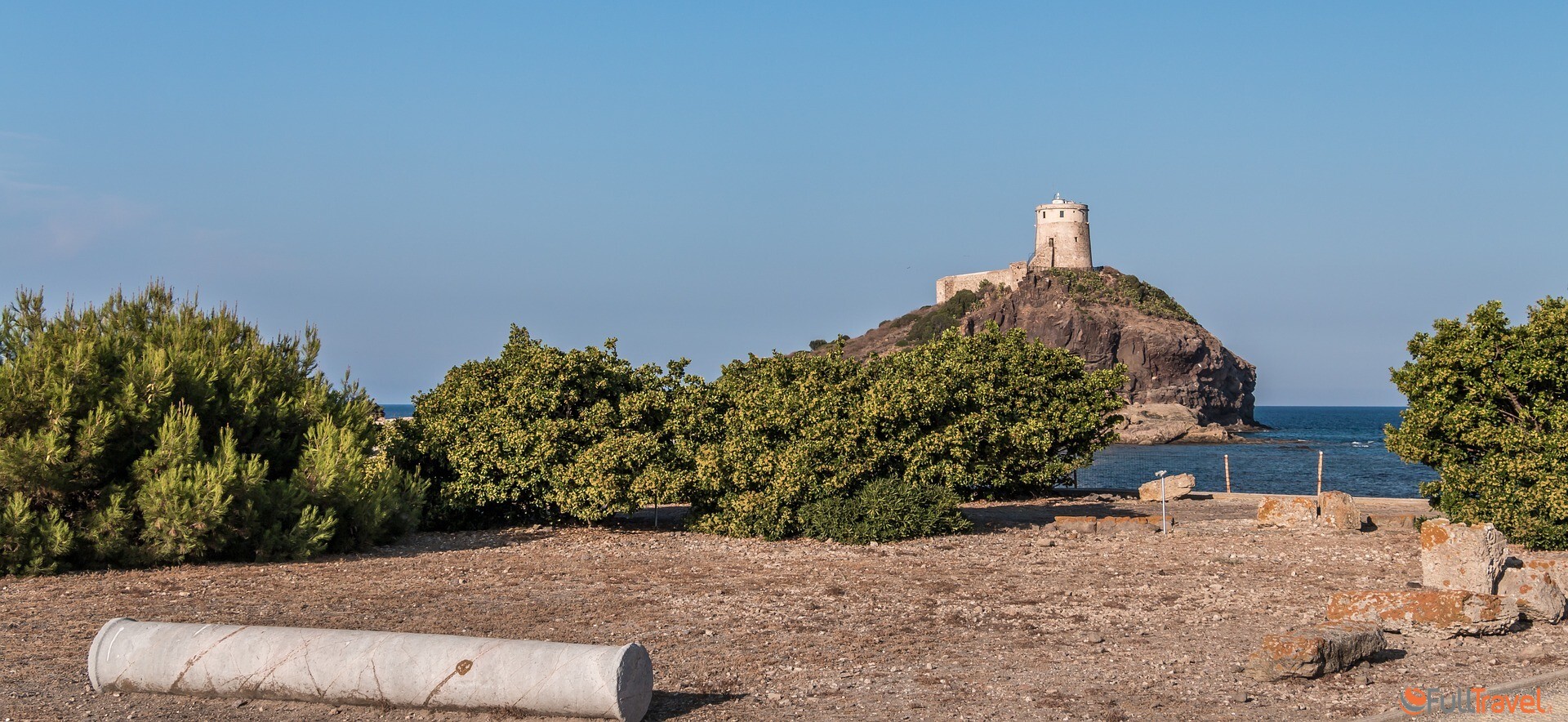


Nora, located within the territory of Pula in Sardinia, not far from Cagliari, is a place of great interest and charm. What stands out first is its position, on a promontory separated from the inland by an isthmus. The promontory expands into two points, Punta ‘e su Coloru (Snake Point) and Punta di Coltellazzo, opposite the islet of the same name.
- Complete Guide to Nora
- 1 The Hill of Tanit
- 2 The Forum of Nora
- 3 The Temple of Nora
- 4 The Theater of Nora
- 5 The residential district of Nora
- 6 The central baths of Nora
- 7 The Sea Baths of Nora
- 8 The Villas of Nora
- 9 The Temple of Asclepius in Nora
- 10 The Church of Saint Efisio in Nora
- 11 Useful information about the archaeological area of Nora
- 12 Nora at the Archaeological Museum of Cagliari
Complete Guide to Nora
The classical sources say that Nora is the oldest city in Sardinia and that it was founded by Norace, a hero coming from Tartessos, the region identified with the Mediterranean coast of Spain. This could be a reference to the foundation by the Phoenicians, who sought sheltered coastal places that offered them a safe harbor, just like the peninsula of Nora. There are no significant visible traces left of the Phoenician and Punic city. The tophet, the cemetery reserved for children, has also been lost. The tophet of Nora was the first complex of this type to be discovered in Sardinia at the end of the nineteenth century. However, it was mistaken for a normal cremation necropolis and therefore did not receive the appropriate attention.

What remains today is Roman Nora, a very important and wealthy city which, due to its position directly on the sea, was progressively abandoned from the beginning of the 5th century AD because of raids by pirates and Vandals. The small church dedicated to Saint Efisio, built in the 11th century, has remained over time a center of cohesion in the territory and is still today a frequented place of devotion.
1 The Hill of Tanit
At the entrance of the excavations, on the right, there is the Hill of Tanit, so called for the remains of a building identified as the Temple of Tanit by Patroni, who excavated it at the beginning of the twentieth century. The attribution comes from the discovery of a small stone pyramid, now lost, which the excavator identified as part of a statuette of Tanit, the Phoenician-Punic female deity represented with a triangle surmounted by a circle. The hypothesis of a large monumental building in this area is reinforced by the presence of remains of terrace walls and a staircase. At the base of the hill, a lion-head water spout, probably coming from this supposed temple, is clearly visible.

2 The Forum of Nora
Continuing along the Roman road that passes in front of the Hill of Tanit, you arrive at the Forum. The shape of the square is very regular, almost square. On the two sides, the remains of the portico are visible, with the bases of the columns, and on the northern side the foundations of a building, perhaps a temple. In the center of the square stood a rectangular base that probably supported the statue of a prominent figure, perhaps an emperor.

3 The Temple of Nora
On the other side of the street, on the right, there is a temple that was accessed by a staircase. The column currently visible was part of the pronaos, but it was arbitrarily re-erected by the excavator. The cella is almost square and the floor consists of a mosaic, fragmentary, dating back to the 2nd-3rd century AD.

4 The Theater of Nora
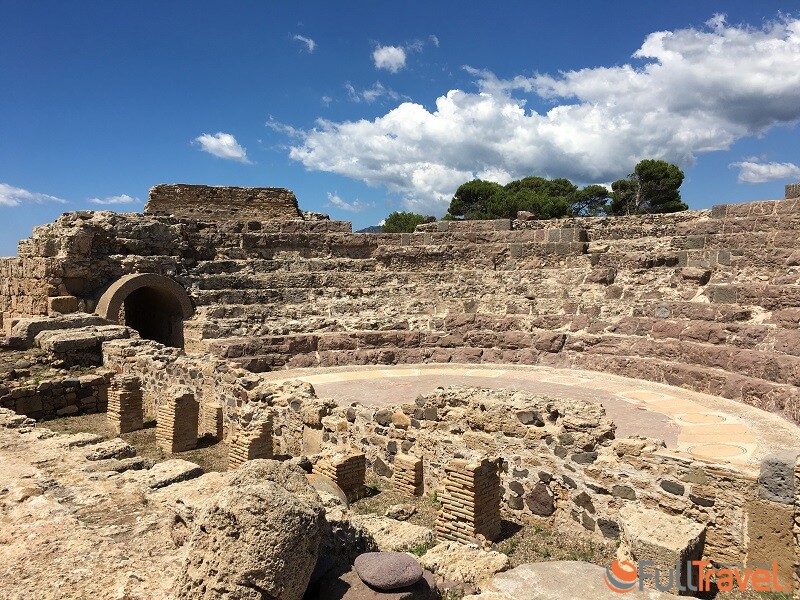
The theater is one of the best-preserved buildings in Nora. The semicircular surface of the exterior is broken by the presence of eight square niches and three vomitoria, entrances for the public. At half of its original height, the wall is decorated with an elegantly molded cornice.
At the front, from the street, you can see the remains of the porticus post scaenam, the portico leaning against the wall that formed the backdrop of the theater scene, and the orchestra, with a mosaic floor with circles. The cavea consists of eleven steps on which the spectators sat.
It has been calculated that the theater of Nora could hold 680 people; from this data, and from a hypothesis of the numerical ratio between the audience attending the theater and the overall population of the city, some scholars have assumed that the population of Nora counted between 3,500 and 4,000 inhabitants.
Under the stage, four large ceramic jars were found that had the function of amplifying the voice of the actors. The trademark of one of these jars and a coin of Emperor Hadrian found in the foundations have allowed dating the theater between 117 and 138 AD.
5 The residential district of Nora
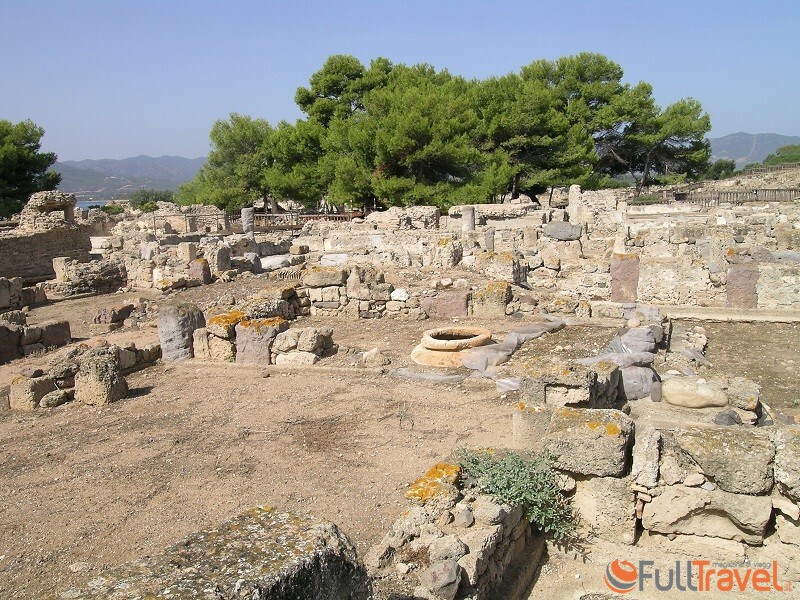
Past the theater, on the left is a block of houses. Among the wall remains, large buried jars can be seen, intended for the storage of foodstuffs, and mortars that may suggest artisanal workshops or houses with small-scale production activities.
6 The central baths of Nora
Continuing along the road, a corridor leads to the central baths. The rooms have some geometric mosaics. On both sides, peristyles are visible, colonnaded corridors that serve as access to the baths, also with mosaic floors. Immediately to the northwest are the remains of Republican-era rooms, predating the baths. One of these has been interpreted as a nymphaeum, that is, a garden with architectural decorations.

7 The Sea Baths of Nora
The Sea Baths are the most important thermal building of Nora. It is a complex about 50 x 30 meters, with a portico entrance on two sides. The massive collapsed vaults are still visible, some of which have been moved to the nearby square (probably, in Roman times, a gymnasium). This complex was richly decorated. Numerous fragments of painted plaster in bands, marble slabs, and many glass paste tesserae were found that probably formed polychrome mosaics on the walls or vaults.
The building can be dated to the late 2nd century AD. About two centuries later it was refurbished for a different use, probably as a military post to protect the city from pirate and Vandal attacks from the sea. On that occasion, it was stripped of its decorations.

8 The Villas of Nora
After walking along the tree-lined avenue, we find ourselves in front of two stately homes. The first is the House of the Tetrastyle Atrium, so called because the atrium with its four columns and impluvium is clearly distinguishable. Around it is a series of rooms, some of which have particularly refined mosaic floors. They are mostly geometric, but there is also a black-profiled emblem depicting a female figure riding a sea animal. This emblem is one of the rare examples of Sardinian mosaics with non-geometric depiction and dates to the first half of the 3rd century AD. In this house, a small staircase can also be seen, which must have led to an upper floor, now completely absent. To the north of the House of the Tetrastyle Atrium lie the remains of another large stately home, in worse condition, with more frequent late-period interventions and no mosaics.

9 The Temple of Asclepius in Nora
The last important building of the archaeological route is a complex of a sacred nature. Located on the top of the promontory, it is arranged on several levels and features a large front space. In a joint of the subfloor, a Constantinian coin was found that allows dating the complex to the 4th century AD.
But there are traces of earlier periods. On the same site, a series of clay figurines dating back to the 2nd century BC, that is, the Roman Republican period, were found. The two largest depict sleeping men, one of whom is surrounded by a snake. We know that in the sanctuaries of the healing deity Asclepius, the rite of incubation was practiced, that is, therapeutic sleep in the temple, and that the snake was a sacred animal to the god. If we are now sure of the existence of a temple of Asclepius at least from the 2nd century BC, we do not have certain traces of an older Punic structure. If it existed, it was probably dedicated to Eshmun, a deity associated with healing.

10 The Church of Saint Efisio in Nora
Outside the archaeological area, on the beach of Nora, there is the beautiful Romanesque church from the 11th century AD, built on the site of the martyrdom of Saint Efisio. Sardinia is particularly devoted to Efisio since, in 1656, the municipality of Cagliari invoked the saint’s protection to free the city from a terrible plague. Since then, to fulfill the vow, every May 1st the statue of the saint is carried in procession from the homonymous church in Cagliari to Nora.
The pilgrimage lasts four days, two on the way there and two on the return, and is particularly attended and felt by the whole Sardinian population. The church of Nora was partly built with stones recovered from the archaeological area. It is therefore not surprising to see Roman inscriptions or Punic steles on the façade or in the internal walls.

11 Useful information about the archaeological area of Nora
The archaeological area of Nora is located in the municipality of Pula, just over thirty kilometers from Cagliari. It is easily reachable from the city by car or by regular buses, and is also close to the tourist locations on the southwest coast of Sardinia (Santa Margherita di Pula and Chia). Guided visits are mandatory. The ticket also includes entrance to the Patroni Archaeological Museum of Pula.
For nature lovers, very close to the excavations is the lagoon park “Laguna di Nora,” where guided canoe tours and visits to the Marine Mammal and Turtle Rescue Center are available.
12 Nora at the Archaeological Museum of Cagliari
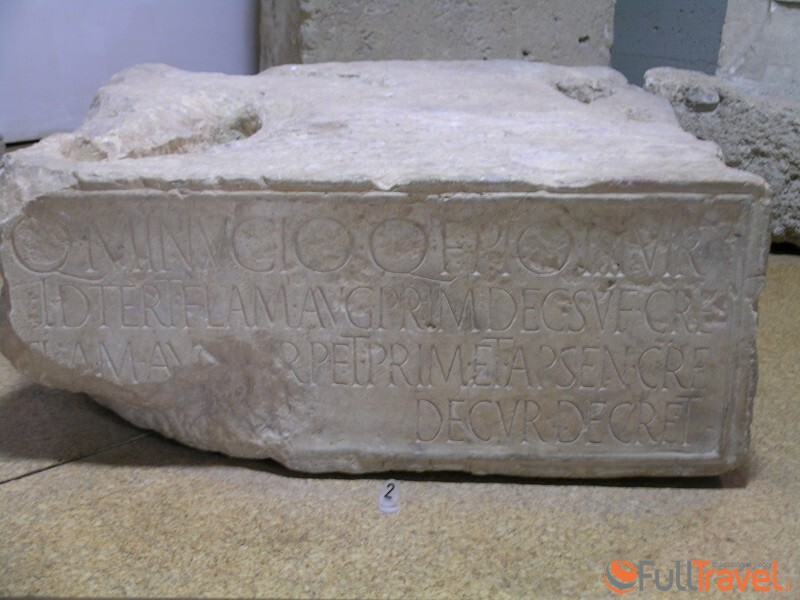
Those who want to complete their knowledge about Nora can find a very significant selection of artifacts at the Archaeological Museum of Cagliari. The best known is probably the Phoenician stele from the 8th century BC which bears the oldest written evidence of the word Sardinia, in the form shrdn. Among the inscriptions, there is also that of the quattuorvir Quintus Minucius Pius, coming from the forum, which attests to Nora’s legal status as a municipium, that is, a city under Roman law.
Finally, votive statuettes from the Temple of Asclepius and some funerary sets with valuable objects, including Attic ceramics, are also exhibited.