


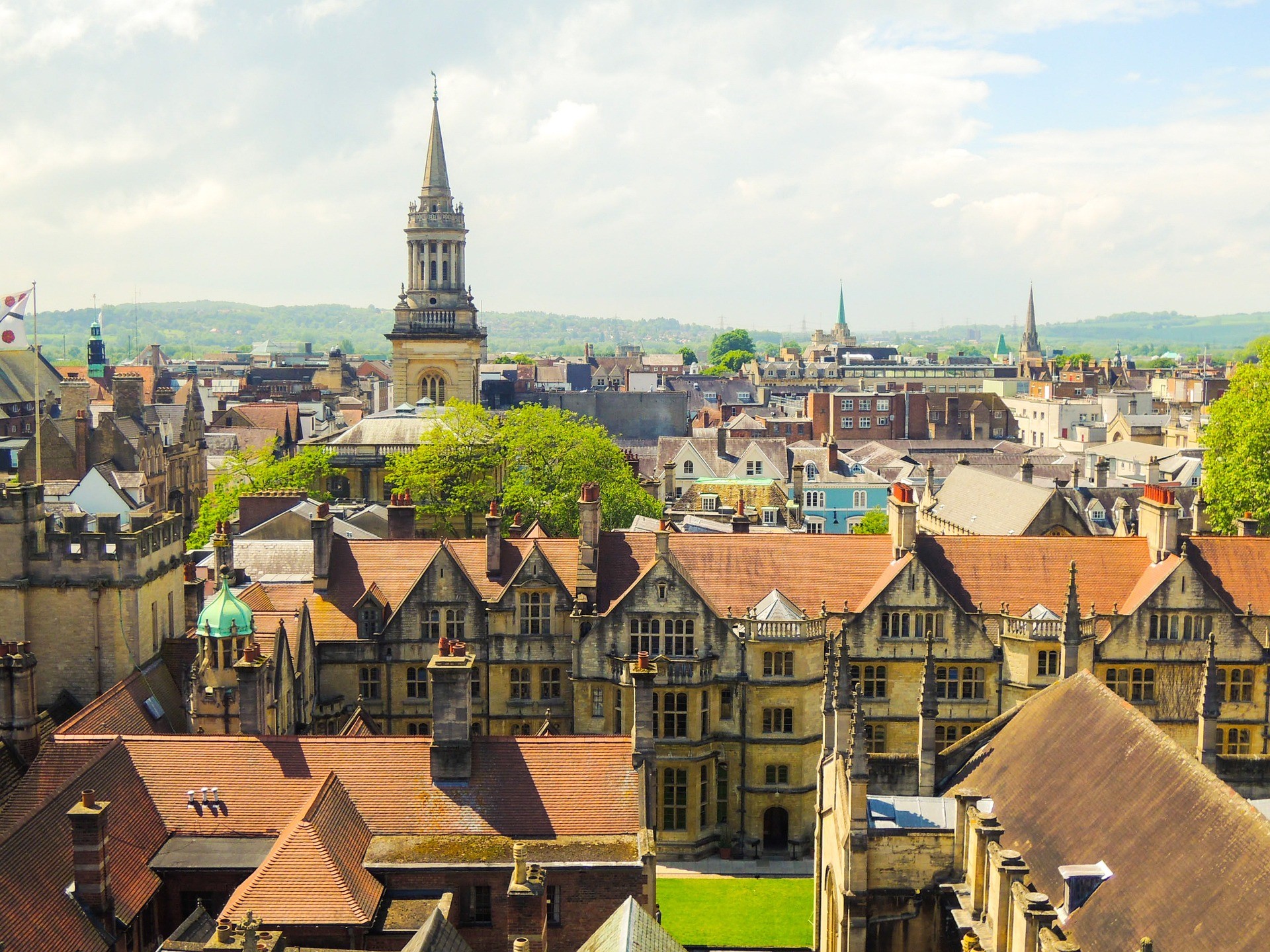

Oxford is, alongside Cambridge, the most renowned university in the United Kingdom and one of the most important in the world. A visit to the city cannot overlook its almost millenary history as a cultural institution, significant in itself and for the influence it has had in subsequent times. The iconography of Harry Potter, for example, owes much to this city.
What to see in Oxford, United Kingdom
The University of Oxford
The University of Oxford in England is the second oldest university in the world (the first is Bologna). The oldest records of teaching date back to 1096, but it is at the beginning of the 13th century that the first evidence of an organized educational system (Scholae Oxoniae) appears. A decisive factor for the development of the university was the expulsion of English students from the University of the Sorbonne in 1167. Historically, the University of Oxford does not have a main campus: the 39 colleges and 6 halls that make it up, along with libraries, accommodations, and other services, are scattered throughout the city.
Most of the colleges were originally founded for religious purposes. For this reason, their appearance closely resembles that of monasteries, primarily due to the presence of large cloisters.
Definitely worth a visit is the Christ Church College, the most prestigious in the city, founded in 1525 by Cardinal Wolsey and re-founded eight years later by Henry VIII. Among its numerous illustrious alumni are the writer Lewis Carroll and the philosopher John Locke.

Inside it is the Tom Quad: initially designed to be a cloister, it is today the largest courtyard in all of Oxford. It is characterized by the Tom Tower, a work by Christopher Wren, which houses the bell that every evening at 9 p.m. strikes 101 times to signal the closing of the college.
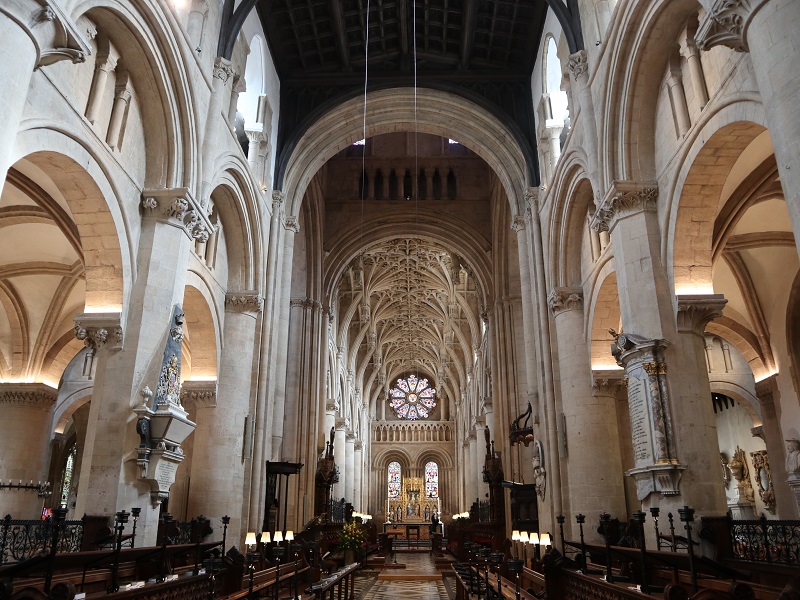
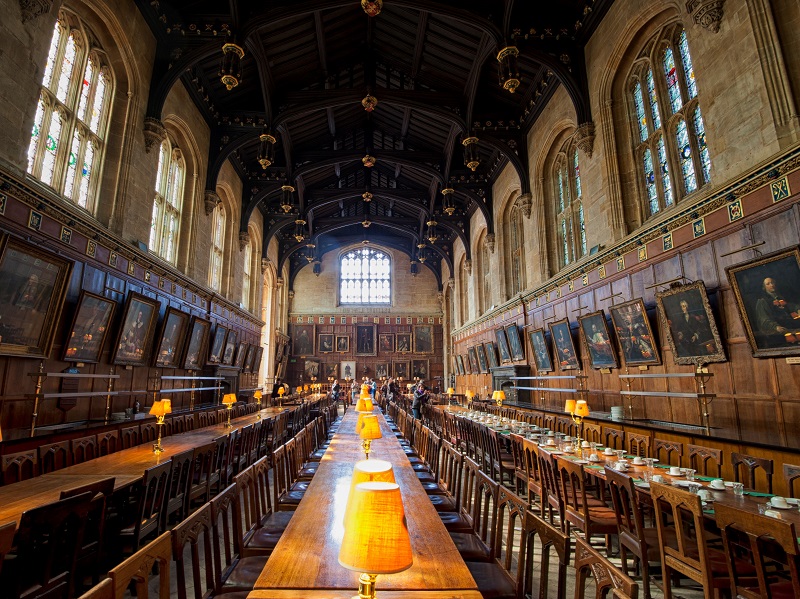
Christ Church College includes within it the Oxford Cathedral, a fine example of medieval architecture. Another notable room is the Great Hall, used daily for meals by students and professors, with a beautiful carved wooden ceiling.
The College also has its own Picture Gallery that includes, among others, three masterpieces of Italian art: The Butchery by Annibale Carracci, The Supper at Emmaus by Lorenzo Lotto, and the Martyrdom of Saint Lawrence by Tintoretto.
Other colleges worth visiting are the Magdalen College, considered the most beautiful from an architectural point of view, and the New College, which has remained virtually unchanged since its foundation in 1379.
The Bodleian Library
A university cannot do without its own library. And naturally, the main library of the University of Oxford, the Bodleian Library, lives up to the institution. The original collection dates back to the 14th century and consisted of a small collection. When, around 1435, the important donation of Humphrey, Duke of Gloucester, was added, it became necessary to build a dedicated space. Thus, a floor was raised above the Divinity School, the oldest lecture hall in Oxford, where theology lessons and exams were held.
After a period of decline, around 1600 Thomas Bodley, professor of Merton College and ambassador of Elizabeth I, offered to reorganize the library (hence the name Bodleian). Bodley expanded the collection and above all created the agreement, still existing today, that a copy of every publication printed in the United Kingdom must be deposited in the library.

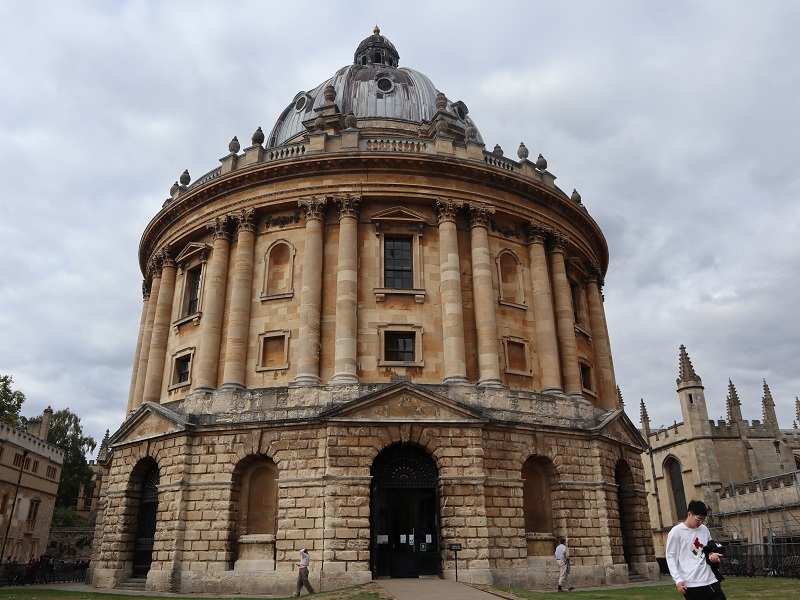
Guided tours of the historical part of the Bodleian Gallery are available. Depending on the type of visit, you can admire the beautiful Gothic hall of the Divinity School, the overlying Duke Humfrey’s Library, the oldest part of the library, and the iconic baroque rotunda of the Radcliffe Camera.
Oxford and Harry Potter
The Gothic architectures of the University of Oxford embody the common imagery associated with English educational institutions. For this reason, several places have been used to set the adventures of Harry Potter in the magic school of Hogwarts.
The main staircase of Christ Church College is the place where Albus Dumbledore welcomes students at the beginning of the school year and assigns them to their houses. The Great Hall of the same college inspired the Hogwarts dining hall, which is part of the tour of the Warner Bros Harry Potter Studios, just outside London.
The Gothic hall of the Divinity School became the Hogwarts infirmary. It is where Harry is hospitalized in the first film after falling during a Quidditch match, and where Hermione is brought when she is petrified in the film “Harry Potter and the Chamber of Secrets”.
The Duke Humprey’s Gallery is the school library. The restricted section is the oldest part of the room. A curiosity: a rule that has historically distinguished this library is the absolute prohibition of any kind of flame. When Harry, covered by the invisibility cloak, goes to the secret library at night, he carries a lamp whose flame was entirely created in post-production.
Finally, the courtyard of the New College is the place where the three protagonists of the film often chat and where Ron, in “The Half-Blood Prince,” finds himself spitting out frogs after casting a spell with a broken wand.