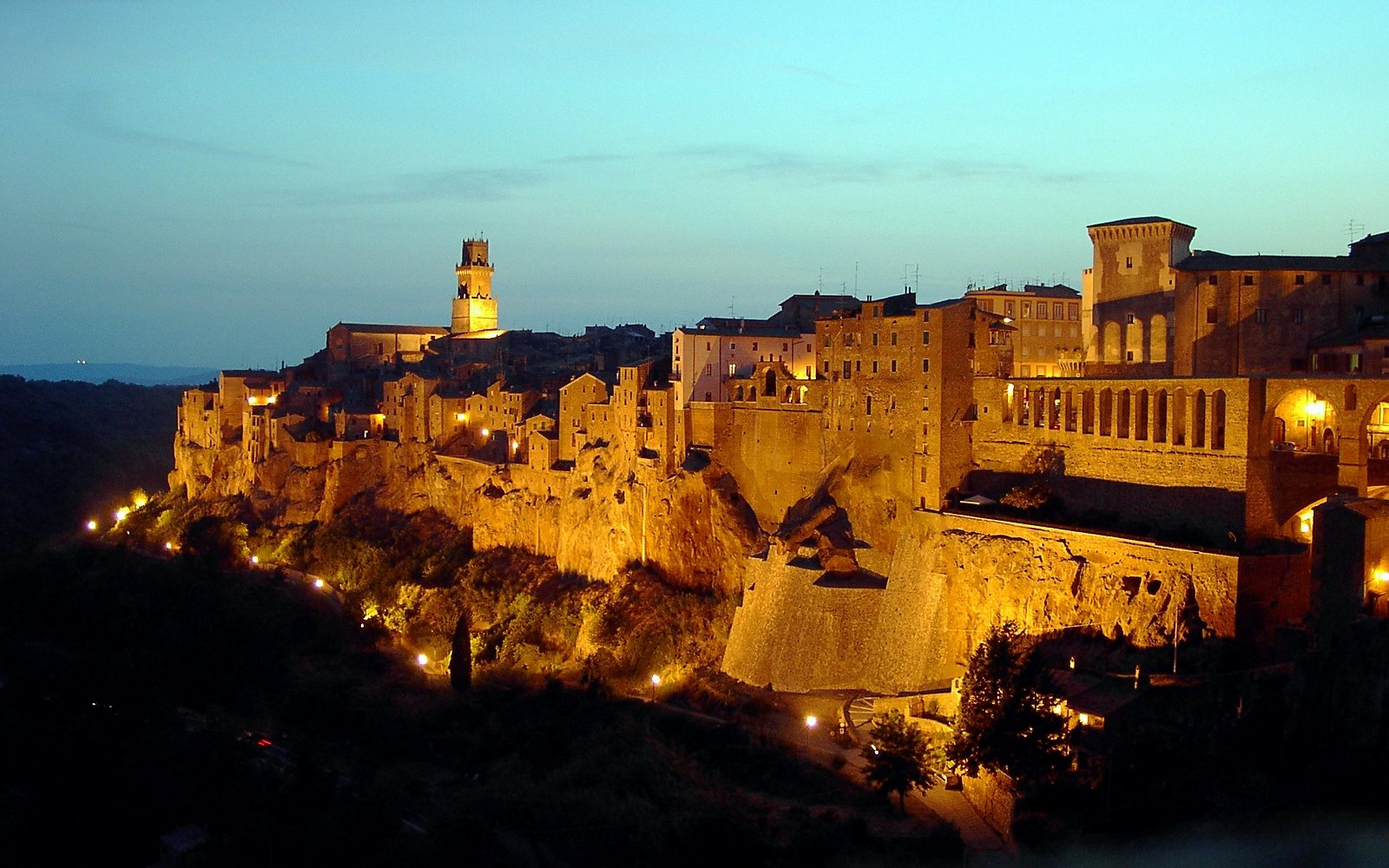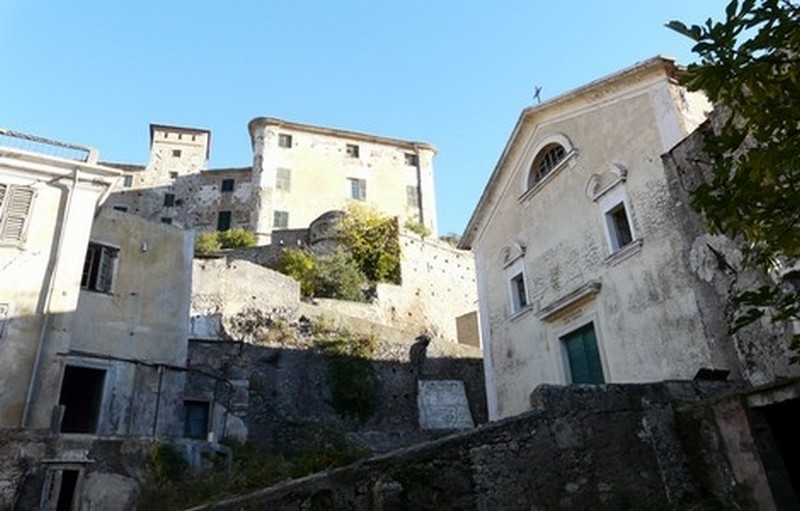


Perched on a large tuff cliff, which rises suddenly from the gentle lines of the surrounding countryside, Orvieto opens its heart in Piazza del Duomo, a suggestive space, surrounded by ancient palaces and dominated by the thirteenth-century silhouette of the Duomo, whose façade, wonderfully sculpted, shines with mosaics and polychrome marbles.
- What to see in Orvieto
- 1 The Cathedral
- 2 St. Patrick’s Well
- 3 Cava Well
- 4 Etruscan Necropolis “Crocifisso del Tufo”
- 5 Moro Tower
- 6 Coelli Palace
- 7 Luigi Mancinelli Theater
- 8 Orvieto Underground
- Orvieto Museums
- 9 National Archaeological Museum of Orvieto
- 10 Museum of Medieval and Renaissance Orvietan Maiolica
- 11 Opera del Duomo Museum (MODO)
- 12 Emilio Greco Museum
- 13 “Claudio Faina” Museum and Civic Museum
- Other places of interest in Orvieto
- 14 Abbey of San Severo and Martyrdom
- 15 Complex of the Papal Palaces
- 16 Former Church of Sant’Agostino of Orvieto
Inside are preserved pictorial masterpieces, such as “The Stories of the Antichrist“, “The Resurrection of the Flesh“, “The Reprobate and the Elect” and the “Last Judgment” (in the Brizio Chapel) by Luca Signorelli, and the Angels on the Sails of the ceiling by Beato Angelico.
The beauty of Orvieto is amplified by the presence of two Etruscan necropolises, located at the base of the cliff (San Martino-Orvieto Scalo area) and by the underground part of the city, expanded during the Middle Ages and used for various purposes, until it became a genuine cluster carved into the mountain.
What to see in Orvieto
1 The Cathedral
The Orvieto Cathedral is a true masterpiece of Gothic architecture and is an Italian national monument. The church was commissioned by Pope Nicholas IV. Construction began in 1290 with the intention of joining two already existing churches. Inside the Cathedral is kept the Corporale del miracolo di Bolsena, from which the feast of Corpus Domini originated. The facade was only completed at the end of the 16th century, with the construction of the side spires by Ippolito Scalza. The mosaics on the facade are of great importance but, due to numerous restorations, they have lost over time their original shapes and style.

2 St. Patrick’s Well
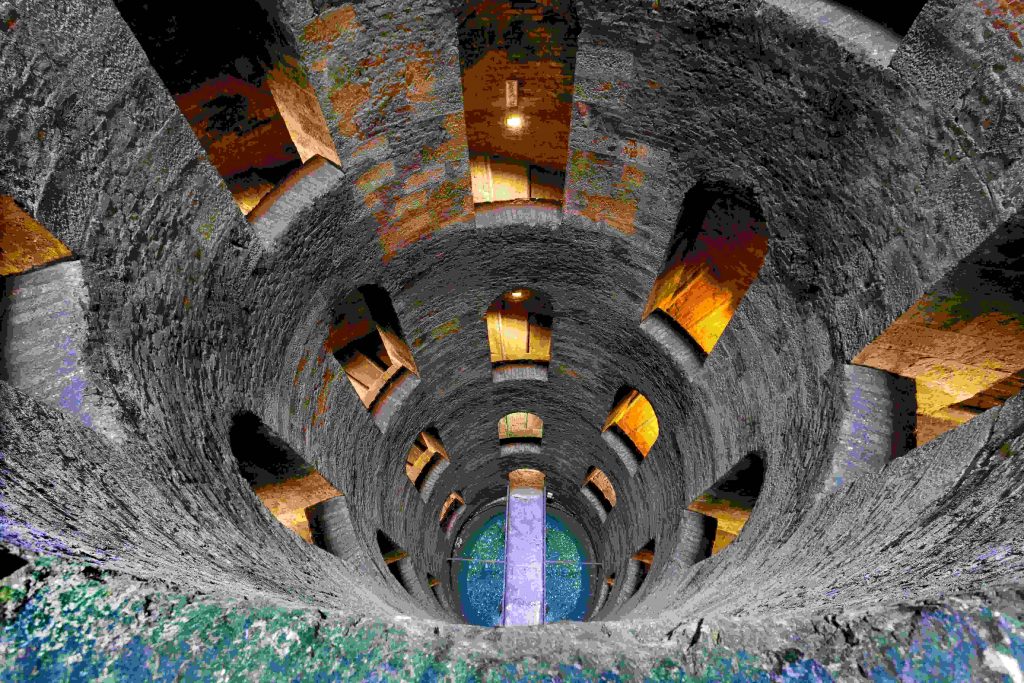
The St. Patrick’s Well is located in a panoramic position in the center of Orvieto. It was built by order of Pope Clement VII, who took refuge in Orvieto during the sack of Rome in 1527. The project was entrusted to the Florentine Antonio da Sangallo the Younger. Work was completed in 1537. Circular in section, it is sixty-two meters deep and thirteen meters wide. Around the well shaft spiral two spiral staircases designed so that they run overlaid on each other without communicating with each other. Each staircase has two hundred and forty-eight very comfortable steps, easy to descend even for pack animals. At the bottom of the shaft a small bridge connects the two staircases. The outer part of the well, consisting of a wide and low cylindrical structure, is decorated with the Farnese lilies of Pope Paul III, successor to Clement VII. At the entrance, the plaque “quod natura munimento inviderat industria adiecit” (“what nature did not give, industry added”) celebrates the power of human engineering capable of compensating for natural shortcomings such as the lack of water in the city.
Pope Clement VII never saw the work completed, which was finished by Simone Mosca in 1543, when Paul III was on the Papal throne. The Fortress Well, as it was originally called, only took on the proverbial name of St. Patrick in the nineteenth century, when the fortress had lost its military function. The name of the Well has no connection with local figures, but refers to the Irish abyss where St. Patrick was accustomed to pray. During the construction of the well, numerous archaeological finds dating back to the Etruscan era were discovered.
3 Cava Well
The complex, with entrance on Via della Cava, extends under the oldest district of Orvieto. Structured into nine basements, it is rich in Etruscan, medieval, and Renaissance finds, brought to light only recently, after almost four centuries of abandonment.
The deep well, from which the entire site takes its name, was excavated using a pre-existing Etruscan well by Pope Clement VII who, having taken refuge in Orvieto in 1527, ordered its construction to be able to draw spring water in case of siege. Its structure features two attached parts: one circular in section and the other, smaller and dating back to the 5th-6th century BC, rectangular. Next to the well it is possible to continue the tour with a visit to an Etruscan cistern, some “butti”, a medieval cellar, and remains of ancient rock-cut tombs. Also interesting are some rooms used in the Middle Ages and Renaissance for ceramic production. During the Christmas period, a suggestive nativity scene is created in the well cavity, whose setup, different every year, is always remarkable in artistic execution and historical setting.

4 Etruscan Necropolis “Crocifisso del Tufo”
The necropolis stretches along the northern side of the tuff cliff on which Orvieto, the Etruscan Velzna, stands. Discovered in the nineteenth century, it represents an extraordinary document of Etruscan history and culture. Its visit is essentially complemented by that of the National Archaeological Museum and the Claudio Faina Museum of Orvieto, which house numerous finds, especially rich ceramic sets. The necropolis was used from the 8th to the 3rd century BC; at its peak development (6th-5th century BC) the necropolis was planned into blocks, defined by mutually orthogonal roads and occupied by “dice-shaped” tombs, following a strict arrangement reflecting an egalitarian social organization. Each burial was reserved for individual families identified by the name engraved on the architrave, revealing also the presence of foreign citizens in Orvieto, increasingly cosmopolitan. Forms of ostentation of wealth attained by a large stratum of citizens are finally expressed by the luxurious burial objects, purchased on the Greco-Eastern market, many of which are now visible at the National Archaeological Museum and the Claudio Faina Museum of Orvieto.
5 Moro Tower
An experience not to be missed is climbing to the top of the Moro Tower, where the gaze can roam freely over city roofs and the wonderful countryside. The tower is located in the center of Orvieto, along the main street.
At the end of the thirteenth century, Orvieto had a new urban arrangement and strategically placed the Palazzo dei Sette with the tower called the Pope’s Tower, 47 meters high and oriented almost perfectly according to the four cardinal points. Its imposing size allowed visual domination of the then vast territory of the Orvieto state. In the 16th century, the tower was named after Raffaele di Sante, called Il Moro, who also gave his name to the underlying Palazzo Gualtiero, his property, and to the entire district. In 1865, at eighteen meters height, the tower received the distributing tank of the new aqueduct and, following the restorations of 1866, the mechanical clock and two civic bells were installed. The smaller bell came from the Sant’Andrea tower and the larger one from the Palazzo del Popolo.
The Palazzo dei Sette with the Moro Tower, recently restored and used as a cultural center, belonged to the ancient Della Terza family, then it was property of the Papacy, seat of the Sette, of the pontiff, and it seems that Antonio da Sangallo also lived there.

6 Coelli Palace
A stone’s throw from the Cathedral stands, in a strategic and privileged position, easily reachable, the elegant and monumental Coelli Palace, home of the Orvieto Savings Bank Foundation. The building, owned over the centuries by illustrious Orvietan families, is the result of the aggregation in successive eras of different volumes that today constitute a refined and versatile location where taste and comfort merge into an inseparable pair. The ancient noble residence, completely renovated and expanded, is now also a qualified congress center functional for organizing any kind of event: workshops, art exhibitions, meetings, conferences and events of cultural and corporate interest.
7 Luigi Mancinelli Theater
The theater of Orvieto, important both historically and artistically, is located in the center of the town, a few steps from the Cathedral and not far from the main square. The visit is recommended both for the beauty of the theater and for the rich theatrical and musical season. Theatrical activity in Orvieto is documented since the sixteenth century with the academy dei Giovani, also called dei Confusi, which met in the upper hall of the city’s Palazzo del Popolo. But in reality the dissatisfaction with a not very functional theater and ambition pushed some to find alternative solutions to the academy’s theater. In the eighteenth century the Gualtiero family created a private theater in the Corniolo villa, in Porano, today villa Paolina. But for a true theater one will have to wait until 1863, the year of its inauguration. Designed by Giuseppe Santini, the Mancinelli Theater was inaugurated in 1863. In the same year, Annibale Angelini was entrusted with decorating the interiors with grotesques, putti and festoons, drawn from classical tradition. Giuliano Corsini took care of the stucco decorations, while the Roman Cesare Fracassini handled the figurative painting, including the curtain, completed in 1886. For the inauguration the opera “Favorita e Marte” was staged together with the ballets “I Bianchi e i Neri” and “Pedrilla”. The hall has the classic shape of the Italian-style theater, with a horseshoe plan, four tiers of boxes and a loggia. In 1921 it was dedicated to the Orvietan musician Luigi Mancinelli (1848-1921). Today it appears in its original form with a capacity of five hundred and sixty seats. In the local culture, it has always had a central role, confirmed by the versatility of activities that take place inside: congresses, conferences, exhibitions, lectures and meetings with artists, but also seminars for the dissemination and study of cinematographic art.

8 Orvieto Underground
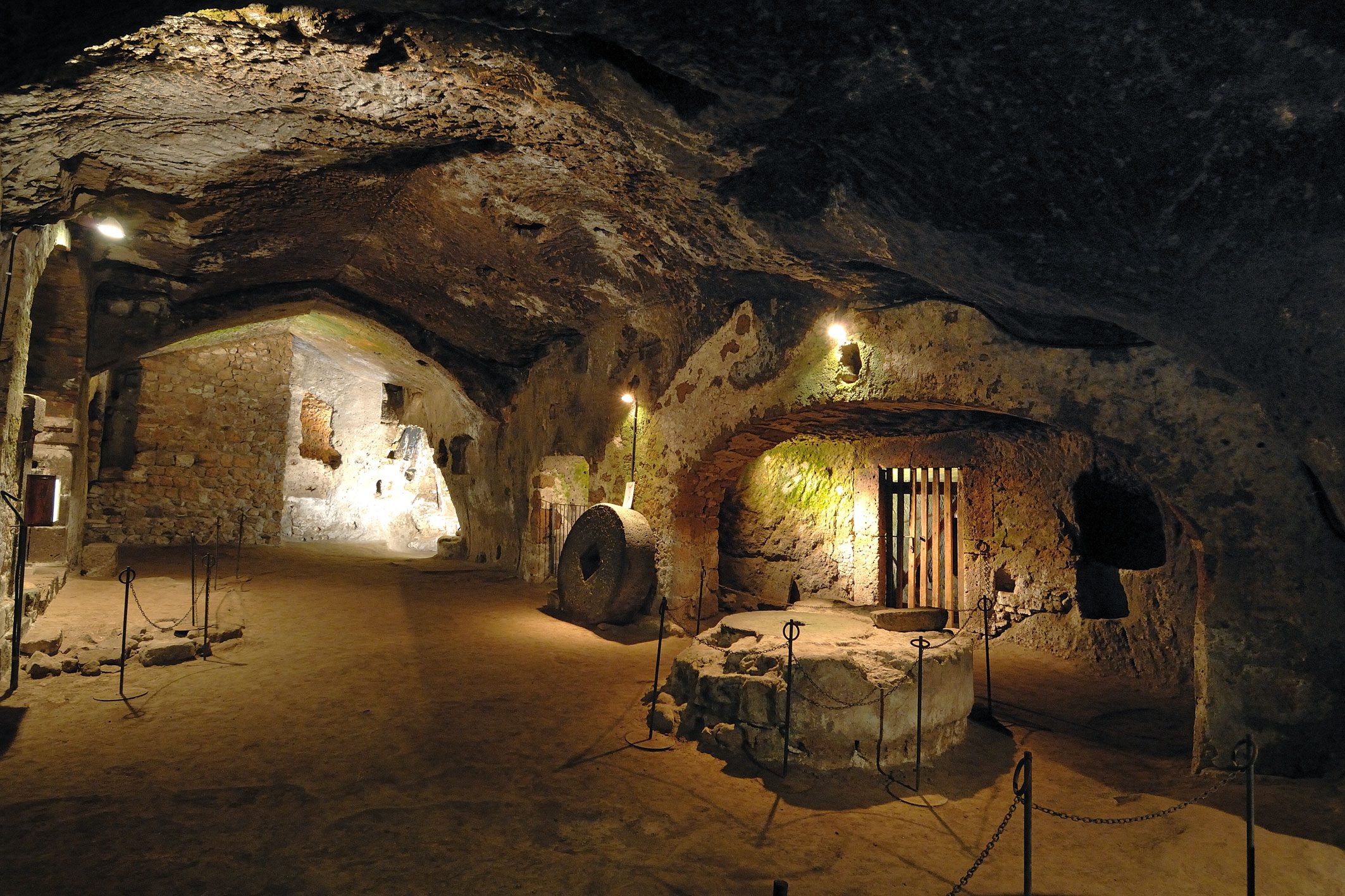
The particular geological nature of the rock on which Orvieto rises has allowed its inhabitants to dig, over about 2500 years, an incredible number of cavities that extend, overlap, and intersect beneath the modern urban fabric. These are a precious reservoir of historical and archaeological information. From the central Piazza Duomo of Orvieto, in front of the Cathedral, at the Tourist Information Office, guided tours for “Orvieto Underground” depart every day at different times. The visit, lasting about an hour, takes place inside one of the most interesting and complex underground complexes of the city. Qualified personnel accompany visitors to discover the traces left by the ancient inhabitants of Orvieto, in an easy and enjoyable route. Here, the interplay of light and shadow carving the millennial darkness of the underground reveals deep and narrow wells with which the Etruscans chased underground water tables in search of water, large stone grinders, and long series of tunnels.
Orvieto Museums
9 National Archaeological Museum of Orvieto
It is set up on the ground floor of the medieval Martino IV palace, one of the three papal palaces behind the Orvieto cathedral. It collects materials from the oldest and most recent discoveries and constitutes, along with the museum of the Faina Foundation – located on the opposite side of the Duomo square – a synthesis of archaeological knowledge about Orvieto. Being linked to the research and study activities of the Superintendence for Archaeological Heritage of Umbria and the scientific and cultural institutions operating in the territory, the national museum shows the results of archaeological research and is therefore constantly evolving. Inaugurated in 1982, the museum exhibits materials found in the area up to the 19th century previously kept in the archaeological section of the Museo dell’Opera del Duomo. To this collection, consisting of several thousand objects, have been added the wall paintings of the Golini tombs in Porano, until then preserved in the Archaeological Museum of Florence, as well as a substantial collection of the oldest finds in the city (urban necropolises of Crocifisso del Tufo and Cannicella, temples of Belvedere and via San Leonardo) and the surrounding territory (necropolis of Porano, Castellonchio and neighboring locations) topographically reorganized according to modern museographic criteria. The finds recovered thanks to recent or ongoing excavations are exhibited according to a rotation plan that allows appreciating the continuous results of the research.
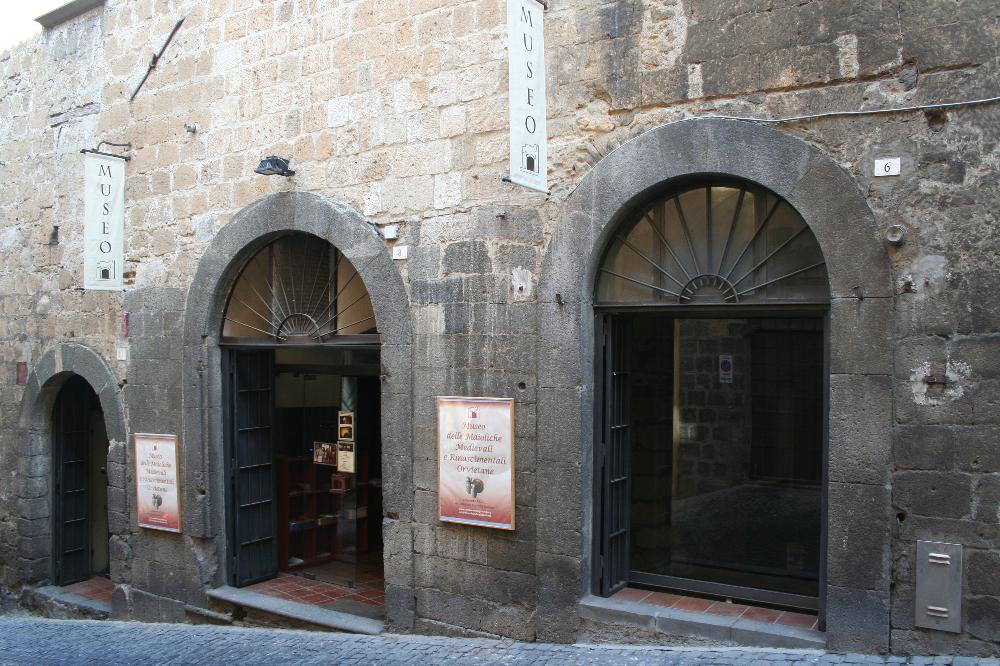
10 Museum of Medieval and Renaissance Orvietan Maiolica
The Museum is created in the premises of an ancient kiln. The permanent collection mainly consists of waste from two kilns active in via della Cava from the second half of the 14th century until the mid-16th century; it is further enriched by maiolica acquired in later periods and linked to the kilns themselves.
The collection counts many pieces and owes its extraordinariness to the continuous production of Orvietan ceramists. Until the mid-14th century, the city of Orvieto was considered a center of importation of maiolica and was therefore regarded as from import.
However, many Renaissance maiolica pieces exhibited in Italian museums and other countries, with attributions to production centers such as Deruta, Faenza, Montelupo, Gubbio, to name the most important, actually show iconographic references typical of the Orvietan area such as noble or guild coats of arms. This alone should have been enough to prove their origin from Orvietan workshops, but some cultural stereotypes, oriented or dictated by the antiques market, prevented a calm attribution of provenance. Today, it is commonly accepted that multiple production realities in the same period offered the same product, highlighting primarily excellences; while it is undisputed that Orvietan production reached the highest levels in the 14th century, it is generally stated that it was then surpassed in the 15th and 16th centuries by Faenza and Deruta. However, if one carefully examines the maiolica of this collection, especially the kiln waste, it becomes evident how the quality remained very high.
In the museum it is possible to visit as many as ten rooms, starting from the Conference Room, which in the Middle Ages and Renaissance was used for painting and firing ceramics. In the Cistern Room you can still see the cistern from which water was drawn for ceramic processing. Through a channel carved into the rock and a probable pipe, water reached the turning points. In the Kiln Room, it is possible to visit a genuine kiln almost intact. This kiln is the only one from the 15th century still existing in the world. In the 14th-century Room, the ceramics here exhibited, almost entirely kiln waste, are those always considered Orvietan production. In the Symbols Room, the most important pieces of the collection are exhibited. In the Truffette Room, you begin to see how some types of maiolica were produced repetitively, almost serially, making it clear that more than an artisanal workshop, the kiln was a real factory. Besides the mugs, there are globular containers called truffette. In the Zaffere Room there are the testimonies of all possible types of zaffere: from the classic ones, to diluted ones, ending with so-called damascene and porcelain works imitating oriental artifacts. In the Bowls Room, in addition to numerous bowls, special maiolica is preserved. In the Renaissance Room, artifacts from the kiln are more present which, although found in large numbers in Orvietan wells, were attributed to artisanal workshops of other cities. Viterbo or upper-Lazio, Deruta, Faenza, Tuscan types or others of unlikely origin such as graffito on slip glazed of Ferrara or Veneto type are visible. In the Cup Room, with its more than four hundred cups, is the clearest testimony of the industrial character production of the kiln in via della Cava.
11 Opera del Duomo Museum (MODO)
Not a single museum but a true System, that of the Opera del Duomo of Orvieto, has as its core one of the most precious assets of the artistic heritage of humanity: the Cathedral of Santa Maria Assunta, which houses inside the Cappella Nova or of San Brizio, a pictorial masterpiece by Luca Signorelli. From the core of the Cathedral, the visit through the MODO locations unfolds following the guiding thread of the history of the city and its Duomo, retraced through the precious art collections that the Fabbriceria has preserved for more than eight centuries. The largest collection is in the Papal palaces, adjacent to the cathedral, where works by Coppo di Marcovaldo, Arnolfo di Cambio, Simone Martini, Luca Signorelli, Niccolò Circignani are exhibited. On the first floor (Palazzo Soliano) the collection of Emilio Greco (1913-1995) is hosted, consisting of plastic and graphic works created between 1947 and 1991.
In the 13th-century church of the Sant’Agostino convent, the second location, the sculptural group of the Annunciation by Francesco Mochi is currently on display, placed at the center of the apse, as well as a series of Apostles and Saints made after models by various artists, including Giambologna and Ippolito Scalza, and removed from the Duomo at the end of the 19th century.
Completing the visit route is the chapel of San Brizio inside the same Duomo. Built around the middle of the 15th century, it is one of the highest testimonies of Italian painting for the cycle of frescoes with the Last Judgment, which entirely decorates it, partly by Beato Angelico (1447-49) and partly by Luca Signorelli (1499-1504).

12 Emilio Greco Museum
Located on Orvieto’s Piazza del Duomo, to the right of the Cathedral and in its immediate vicinity, Palazzo Soliano is the largest and most imposing of the Orvietan papal residences. It was built at the behest of Pope Boniface VIII Caetani (1294-1303).
Already the historic seat of the Museo dell’Opera del Duomo, since September 2008 it has returned to the center of the MODO exhibition route, of which it represents the starting point, to host on the ground floor the
Emilio Greco collection (1913-1995), donated by the artist to the city of Orvieto, with which he was artistically and personally connected. Since 1970, in fact, the majestic medieval portals of the cathedral have welcomed the large bronze doors made by Greco between 1962 and 1964. With this extraordinary testimony of the renewal of sacred art of the second half of the 20th century, the route towards the most famous icons of the Opera del Duomo collection in the Papal Palaces begins.
The works exhibited in the suggestive environments of Palazzo Soliano range from 1947 to 1990 and mark the most significant milestones of the Sicilian artist’s career: from the Wrestler, exhibited in London on the occasion of the 1948 Olympics, to the famous plaster cast of the Monument to Pope John XXIII created between 1965 and 1967.

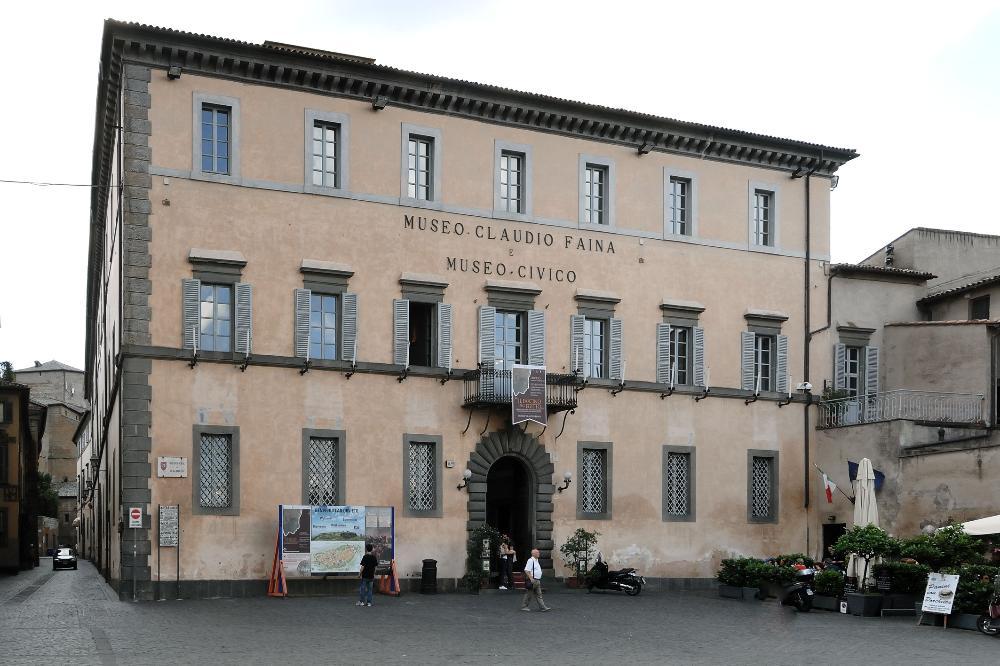
13 “Claudio Faina” Museum and Civic Museum
The Claudio Faina museum and the civic archaeological museum are located in Palazzo Faina, situated in Orvieto’s Piazza Duomo.
Built in the mid-19th century, the palace was constructed by reusing the structures of the house of the Monaldeschi, one of the most important families of Orvieto since the 13th century. In the palace, acquired in the mid-19th century by Count Claudio Faina senior, the family collection initially housed in the residence in Perugia was transferred. The building has been a museum seat since 1954, when the last heir Claudio junior bequeathed all the properties to the Municipality of Orvieto to finance the “Foundation for the Claudio Faina Museum”.
The exhibition path aims to illustrate the stages of formation of the collection, from the original core constituted starting from 1864 by Count Mauro according to the collecting directions of the time to the collection increased by the heir Eugenio who limited acquisitions to artifacts from the Orvietan area and promoted the creation of a civic museum rather than enriching the family collection.
From the gallery located on the second floor of the palace, one can admire a particular perspective of the Duomo. From the entrance in Piazza Duomo, access is gained to the Civic archaeological Museum, arranged on the ground floor of the palace, entirely dedicated to finds from the excavations of the city and the Orvieto territory, which testify to the exceptional flourishing of Volsinii, the Etruscan Orvieto. Among the productions of very high artistic quality created during the 5th century BC by Volsinian workshops are exhibited terracotta architectural elements from the Belvedere temple. Directly inspired by classical Greek art, they constituted the decorative and cladding apparatus of sacred buildings. From the sacred area of Cannicella, a sanctuary complex inside the necropolis located south of the city, comes the famous statuette of Venus, and from the Crocifisso del Tufo necropolis some stone boundary stones are exhibited, the markers of tombs generally carrying the name of the deceased. Materials collected in the 19th century from the Orvietan territory are illustrated, including the sarcophagus of Torre San Severo, with sculpted scenes depicting episodes deriving from Greek mythology, of funerary inspiration.
The Faina collection is arranged on the main floor and the second floor of the palace in a renewed layout that dates back to 1996. On the main floor, which preserves the 19th-century decoration, the finds recovered or acquired by the Fainas are arranged, with particular attention to Mauro’s collecting activity, especially regarding the numismatic collection of coins, mostly Roman from the Republican and imperial periods, exhibited in strict chronological sequence.
On the second floor, the artifacts are ordered according to typological and chronological criteria: from pre-protohistoric materials to Attic pottery, while some rooms are entirely dedicated to Etruscan pottery.
Other places of interest in Orvieto
14 Abbey of San Severo and Martyrdom
Interesting building dating back to the early Middle Ages and later rebuilt in the 12th century by the Benedictines. The French order of the Premonstratensians, which succeeded the Benedictines in 1220, expanded the Abbey towards the north in a transitional Romanesque-Gothic style.

15 Complex of the Papal Palaces
Papal residences built by Popes Urban IV and Martin IV. The first (1264) in a Romanesque style transitioning to Gothic and the second (1284) inspired by French Gothic.
16 Former Church of Sant’Agostino of Orvieto
Former Church of St. Augustine with a richly decorated Gothic portal from the 1300s. Baroque interior with side altars.