


A about an hour by train from London, starting from Waterloo station, there is Winchester, a town rich in history and art. Its first settlement was Breton, but the first real town was a Roman foundation, Venta Belgarum. In 827, with King Egbert, it became the capital of England.
When William the Conqueror also made London the capital, he was crowned in both cities, a practice also adopted by other kings until London definitively became the sole capital of the kingdom.
William the Conqueror also commissioned the monks of Winchester to compile the Domesday Book, the great property census of much of England and Wales.
Winchester can be explored on foot to admire its monuments and to get lost in its authentic medieval corners.
What to see in Winchester, England
1 Winchester Cathedral
A visit to Winchester cannot ignore the Cathedral, the city’s most important monument and one of the most beautiful churches in England. The first thing that strikes you is its size, particularly the length: 167 meters. The dominant style is Gothic, but the transept is a beautiful example of Norman architecture. Inside are exquisite works of art: the bishops’ chapels and tombs, including the richly decorated chapel of Bishop Wykheam and that of Bishop Fox; the precious 14th-century carved stalls; a splendid 12th-century Norman baptismal font made of black Tournai marble, carved with the stories of Saint Nicholas; the 13th-century frescoes of the Chapel of Holy Sepulchre and the Guardians’ Angel Chapel.
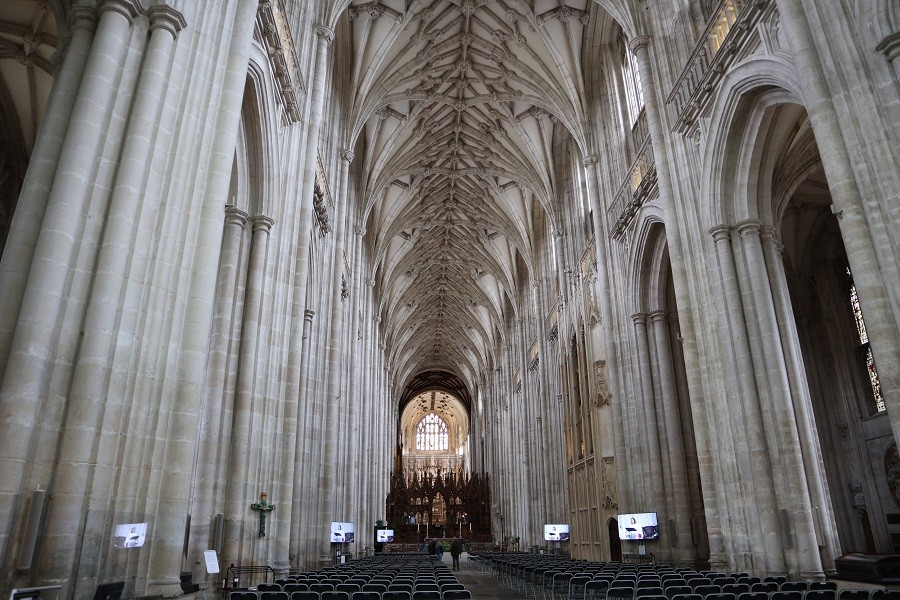
The Cathedral also houses a double memorial to writer Jane Austen, who spent much of her life in Winchester. When she died, she was not particularly famous, so the inscription on the modest tombstone only refers to the “extraordinary endowments of her mind” (extraordinary endowments of her mind). The posthumous success of her novels earned her the placement of another memorial, not large but richer and more ornate, specifically mentioning her talents as a writer.

From the transept, you enter the beautiful 17th-century library and the treasury, where a 13th-century illuminated Bible stands out. Many volunteers offer free guided tours, highly recommended if you want to discover the secrets and stories of Winchester Cathedral.

2 Around Winchester Cathedral
Leaving the Cathedral, you can admire the various buildings connected to it. You can start by walking along the outside of the right nave, where a passage called The Slype leads to The Close, the episcopal precinct partly surrounded by walls. Some Norman arches reveal the former presence of the chapter house that joined the Cathedral transept to the Deanery. Passing by the 17th-century buildings of the Long Gallery and the Pilgrims’ School you reach Dome Alley with beautiful timber-framed houses. Going through St Swithun’s Gate you find the 14th-century Kingsgate on the left, above whose arch is the small church of St Swithun upon Kingsgate.

3 Wolvesley Castle
Next to the enclosure of the current bishop’s palace, a green path leads to an unexpected place: the ruins of Wolvesley Castle, the medieval bishop’s palace destroyed during the Civil War of 1646. Its origins date back to 970, but it was expanded in the first half of the 12th century.
Its ruins cover a very large area and the chapel and the hall, which was the setting for the wedding banquet of Queen Mary and Philip of Spain in 1554, can still be recognized. What impresses most are the fortifications, added by Henry II in the second half of the 12th century, giving the site the appearance of a castle, hence the name.

4 Great Hall and the Round Table
The only surviving parts of the castle built by William the Conqueror are the foundations of the Round Tower and, above all, the Great Hall, the large central hall, perfectly preserved and famous because it houses the Round Table. Obviously, it is not that of King Arthur, but it is nonetheless an impressive example of a 14th-century wooden artifact, possibly made for a tournament, bearing the names of knights and the king’s effigy.

5 High Street
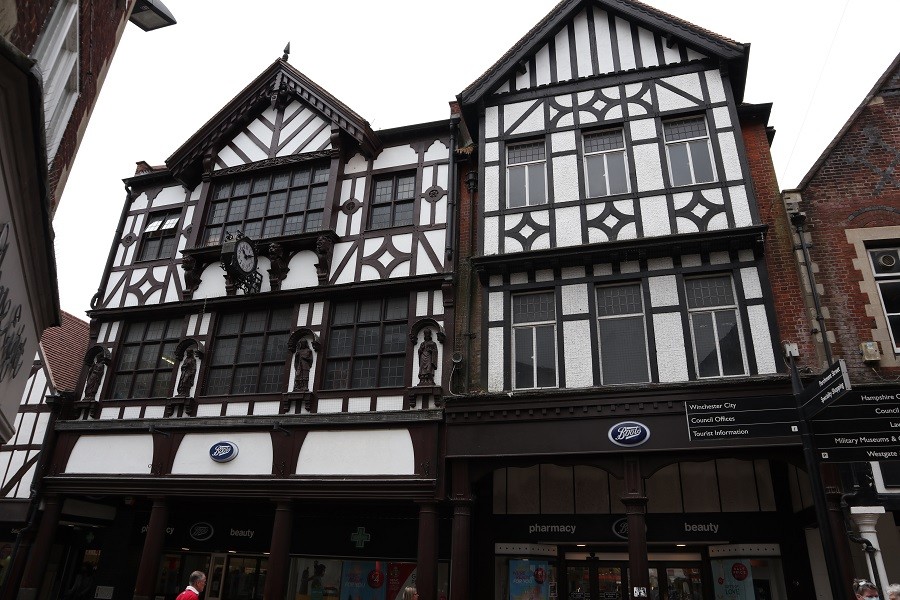
The High Street is the main street of the town and follows the decumanus, one of the axes of the Roman city. It is entirely pedestrian and is lined with shops and restaurants, often housed in delightful timber-framed houses. Access is through the Westgate, which houses a small museum that may be worth visiting for access to the roof, from which you can enjoy a nice view of the city.
The Old Guildhall, with a large clock projected onto the street, is now the headquarters of Lloyds Bank. At the final stretch of the street, on the right, is the neo-Gothic Guildhall and, in the center, the statue of Alfred the Great from 1901.
6 Winchester College
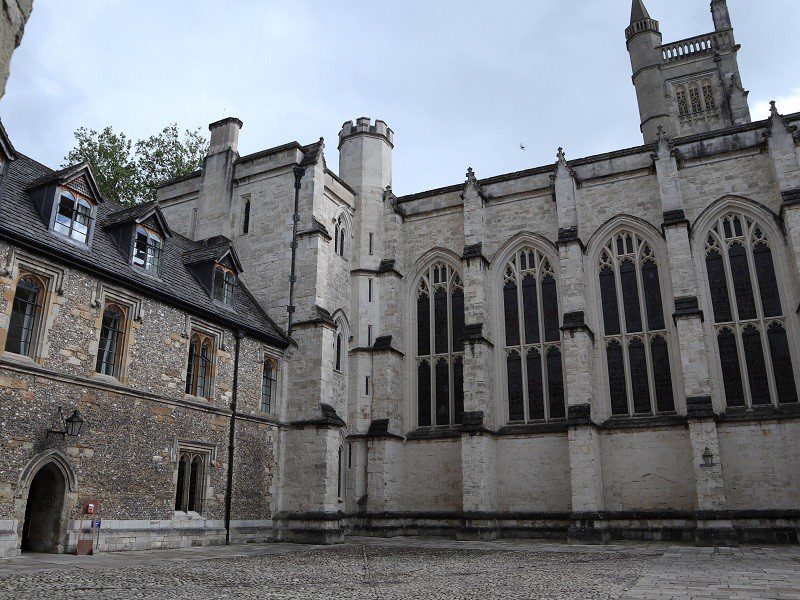
The city’s most prestigious cultural institution is Winchester College, the oldest private school in England. Founded in 1382, it was originally reserved for the underprivileged, while today it is one of the most exclusive schools in the country and internationally renowned.
Inside there are 80 historic buildings, mostly dating back to the late 14th century and still in regular use, spread over a garden of about 45,000 square meters. You can visit the treasury, which consists of a collection of archaeological finds preserved in the atmospheric stables. It is recommended to take the guided tour, which gives you the opportunity to discover the most beautiful areas of the complex.
To preview Winchester College, you can watch this short documentary
7 Military Museums
Near the Great Hall is Winchester’s Military Quarter, where some late 18th-century barracks host six collections of English regiments from 1702 to today. You can discover the history, among others, of the King’s Royal Hussars, the Royal Hampshire Regiment, the Royal Green Jackets, and the Gurkhas from Nepal who served the British Empire for about 200 years. One of the most popular attractions is the diorama of the Battle of Waterloo, displayed at the Royal Green Jackets Museum.
Beyond the specific interest in military history, the Military Quarter site is interesting historically and architecturally. It stands where William the Conqueror had built his castle, which was partly destroyed after the Civil War. In 1683, Charles II decided to build his palace here, modeled after Versailles, designed by the famous architect Christopher Wren, the same as St Paul’s Cathedral in London. However, work stopped at the king’s death and the buildings, after decades of disuse and decay, were temporarily used for military purposes until they officially became barracks from the late 18th century, housing 3,000 soldiers during the Napoleonic Wars.

8 The Itchen River and the City Mill
Winchester is also a charming water town, with the Itchen River and its canals skirting the historic center, offering opportunities for beautiful walks in greenery, such as the Keats’ Walk. The force of the Itchen’s water is harnessed at the City Mill, a mill from 1774 built on a previous medieval building. The mill is still in use and you can personally watch the grain processing and flour packaging, which can also be purchased on-site.

9 Where to eat in Winchester
Winchester’s cuisine is typical pub fare, of which the historic center is dotted. Some pubs are very old, such as The Eclypse Inn, housed in a 16th-century house that was originally the rectory of the church of St Lawrence. The God Begot House, dating back to 1052, houses an Ask chain restaurant on the High Street side and the The Royal Oak pub on the side of the very narrow side alley.
To try traditional cuisine with a somewhat more sophisticated twist, in a cozy designed interior, the Pitcher and Piano, next to the Guildhall, is the ideal place.

10 Where to stay
Winchester can be visited in one day. But if you want to extend your stay by one or more days, some pubs in the historic center, such as The Wykeham Arms and The Old Vine, have rooms upstairs where you can stay and ideally savor the spirit of medieval inns.
For a luxury experience, about 4 kilometers from the town center, in the Hampshire countryside, there is Lainston House, a 17th-century villa transformed into a five-star hotel.


 and, in the past, capital of the Saxon kingdom.)