


The garden area of Virgil’s Park and Tomb is home to monuments pivotal to the history of Naples. Its name traces back to the tradition that attributes the ancient Roman tomb present here to the poet Publius Vergilius Maro (Andes, 70 BC – Brindisi, 19 BC). This interpretation was officially confirmed in 1930 with the park’s opening, following a major renovation that gave the area its current look, marked by evocative landscapes and panoramic views.
At the park entrance, as you walk up the avenue that climbs the hillside in several bends, you’ll spot an impressive shrine. Ordered in 1668 by Viceroy Pietro d’Aragona, it houses two plaques, one of which mentions Virgil’s tomb. Nearby, nestled in a large niche, stands a bust of Virgil on a column, donated in 1931 by students from the Ohio Academy. At the end of the second ramp, on a small terrace to the right, is the area dedicated to Giacomo Leopardi’s tomb (Recanati, 1798 – Naples, 1838), a monument that since 1939 holds the poet’s remains, transferred here from the now vanished Church of San Vitale in Fuorigrotta. The original headstones are now affixed to the tufa wall behind.
Higher up, you reach the square before the eastern entrance to the Crypta Neapolitana, one of the world’s oldest tunnels. Carved during Augustus’s era, it once connected Naples with the Phlegraean Fields.
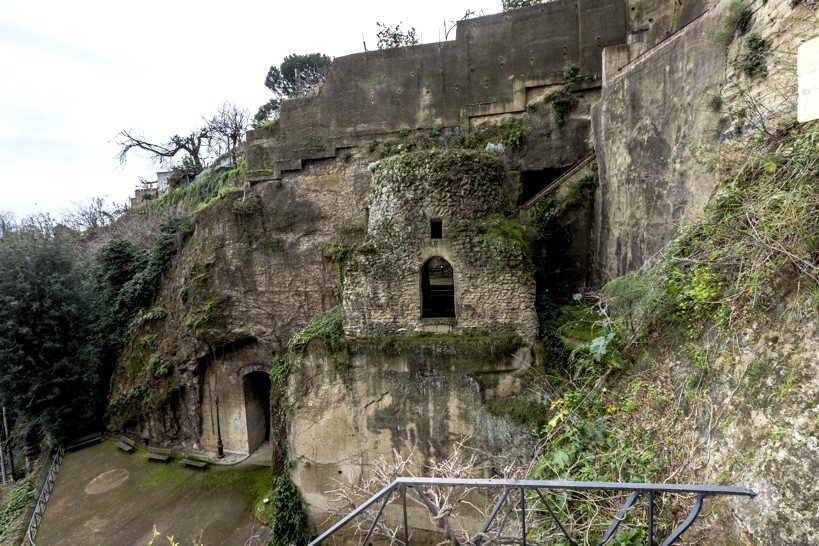
The striking funeral mausoleum overlooking the Naples side of the Crypta confirms the significance of the person buried there, closely tied to the city’s long tradition of linking Virgil to Naples and especially to this grotto. Even in ancient times, about a century after the poet’s death, the site became sacred to his admirers, inspiring literary fascination and attracting learned travelers such as Statius, Pliny the Younger, and Silius Italicus, who is said to have celebrated Virgil’s birthday here every October 15.
From then till today, poets, chroniclers, and travelers—Italians and foreigners alike, including Petrarch, Boccaccio, and Cino da Pistoia—have continued to reference the tomb. From the 12th century, literary records intertwine with growing legends, some likely rooted in local oral tradition. Yet debates over the tomb’s authenticity persist, partly due to the ancient biographer Elio Donato (4th century AD), who wrote that Virgil was buried at the second mile of the via Puteolana—a place some situate elsewhere (Villa Comunale, Piazza Amedeo, the slopes of Vesuvius, etc.).
Popular tradition, as summed up in the ‘Chronicle of Partenope’ (14th century), confidently identifies this mausoleum as Virgil’s final resting place. According to legend, he became Naples’ divine protector and the magical creator of the Crypta. During the Norman conquest, it’s said his remains were secretly walled up in Castel dell’Ovo to safeguard the city’s talisman.
The mausoleum, built in opus reticulatum at the start of the Imperial Age, follows the columbarium style: a cylindrical drum atop a square base, with a square burial chamber featuring a barrel vault, illuminated by windows and containing ten niches for cinerary urns.
This tunnel, also known as the “Old Grotto of Pozzuoli,” was constructed in the Augustan age by Lucius Cocceius Auctus, a freedman and architect to Agrippa and Admiral Octavian, according to Strabo (V, 4, 6), also involved in the Portus Iulius, the “Grotta di Cocceio,” and the Roman crypt at Cuma. Cited on the Tabula Peutingeriana and by other ancient sources, it is entirely hewn from tuff stone: 705 meters long, 4.5 meters wide, some 5 meters high, and naturally lit and ventilated by two oblique shafts.
Poor visibility inside led, already under Spanish rule, to installing lanterns suspended on ropes between posts; in 1806, Joseph Bonaparte added two rows of lamps. Gas lamps followed in the mid-19th century—one, dating from the late 1800s, was found during recent restorations.
Over the centuries, the tunnel lost its original appearance due to repeated road works—widening, lowering, and paving—by Alfonso d’Aragona (1455), Don Pedro de Toledo (1548), Charles of Bourbon (1748), and finally the city of Naples in 1893. On either side of the entrance, two frescoed niches remain: the left with a Madonna and Child (14th century), the right with a depiction of the Almighty of uncertain date. Petrarch’s ‘Itinerarium Syriacum’ describes a small chapel, Santa Maria dell’Idria, established by a hermit near the entrance.
During Aragonese renovations or the Spanish viceroyalty, a marble bas-relief of Mithras (late 3rd–early 4th century AD) was discovered—today preserved at the National Archaeological Museum of Naples. Evidence of the Eastern god Mithras appears in Campania from the 2nd century AD, in contrast with rising Christianity.
Mithras’ presence suggests the Crypta may have housed a Mithraic cult: the mithraeum is often associated with a spelaeum, or cosmic cave, where the sacrifice of the bull was depicted since antiquity. It’s likely these mysterious rites contributed to enduring local superstition, which has always given the grotto an aura of magic—so much so that merely crossing it was considered almost miraculous.
Info on Virgil’s Park and Tomb
Salita della grotta, 20 80121 Naples (Naples)
Tel. 081.669390



 for the tranquility once found at the lavish Roman villa there.)