

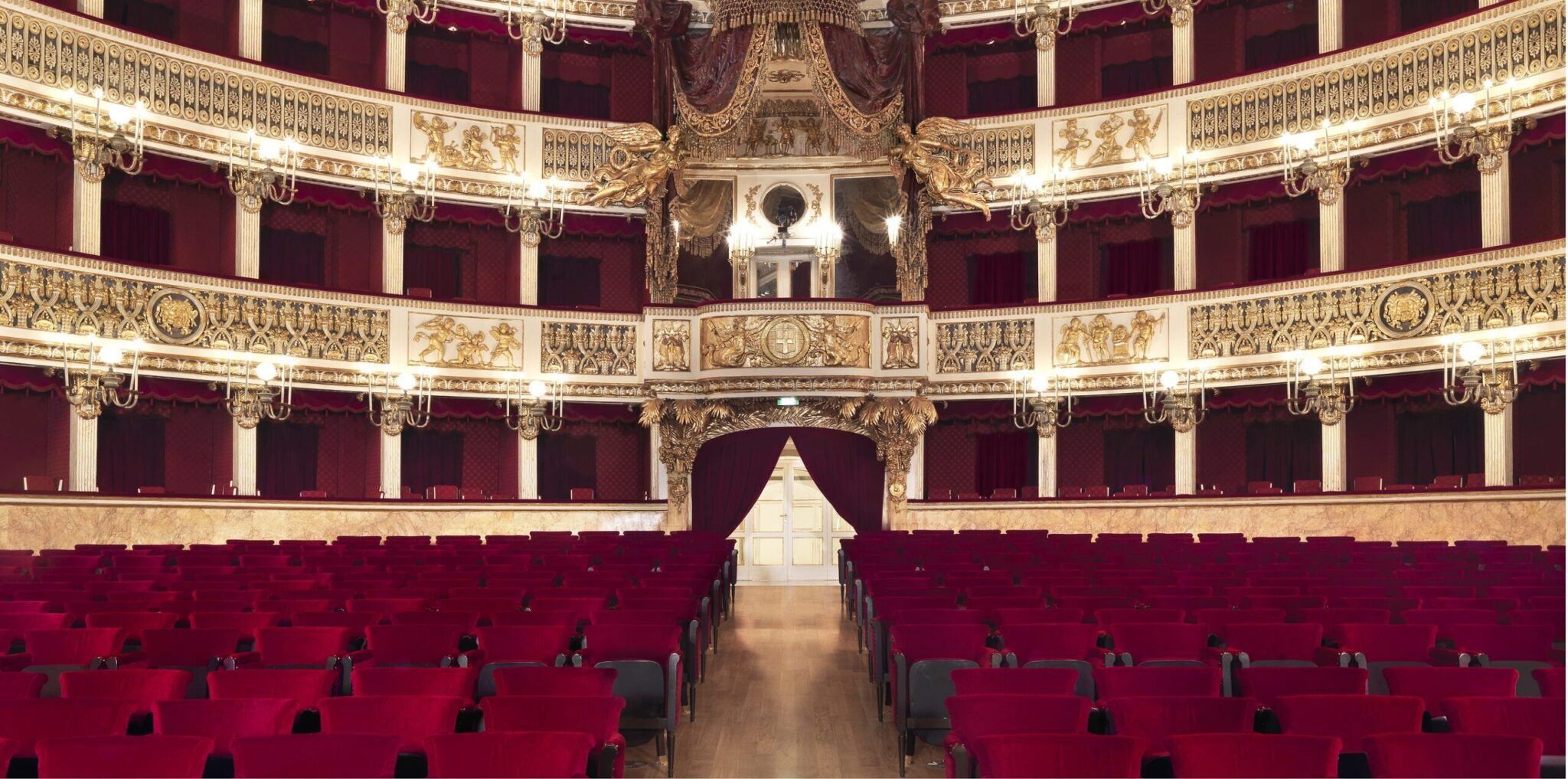

The design by Medrano of the San Carlo Theatre of Naples featured a hall 28.6 meters long and 22.5 meters wide, with 184 boxes, including those at the proscenium, arranged in six tiers, plus a royal box capable of hosting ten people, for a total of 1379 seats. Eight months after the start of the work, on November 4, 1737, the theatre was already completed.
The interior of the structure can be reconstructed today based on a painting by Michele Foschini and some surveys carried out by European architects visiting the hall.
Numerous accounts passed down by travelers and visitors unanimously celebrate the vastness of the hall and boxes, albeit at the expense of acoustics and the richness of the decorations. During the eighteenth century, the building underwent several modernizations prompted by changing tastes or the need to improve its acoustics. Permanent renovations were carried out by Ferdinando Fuga, first in 1767-68 and then in 1777-78.
In the first works, the Tuscan architect renewed the decoration of the auditorium and added large mirrors in the boxes equipped with sconces holding candles which, exploiting the reflection effect, multiplied the hall’s illumination. The subsequent intervention almost exclusively concerned the stage opening. In 1797, the hall underwent a new decorative restoration under the direction of the theatre’s scenographer Domenico Chelli.
The brief episode of the Neapolitan Republic of 1799 did not bring particular changes to the structure, except for some damage caused by improper use of the hall, renamed National Theatre and “desecrated” by equestrian shows. Domenico Barbaja entrusted Antonio Niccolini with a new restructuring of the theatre.
The leading figure of Neoclassicism in Naples repeatedly intervened on the building. The first phase of the metamorphosis concerned the facade, with the consequent addition of the foyer and recreation and refreshment rooms. The carriage porch supported by pillars was inspired by the model offered by the Scala by Giuseppe Piermarini, albeit modified by the insertion of the Ionic loggia corresponding to the foyer rooms.
With Niccolini, the Theatre acquired the characteristics of a temple, becoming a monument-symbol of the city. The facade, in fact, incorporates elements of classical grammar and a Hellenistic decoration alluding to dramatic poetry and music. Equally interesting is the foyer: a large tetrastyle hall, with golden vegetal decoration, flanked by smaller rooms intended as gaming halls.
One year after the completion of the frontage works, the Tuscan architect adapted the hall to the new decoration of the vestibule and stairs. Among the innovations carried out, there are pairs of semi-columns attached to the pillars already made by Fuga in the proscenium, the chandelier suspended in the darkest area of the hall, and the remaking of the velarium supported by rods with caryatids. The reconstruction, completed in nine months, was always by Antonio Niccolini, who broadly recreated the 1812 hall.
The Tuscan architect indeed preserved the horseshoe layout and configuration of the stage opening, although widened and decorated on the interior surface by the bas-relief depicting Time and the Hours, still existing today. The current foyer, built in the eastern area of the Royal Palace garden, was instead realized in 1937 to a design by Michele Platania. Destroyed by a bombing in 1943, it was rebuilt immediately after the war.
The San Carlo Theatre, alongside performances of the great melodramatic repertoire and revivals of nineteenth-century masterpieces, has also carried out in recent years an intense activity aimed at recovering the eighteenth-century Neapolitan opera buffa.