


L’area a giardino del Parco e Tomba di Virgilio ospita monumenti rilevanti per la storia dell’area partenopea e la sua denominazione ha origine dall’attribuzione al poeta Publio Virgilio Marone (Andes, 70 a.C. – Brindisi, 19 a.C.) del sepolcro romano ivi ubicato. Tale interpretazione fu ufficialmente ribadita con l’inaugurazione del parco avvenuta nel 1930, dopo un consistente intervento di risanamento e consolidamento che diede all’area la fisionomia ancora oggi osservabile, ricca di scorci paesaggistici molto interessanti.
At the park entrance, taking the avenue that rises with multiple ramps along the hillside, there is an imposing niche placed there in 1668 by the viceroy Pietro d’Aragona, containing two inscriptions that also recall the presence of Virgil’s tomb. Nearby, in a large niche on the wall, there is a bust of Virgil on a column, a tribute in 1931 from the students of the Ohio Academy. At the end of the second ramp, on a square to the right, is the area dedicated to the tomb of Giacomo Leopardi (Recanati, 1798 – Naples, 1838), a monument that since 1939 has housed the poet’s remains, transferred here from the ancient Church of San Vitale in Fuorigrotta (now disappeared), along with the plaques now embedded in the tuff wall behind. Going further up, you reach the square in front of the eastern entrance of the Crypta Neapolitana, one of the oldest tunnels in the world, excavated in the Augustan age to facilitate connections between Naples and the Phlegraean Fields.
The prominent position of the funerary mausoleum dominating the entrance on the Neapolitan side of the Crypta certainly attests to the importance of the person buried there and fits well with the long Neapolitan tradition that associates Virgil Maro with the city of Naples and the cave in particular with a multiple and complex bond. Already in ancient times, about a century after the poet’s death, the place became sacred to his admirers and was long a literary theme and destination for cultured tourism, as for Statius, Pliny the Younger, and Silius Italicus, who cared to “approach as to a temple” the Virgilian tomb, celebrating on October 15 the anniversary of the poet’s birth.
Almost without interruption, in the following centuries the tomb was referred to by writers, chroniclers, and travelers, both Italian and foreign, including Petrarch, Boccaccio, and Cino da Pistoia, who provide valuable information sources. From the 12th century, legends, perhaps already existing in local oral tradition and only then recorded in written texts, began to add to the literary testimonies. However, controversies and doubts continue about the authenticity of the tomb, also regarding what was stated by Aelius Donatus (4th century AD), Virgil’s biographer, who said the poet was buried at the 2nd mile of the Puteolana road, a location which for some, instead of corresponding to the area adjacent to the Roman road that crossed the cave towards Pozzuoli, would refer to different and more distant places (Villa Comunale, Piazza Amedeo, slopes of Vesuvius, etc.).
Popular tradition, however, well summarized in the ‘Chronicle of Partenope’ (14th century), has no doubt about the identification: in this mausoleum lay Virgil, raised to divine protector of Naples and magical creator of the Crypta, whose remains, at the time of the Norman conquest, were transferred and walled up in a hidden place in Castel dell’Ovo to prevent such a precious effigy from being removed from the city, nullifying its protective function.
The funerary mausoleum, built in opus reticulatum at the beginning of the imperial age, is of the columbarium type with a cylindrical drum on a quadrangular base, in which is carved the funerary cell with a square plan and barrel vault, illuminated by slits and equipped with ten niches to host cinerary urns.
Also known as the “Old Cave of Pozzuoli,” this gallery was constructed in the Augustan age by the freedman Lucius Cocceius Auctus, architect of Agrippa and admiral of Octavian, who according to Strabo (V, 4, 6) was also responsible for the Portus Julius, the “Cave of Cocceius,” and the Roman Crypta at Cumae. Mentioned in the Tabula Peutingeriana (a map with road itineraries from the late imperial period) and recalled not only by Strabo but also by Donatus, Seneca, Petronius, and Eusebius, the tunnel is entirely excavated in tuff for a length of 705 m, an original width of 4.5 m and a height of about 5.0 m, lit and ventilated by two oblique light wells.
The poor visibility inside the structure led during the Spanish viceroyalty to the installation of a lighting system consisting of lanterns supported by ropes stretched between poles; in 1806, under Joseph Bonaparte, two rows of lanterns kept constantly lit were installed, while from the mid-19th century gas lamps were used, one of which dating back to the end of the century was found in recent restoration works.
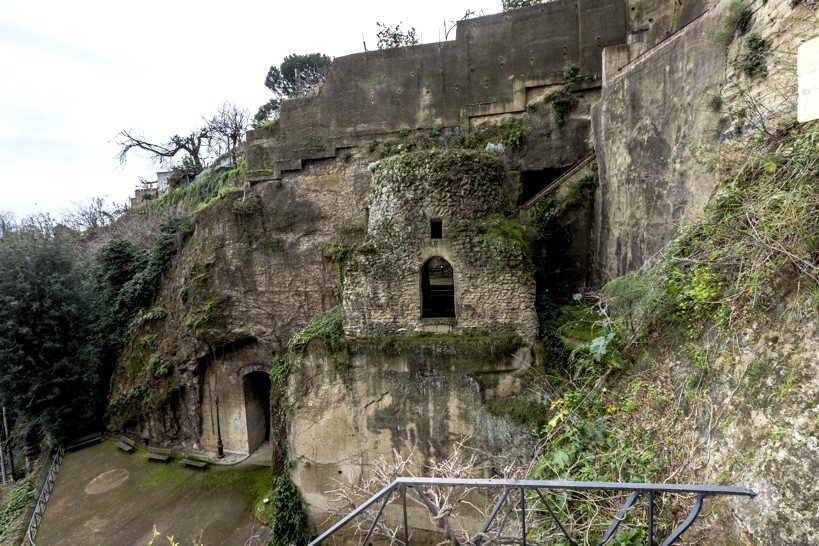
Following the widening and lowering of the road level, as well as paving works carried out in several phases by Alfonso d’Aragona in 1455, Don Pedro di Toledo in 1548, Charles of Bourbon in 1748, and the Municipality of Naples in 1893, the cave has lost much of its ancient appearance. On both sides of the entrance are still visible two frescoed niches: the one on the left with a depiction of the Madonna and Child dating to the 14th century, the one on the right with the face of the Almighty of uncertain dating. Petrarch in the Itinerarium Syriacum recalls a small chapel called Santa Maria dell’Idria, built by a hermit right near the entrance to the cave.
During the Aragonese restoration or during works carried out in the time of the Spanish viceroyalty, a white marble bas-relief depicting Mithras, dated between the late 3rd and early 4th century AD, was found here; it is now preserved in the National Archaeological Museum of Naples. Testimonies concerning the oriental god Mithras are known in Campania from the 2nd century AD onward, in opposition to the increasingly widespread Christianity.
The presence of the relief in the Crypta has therefore led to speculation that this is a Mithraic place of worship: the mithraeum is usually identified as the spelaeum, the cosmic cave, inside which, from the earliest iconographic evidence, the bull sacrifice is depicted. It is likely that mystery cults greatly influenced popular superstition, which always associated something mysterious and magical with the cave, to the point that merely passing through it unharmed was considered a true miracle.
Information on the Park and Tomb of Virgil
Salita della grotta, 20 80121 Napoli (Naples)
Tel. 081.669390




 dato alla splendida villa romana che sorgeva sulla collina per indicare la pace e la quiete ivi esistenti.)