

Peru is a country in South America, with a long coast facing the Pacific Ocean offering many beautiful seaside locations. But even more beautiful is the country’s rich and interesting history, starting 32,000 years ago, peaking in the 13th century thanks to the Incas and declining after the Spanish conquest. This was what motivated us to choose it as the destination for our honeymoon: an unusual destination for many, but one that satisfied our curiosity and made us return home “changed”.
For those interested in pre-Columbian and Inca culture, there are many sites of interest that have preserved the strong Andean personality.
Traveling in Peru, the departure
Our journey began in the Sacred Valley of the Incas (altitude between 2,800 and 3,200 m), the valley of the Urubamba River with abundant waters that make its lands fertile and for this reason considered sacred (Valle Sagrado de los Incas), where Quechua is still spoken and bartering (“trueque”) is practiced.
We reached Cuzco by a scheduled flight from the Peruvian capital, Lima, and from there we moved to the Grand Valley by bus for about an hour. Here, archaeological, historical, and folkloric testimonies are endless and still visible today:
- We took a step back in time by visiting Pisaq, with its typical artisan market;
- We were amazed by the salt pans of Maras, a complex of about 000 pools, each about four square meters and 30 centimeters deep. The salty water rises from a well and is diverted to the other pools by a complex hydraulic system that testifies to the Inca technological knowledge. Due to sun and climate, the water evaporates, leaving crystallized salt on the surface which is then collected and sold in markets;
- We marveled at Ollantaytambo, home to an Inca fortress whose name means “inn of Ollantay” (a warrior’s name). This was the site of the last, bloody battle between Incas and Spanish when Manco Inca tried to regroup Inca resistance after the defeat of Cusco. By climbing the stairs that run along terraces dating from Inca times, you reach the heart of the temple, of which only a few perimeter stones remain. At the summit, you can see a peculiar building on the opposite mountain, a large Inca food storage (probably a granary), positioned in a cooler place thanks to local winds to keep supplies longer. At the foot of this fortress is a town, the departure station for the train to Aguas Calientes, the last stop before climbing to Machu Picchu (from here you can start the Inca Trail on foot, a two or three day trek through the mountains to Machu Picchu).
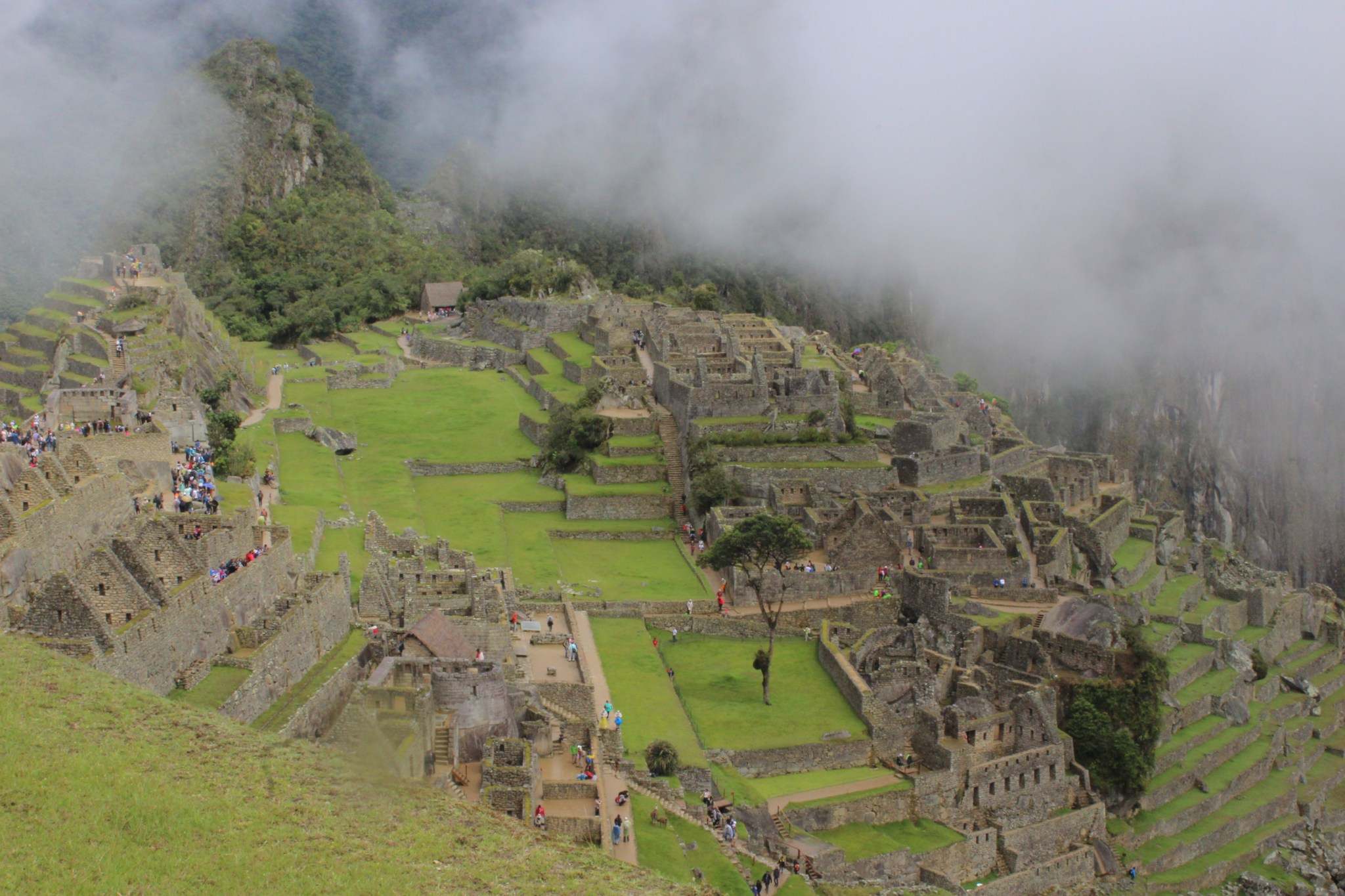
- Then, we were moved visiting Machu Picchu, perhaps the most famous wonder in Peru: elected one of the New Seven Wonders of the World in 2007, it was accidentally discovered by American archaeologist Hiram Bingham in 1911. It is an incomplete citadel built on a green hill in the heart of the tropical forest. The remains are completely intact (only the straw roofs are missing), and probably it was of considerable importance, since besides the “town” part, a sun temple was found along with a path connecting it to Cuzco, the Inca capital. Passing through the entrance gate feels like entering a dream: the light mist enveloping the mountains and site, the guide’s voice telling its history, and the view of the ruins make the experience dreamlike, so much so that you realize the reality of the visit only when looking at the photos or documentaries, and it’s impossible not to get a chill down your spine;
- Finally, we completed the visit of the Sacred Valley with Cuzco, capital of the Inca Empire shaped like a puma, representing one of the three Inca life levels, specifically “this world” (the other two are: the “underworld”, represented by the serpent, and the “upper world”, represented by the condor). We inevitably stopped at the Cathedral of the Assumption of the Blessed Virgin Mary and the adjacent Sagrada Familia (a UNESCO Heritage site), in the splendid and evocative Plaza de Armas (in the evening it’s beautiful, with the arcaded buildings surrounding it and a bustling crowd of tourists and locals that make it lively and real).
What to see in Cuzco
Cuzco is full of alleys, some of which lead to the Temple of the Sun, Qorikancha, on which the Spaniards built the Santo Domingo convent. Not to be missed near Cuzco are the “four Inca ruins,” holding symbols of local culture: the colossal Fortress of Sacsayhuaman, built in a zigzag shape honoring the serpent and lightning, from which you can admire a spectacular view of Cuzco city; the sanctuary of Qenqo, which houses “wanka” stones emitting positive energy; the fortress of Puca Pucara and the Tambomachay Palace, an important Inca aqueduct, whose architects and builders were killed after completing the work. For a clearer vision of the Inca and pre-Inca civilizations, a stop at the beautiful Inkariy Museum is essential.
As if what we saw so far wasn’t spectacular enough, completing the picture are the snow-capped peaks of the Andes almost year-round, overlooking the majestic and peaceful Urubamba River, which has witnessed many scenes over the centuries. Moving a few kilometers away (and meters up in elevation!), a visit to Puno is also well worth it.
What to see in Puno
It’s advisable to get there by bus from Cuzco, traveling the 350 km Solar Route: many companies organize such trips which, although lasting about ten hours, seem to fly by thanks to numerous interesting stops. After about 50 km, we stopped at Andahuaylillas, where for 3 soles we visited the Church of San Pedro, built by Jesuits on top of an Inca structure around the 17th century. From outside it looks very simple and austere, but inside it’s astounding: many frescoes cover it, as well as gold leaf.
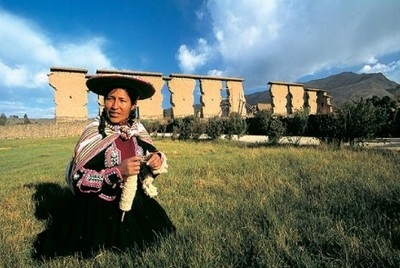
We continued to the archaeological site of Raqchi: we were welcomed by local artisans and vendors whose stalls accompanied us to the entrance of this complete Inca city with walls divided into residential, military, and religious zones. We left and climbed higher, still through the desert cordillera with snow-capped peaks in the background, reaching Paso la Raya at 4,500 meters, where we stopped to admire the breathtaking panorama and photograph glaciers found at 6,000 meters.
The last stop was Pucara, a town at 4,000 m famous for its symbol, the “torito” (little bull), visible on every roof as a wish for prosperity. Here there is a nice museum with remains of pre-Inca civilizations.
We resumed the journey and realized we were almost in Puno when, looking out the bus windows, we saw unpaved roads and lots of chaos: it was Juliaca, a lawless city where drug traffickers do as they please. Beyond this outpost of illegality, a stretch of highway led us to our destination: Puno is on the western shore of the infamous (and rightly so) Lake Titicaca. It’s a city of about 120,000 inhabitants, at almost 4,000 m altitude! The recommendation, precisely for this reason, is to visit it last, after gradually acclimatizing to the heights. It’s charming and evocative and often in celebration, you’ll see its brightly colored inhabitants singing and dancing late into the night.
Lake Titicaca
We stayed briefly in Puno, just long enough to visit Lake Titicaca: a huge navigable lake (over 8,000 square km) located between Bolivia and Peru, situated over 3,000 meters high, it’s the highest navigable lake in the world. The water is so pure that the lake’s transparency is astonishing.
On the lake’s surface, there are artificial islands entirely built with totora reeds (which grow naturally along Titicaca’s shores) that float on the water. The Uros islands host traditional villages and are anchored to the lakebed, rising and falling with water levels and “rebuilt” approximately every two weeks. They were built by a people known as the Uros to escape attacks from warring peoples like the Incas.
We then proceeded to Taquile Island: after a three-hour journey we arrived in a place out of this world! The climb at 4,000 m isn’t easy, but atop you enjoy a spectacular view over the clear waters of the lake. The communal restaurant on the island offers typical dishes and showcases musicians and Andean dancers who delight visitors with the splendid sounds and colors of their culture.
The next day, tired from the walk and altitude but full of adrenaline, we headed by bus to Arequipa, the “White City” named after the color of the stones used to build its buildings.
What to see in Arequipa
Arequipa, at the feet of the imposing “El Misti” volcano, was built by Spaniards in 1540 and is justly a mix of cultures and epochs, palpable in Plaza de Armas, dominated by the Cathedral and the Jesuit Church, surrounded by colonial buildings that seem to transport you to another era where European aesthetic canons blend with Andean sensibilities. Not to be missed is the Monastery of Santa Catalina, built in 1579 as a cloistered convent. It’s so large that inside there are streets, gardens, and parks, and in some buildings you can see rooms furnished like the old days. Although today it’s no longer completely cloistered and the number of nuns is significantly lower, the rule of silence is explicitly maintained thanks to the quiet that pervades it.
A gem not to miss is the mummy of Juanita, the Ice Maiden, housed at the Santury Museum. In 1995, on the summit of Mount Ampato (6,312 meters above sea level), opposite the Misti volcano behind the Peruvian city of Arequipa, archaeologists Johan Reinhard and José Antonio Chávez found the mummified body of a young Inca girl, now known as “Juanita” in honor of the American archaeologist. The so-called “Ice Maiden” is perhaps the most famous of the 18 mummified bodies sacrificed in Inca times and found so far on the peaks of the Andes (14 in Peru and 4 in Argentina – one is kept at the M.Gambier Museum in San Juan, which we visited last November). Once again, a chilling opportunity to relive the Inca era in all its fascination.
Our trip to Peru ends with this magnificent city: we returned home enriched and “changed,” thanks to Peru, its history, and its people: the personality of this country is strong, attached to the past, traditions, and origins to be preserved. Peruvians offer smiles, lower their eyes when you speak to them, offer you the little they have as if it were the most precious wealth in the world.