

Il Peru es un estado de América del Sur, con una larga costa que da al Océano Pacífico que ofrece muchas y hermosas localidades marinas. Pero aún más hermosa es la historia del país, rica e interesante, que comienza hace 32,000 años, con su apogeo en el siglo XIII gracias a los Incas y su declive tras la conquista española. Esto es lo que nos impulsó a elegirlo como destino para nuestro viaje de bodas: un destino inusual, para muchos, pero que nos sació muchas curiosidades y nos hizo regresar a casa “diferentes”.
Para quienes están interesados en la cultura precolombina e Inca, hay muchos sitios de interés y aquellos que han mantenido intacta y fuerte la personalidad andina.
Trip to Peru, the departure
Our trip started from the Sacred Valley of the Incas (alt. From 2,800 to 3,200 m), the valley of the Rio Urubamba with abundant waters, which make its lands fertile and for this reason considered sacred (Valle Sagrado de los Incas), where “Quechua” is still spoken and “trueque” (barter) is practiced.
We arrived in Cuzco with a commercial flight from the Peruvian capital, Lima, and from there we moved to Valle Grande by bus for about an hour. Here the archaeological, historical, and folkloric testimonies still visible today are endless:
- We took a leap back in time visiting Pisaq, with its typical artisanal market;
- We were amazed by the salt pans of Maras, a complex of about 000 pools, each about four square meters and 30 centimeters deep. The saline water comes out from the underground through a well and is diverted to the other pools by a complex hydraulic system demonstrating the technological knowledge of the Incas. Due to the sun and climate, the water evaporates, leaving crystallized salt on the surface, which is then collected and sold in the markets;
- We fantasized at Ollantaytambo, home of an Inca fortress whose name means “inn of Ollantay” (the name of a warrior). This was the scene of the last bloody clash between Incas and Spaniards who fought when Manco Inca tried to gather Inca resistance after the defeat of Cusco. Walking up the stairs climbing the terraces dating back to the Inca era, you reach the heart of the temple, of which only a few perimeter stones remain. Once at the summit of the site, you can appreciate a particular construction on the opposite mountain. It is a large Inca food storage (probably a granary), whose position was chosen to find a cooler place (thanks to the winds of the area) where supplies could be kept longer. At the foot of this fortress, a town develops, the departure station of the train that goes to Aguas Calientes, the last outpost before ascending to Machu Picchu (from here it is possible to start the Inca Trail on foot and walk the Inca path that leads to Machu Picchu, two or three days journey through the mountains).
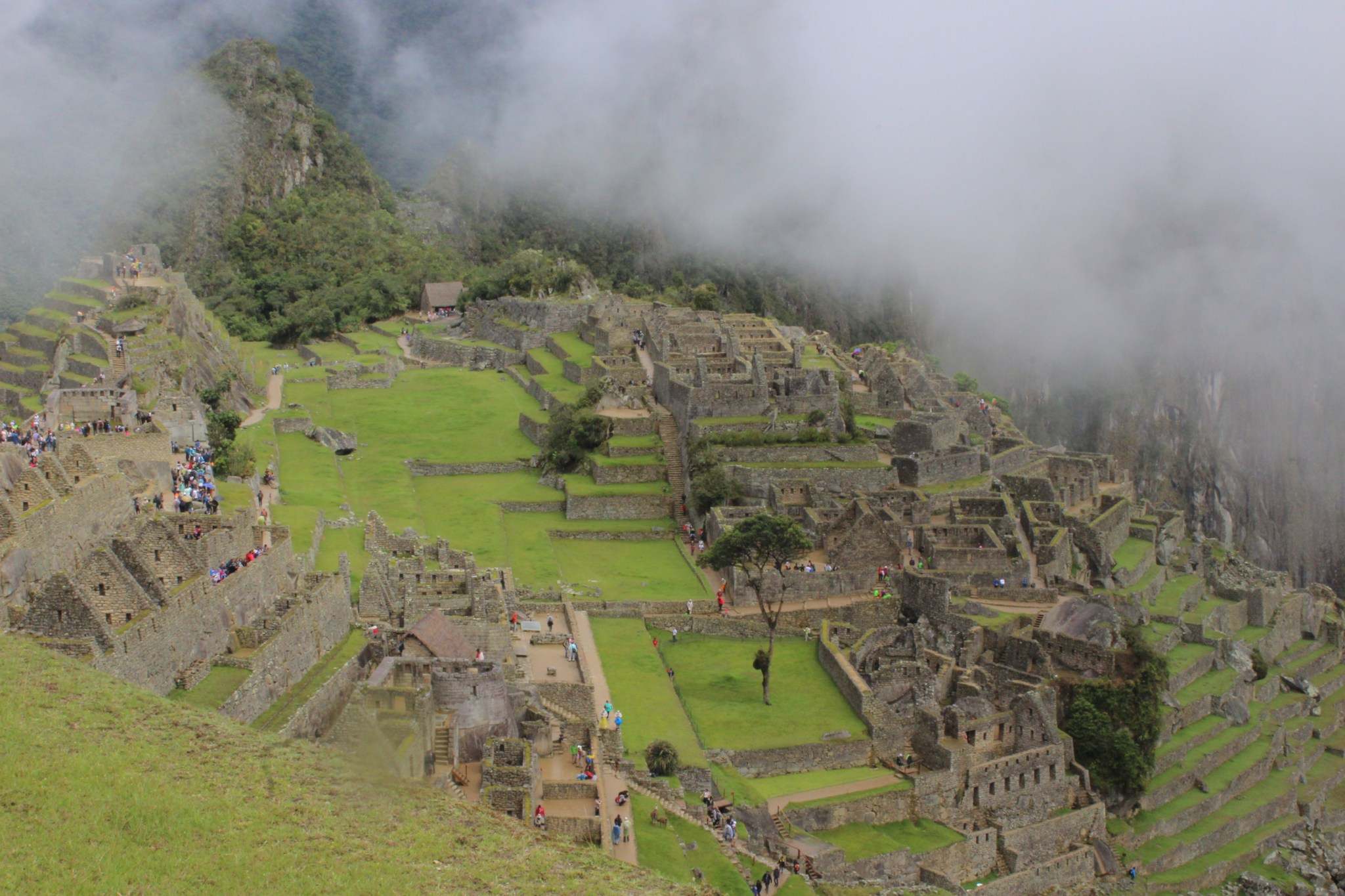
- And then, we were moved at Machu Picchu, perhaps the most famous wonder of Peru: elected one of the Seven Wonders of the World in 2007, it was discovered purely by chance by the American archaeologist Hiram Bingham in 1911. It is an incomplete citadel built on the green peak in the heart of the tropical forest. The remains are completely intact (only the straw roofs are missing) and, probably, it should have had an importance not to be underestimated, as, beyond the “city” part, a solar temple was found, as well as a path linking it to Cuzco, the Inca capital. When crossing the entrance turnstile, it feels like diving into a dream: the light mist enveloping the mountains and the archaeological site, the guide’s voice telling its history and the view of the ruins, make the experience dreamlike, so much so that you realize the reality of the visit only by looking at photos or numerous documentaries, and it is impossible not to feel a shiver down the spine;
- Finally, we completed the visit of the Sacred Valley with Cuzco, capital of the Inca Empire shaped like a puma, representing one of the three levels of Inca life, precisely “this world” (the other two are: the “underworld”, represented by the serpent, and the “upper world”, represented by the condor). A stop at the Cathedral of the Assumption of the Blessed Virgin Mary and the adjacent Sagrada Familia (a UNESCO World Heritage site) in the splendid and evocative Plaza de Armas was unmissable (the evening is beautiful, with the porticoed buildings surrounding it and a buzz of people, tourists and not only, which make it lively and real).
Cuzco cosas para ver
Cuzco está llena de callejones, algunos de los cuales llevan al Templo del Sol, Qorikancha, sobre el cual los españoles construyeron el convento de Santo Domingo. No se pueden perder, cerca de Cuzco, las “cuatro ruinas” Incas, que esconden símbolos de la cultura local: la colosal Fortaleza de Sacsayhuamán, construida en “zig zag” en honor a la serpiente y al rayo, desde donde se puede admirar un panorama espectacular de la ciudad de Cuzco; el santuario de Qenqo, donde están las “wanka”, piedras sagradas que emanan energías positivas; la Fortaleza de Puca Pucara y el Palacio Tambomachay, un importante acueducto Inca, cuyos diseñadores y constructores fueron asesinados después de las obras. Para tener una visión más clara de las civilizaciones Inca y pre-Inca, es obligada una parada en el hermoso Museo Inkariy.
Como si lo visto hasta ahora no fuera ya bastante espectacular, completan el cuadro las cumbres nevadas, casi en todas las estaciones del año, de las Andes, que observan desde lo alto el majestuoso y pacífico curso del río Urubamba, que ha visto tantos escenarios a lo largo de los siglos. Alejándose unos kilómetros (¡y metros de altitud!), también merece una visita Puno.
Mucho que ver en Puno
Es recomendable llegar en autobús, desde Cuzco, recorriendo los 350 km de la Ruta del Sol: son muchas las compañías que organizan desplazamientos de este tipo que, aunque duran unas diez horas, parecen volar gracias a las numerosas e interesantes paradas. Después de unos 50 km nos detuvimos en Andahuaylillas, donde por 3 soles visitamos la Iglesia de San Pedro, construida por los jesuitas sobre una construcción incaica, alrededor del siglo XVII. Por fuera parece muy simple y austera, mientras que por dentro deja asombrados: son muchos los frescos que la cubren, así como las láminas de oro.
Reanudamos el camino hasta llegar al sitio arqueológico de Raqchi: nos recibieron artesanos y vendedores locales, cuyos puestos nos acompañaron hasta la entrada de esta ciudad Inca completa con murallas y dividida en zonas, desde las viviendas hasta la zona militar y la religiosa. Partimos y ascendimos de altura, siempre a través de la cordillera desierta con las cumbres nevadas de fondo, alcanzando el paso la Raya a 4.500 metros, donde nos detuvimos para admirar el paisaje impresionante y para tomar fotografías a los glaciares que se encuentran a 6.000 metros.
La última parada fue Pucara, un pueblito a 4000 m, famoso por su símbolo, el “torito”, que se ve en los techos de cada casa, como augurio de prosperidad. Aquí hay un bello museo con restos de civilizaciones preincaicas.
Reanudamos el viaje y nos damos cuenta de que estamos casi en Puno cuando, mirando por las ventanillas del autobús, vemos calles no asfaltadas y mucho caos: es Juliaca, ciudad sin ley donde los narcotraficantes hacen un poco lo que quieren. Superado este bastión de la ilegalidad, otro tramo de autopista nos lleva a nuestro destino: Puno se encuentra en la orilla occidental del famosísimo (y con razón) Lago Titicaca. Es una ciudad de unos 120000 habitantes, a casi 4000 m de altitud! La recomendación, precisamente por este motivo, es visitarla al final, después de haberse acostumbrado gradualmente a las alturas. Es pintoresca y sugestiva y no es difícil encontrarla en fiesta y ver a sus habitantes, con colores vistosos, cantar y bailar hasta tarde en la noche.
Lake Titicaca
We stop briefly in Puno, just enough time to visit Lake Titicaca: a huge navigable lake (over 8000 square km wide) located between Bolivia and Peru, situated at over 3000 meters high, it is the highest navigable lake in the world. The water is so pure that the lake’s transparency is impressive.
On the surface of the lake there are artificial islands entirely made from totora reeds (which grow naturally on the shores of Titicaca) and that float on the water, the Uros islands, which host traditional villages and are anchored to the bottom of the lake, rising and falling following the water level and “rebuilt” approximately every two weeks. They were built by a people, the Uros indeed, to escape attacks from warlike peoples such as the Incas.
We then continue to Taquile Island: after three hours we arrive in a place out of this world! The climb, at 4000 mt, is not easy, but once at the top you enjoy a spectacular view over the clear waters of the lake. In the “communal” restaurant on the island, it is possible to eat typical products and watch a show by Andean musicians and dancers, who brighten the visit with the beautiful sounds and colors of their culture.
The next day, tired from the walk and the altitude, but full of adrenaline, we leave by bus for Arequipa, the “White City”, named for the color of the stones from which its buildings are made.
What to see in Arequipa
Arequipa, at the foot of the imposing “El Misti” volcano, built by the Spanish in 1540, is rightly a blend of cultures and times, palpable in Plaza de Armas, where the Cathedral and the Jesuit Church stand out, surrounded by colonial buildings that seem to transport us to another era where European aesthetic canons merge with Andean sensitivity. Not to be missed is the Monastery of Santa Catalina, built in 1579 as a cloistered convent. It is so large that inside there are streets, gardens, and parks, and in some buildings, it is possible to see some rooms with furniture from the era. Although today it is no longer strictly cloistered and the nuns are much fewer, the explicit rule of silence prevails, thanks to the calm that pervades it.
A gem not to be missed is the mummy of Juanita, the ice maiden, at the Sanctuary Museum. Year 1995: on the summit of the Ampato Volcano (6,312 meters above sea level), opposite the Misti volcano, behind the Peruvian city of Arequipa, archaeologists Johan Reinhard and José Antonio Chávez discovered the mummified body of an Inca girl, now known as “Juanita” in honor of the American archaeologist. The so-called “ice maiden” is perhaps the most famous of the 18 mummified bodies sacrificed in Inca times and found so far on the peaks of the Andes (14 in Peru and 4 in Argentina – one is kept at the M. Gambier Museum in San Juan, which we visited last November). Once again, a chilling opportunity to relive the Inca era in all its charm.
Our trip to Peru ends with this splendid city: we returned home enriched and “different,” thanks to Peru, its history, and its people: the personality of this country is strong, the attachment to the past, traditions, and origins to be preserved. Peruvians offer smiles, lower their gaze when you speak to them, and offer you what little they have as if it were the most precious wealth in the world.