When you arrive at the Caserta Palace, the first impression is breathtaking. It’s no coincidence that the Caserta Palace is a UNESCO World Heritage site, with its wonderful gardens of the Royal Park. We recommend allowing enough time to visit both: the Royal Palace and the adjacent vast gardens.
- What to see in the Caserta Palace
- The history of the Caserta Palace
- Architecture of the Caserta Palace
- Anterooms
- Apartments
- Back rooms
- The Theater of Caserta Palace
- Royal Park and gardens of the Caserta Palace
- First part of the Royal Park
- Second part of the Royal Park
- Third part of the Royal Park
- Museum of the Opera and Territory of Caserta
- Caserta Palace Opening Hours
- Royal Apartments
- Park of the Palace
- English Garden
- Ticket Prices for Caserta Palace and Royal Park
What to see in the Caserta Palace
The history of the Caserta Palace
Commissioned by Charles of Bourbon modeled after the Versailles of Louis XIV, the Caserta Palace was designed by the architect Luigi Vanvitelli. Construction began in 1752: the supervision of works was first taken over by Carlo Vanvitelli and continued under the guidance of other architects until 1847.
The slowdown in construction was due to declining interest (and funds) following the departure of Charles III: under his successor, Ferdinand IV, the court resided at the palace only in the fine season, while Ferdinand II, the last king, made it his preferred residence.
The Palace belonged to the assets of the Bourbon crown (except during the Napoleonic period), then to the Savoys until 1921, when it passed to the State. Currently, it houses the Superintendence for Architectural, Landscape, Historical, Artistic and Ethno-Anthropological Heritage of Caserta and Benevento, the Caserta EPT, the Society of Homeland History, the Higher School of Public Administration and the Air Force Non-Commissioned Officers School, as well as the Museum of the Opera and Territory which collects historical and artistic documents of Caserta.
Architecture of the Caserta Palace
The Caserta Palace building has a rectangular plan, with four inner courtyards divided by two central building bodies that intersect perpendicularly. The original project included two semicircular wings meant to embrace the huge square facing the main facade, softening the outlook, now isolated.
The two facades – identical and facing one the parade square and the other the park – are made of brick and travertine with a rusticated base, double rows of windows, and a balustrade on the top floor. From the palace atrium, you enter the lower vestibule, with views of the four courtyards opening onto the park. The spectacular grand staircase, with a large central ramp followed by two side ramps, leads to the upper octagonal vestibule lit by large windows.
Opposite is the Royal Chapel, rectangular with a semicircular apse, decorated with polychrome marbles and a barrel vault adorned with coffers and golden rosettes, modeled on that of Versailles. To the left of the Chapel are the Royal Apartments, which include the Throne Room preceded by anterooms, the king’s apartment and the queen’s apartment.

Anterooms
The anterooms are: the Hall of Halberdiers, the Bodyguard Hall, and the Alexander Hall which serves as a link between the 18th-century and 19th-century areas. From here, on the left is the 18th-century apartment and on the right, the 19th-century one.
The New Apartment, built during the French reign years, is preceded by two neoclassical anterooms, the Hall of Mars and the Hall of Astraea, where military virtues are celebrated. The Throne Room, the largest of the royal apartments, features Corinthian pilasters on the walls while the architrave is decorated with portraits of the royal house, crafted by various sculptors.
The Council Room, from which you enter the king’s private apartment, has a vaulted ceiling frescoed by Cammarano with the theme of Minerva crowning Art and Science and walls adorned with large 19th-century paintings; in the center, a table decorated with porcelain medallions depicting popular costumes of the kingdom. Following are the Anteroom and the Bedroom of Francis II, furnished in mahogany Empire style with gilded bronzes, while the Bathroom of Francis II has a Carrara marble toilet with a granite tub adorned with lion protomes and a ceiling frescoed by Cammarano depicting Ceres.
In the first and second Anterooms of Joachim Murat and in the Bedroom, some furnishings from the royal residence of Portici are found: mahogany commodes and consoles with gilded bronze details in French Empire style, as well as the bed and silk-upholstered chairs bearing the monarch’s cyphers, while paintings decorate the walls. The 18th-century Apartment, the first lived in by Ferdinand IV and Maria Carolina, is preceded by four conversation rooms, called the Rooms of the Seasons for their ceiling frescoes.
Apartments
Of the Apartment of Ferdinand I of Bourbon, the first room, the Rich Cabinet of His Majesty, is decorated with furnishings by the famous German cabinetmaker Weisweiler and gouaches by Hackert depicting royal sites.
In the Apartment of Maria Carolina stand out four small rooms decorated in typical Rococo taste; impressive is the decoration of the Workroom, with yellow satin walls framed by mirrors; through the Stucco Cabinet you enter the Bath Cabinet and the Ristretto Cabinet, featuring Venetian mirrors, putti, frescoes by Fischetti, and a marble tub with trompe l’oeil decorations.
From the boudoir, you enter the Company Room, then the Lady of the Court Room, and finally the two reading rooms anteroom to the Palatine Library, which comprises three rooms decorated by the German painter Fugger. The Elliptical Room, originally intended for court entertainment, hosts the reconstruction of the Royal Nativity Scene: from here, you access the Art Gallery, a collection of works (still lifes, battle scenes, the series of Ports of the Kingdom of the Two Sicilies by Hackert) distributed in several rooms, some of which, the Picture Gallery, display portraits of the Bourbon dynasty monarchs.
Back rooms
In the back rooms of the historic Apartment lies the exhibition of the contemporary art show Terrae Motus, curated by the gallerist Lucio Amelio after the 1980 earthquake, featuring works by leading contemporary artists (Warhol, Hearing, Schifano, Beuys, Pistoletto).
The Theater of Caserta Palace
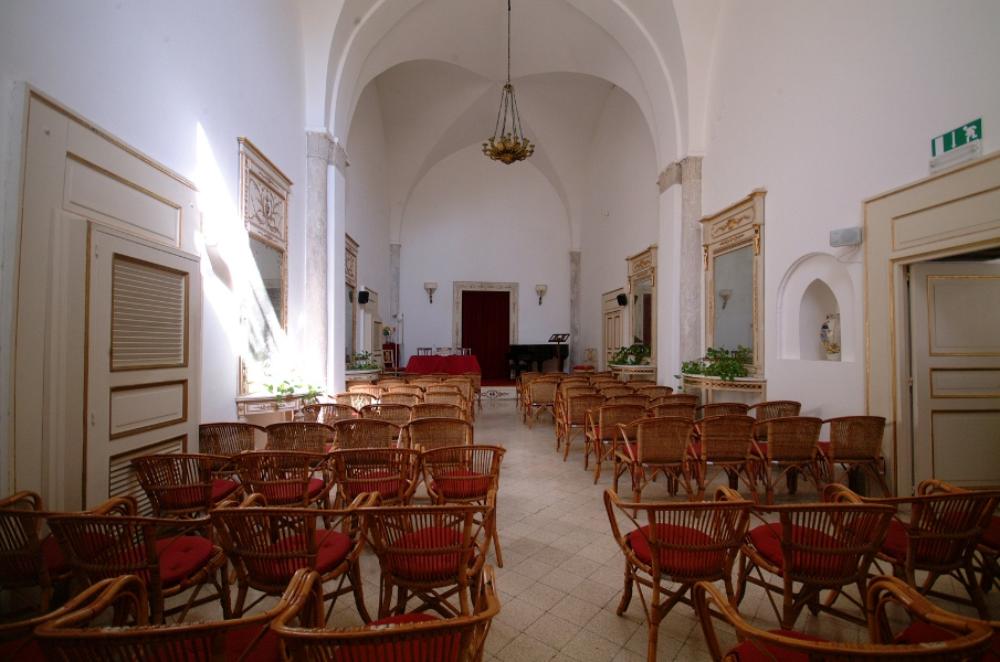
Of great importance is, finally, the Theater, on the palace’s western side, a scaled reproduction of the San Carlo of Naples with five tiers of boxes and a sumptuous royal box: the only room completed by Vanvitelli the elder by order of Ferdinand IV, it was inaugurated in 1769. Together with the building, Vanvitelli conceived the surrounding Park, a splendid example of an Italian garden.
Royal Park and gardens of the Caserta Palace
The current Royal Park is only partly the realization of Luigi Vanvitelli‘s project; the works were completed by his son Carlo, who scaled down his father’s design due to lack of funds. The layout is divided into three parts.

First part of the Royal Park
The first part of the park, just behind the Royal Palace, is dedicated to the parterre (a lawn with straight avenues) and includes the Old Wood (existing before the Palace) where stands the Castelluccia, a 16th-century building rebuilt in 1769 in the form of a miniature fortress where young Ferdinand IV practiced mock battles. The avenues lead to the Pond, an artificial lake with an islet in the center, enhanced by a circular temple.

Second part of the Royal Park
The second part of the park, characterized by water games flowing from fountains aligned with the Palace, starts from the “Margherita” fountain: up two side ramps, you ascend to the Hercules bridge where the great “waterway” begins. Following the slope of the hill, there are successive water basins, stacked tanks adorned with statues; two broad roads, bordered by holm oak embankments and groves of oaks, run alongside to the large basin, in which from the slopes of Mount Briano falls a majestic waterfall.
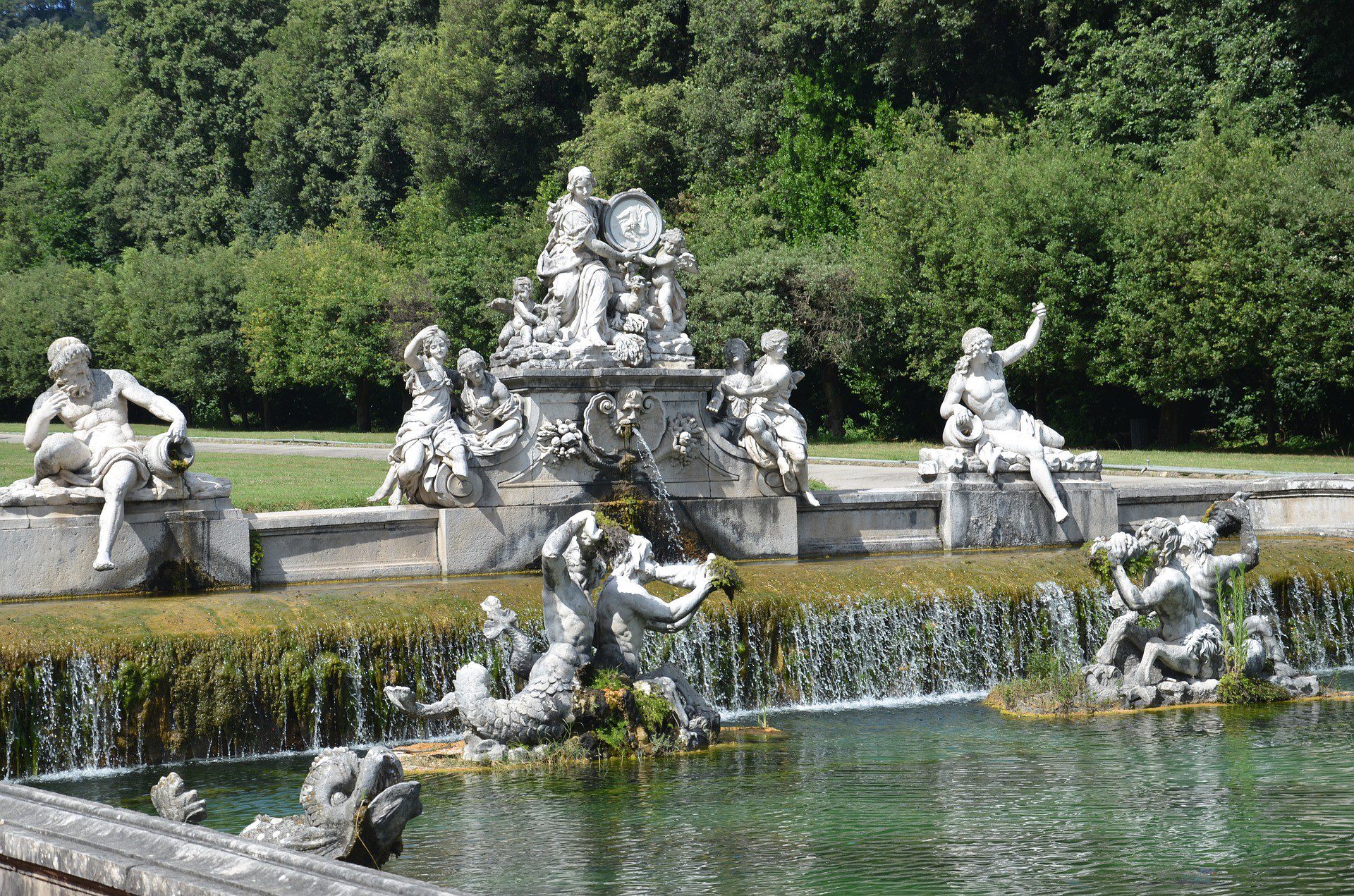
The first fountain you encounter is called the “Dolphins” because water gushes from the mouths of three large stone-carved fishes. Then comes the “Aeolus” fountain, a large exedra with many “caves” simulating the abode of the winds, represented by many statues of zephyrs, never completed. You then encounter seven descending basins forming seven waterfalls and the “Ceres” fountain, symbolizing the fertility of Sicily, with statues of the goddess and the island’s two rivers. The last fountain depicts the story of “Venus and Adonis”.
In the basin below the Mount Briano waterfall, called “Diana’s Bath“, two important marble groups depict Actaeon at the moment when, transformed into a stag, he is about to be torn apart by his own dogs, and Diana, surrounded by nymphs, caught by surprise while leaving the bath.
Third part of the Royal Park
The third part is the English Garden, commissioned by Maria Carolina. It was Lord Hamilton who persuaded the queen to rival her sister Marie Antoinette of France, who had built the Petit Trianon at Versailles. Thus, the English botanist Andrew Graefer was called, who began work in 1782 in the area near the large waterfall, where the terrain slopes southward, suitable for imaginative compositions and cultivating exotic species.
The garden offers a series of picturesque spots deeply inspired by contemporary models: the cryptoporticus, with statues from the excavations of Pompeii and the Farnese collection; the small pond of Venus’ bath, with faux Pompeian ruins; the English Casino, a two-story building with a base and Doric pillars supporting a cornice adorned by medallions, which was Graefer’s residence, and finally, the apiary, an area used as a water reservoir by Vanvitelli, later for beekeeping, and transformed into a greenhouse in 1826.
Nearby are the four greenhouses where Graefer planted the species he sought out in Capri, the Salento region, or Palermo. Close by are the Aquarium, devoted to aquatic plants, the Rose Garden, and the Botanical School.

Museum of the Opera and Territory of Caserta
The Museum of the Opera and Territory is housed in the underground sections of the Caserta Palace, restored and used with full respect for the original architecture. It collects a series of objects documenting and illustrating Vanvitelli’s work, the history of the Caserta area, including archaeological finds from the 1990 excavations, and life at the Bourbon court between the 18th and 19th centuries. Moreover, it houses several other artworks kept for decades in the depots of the Campania Superintendences, now returned to the public.
Of great interest are the architectural models made by the cabinetmaker Antonio Rosz and commissioned by Vanvitelli. These models, faithfully reproducing the Palace, were submitted by the architect for the approval of Charles III.

Caserta Palace Opening Hours
The Caserta Palace is closed only on Tuesdays.
Royal Apartments
Opening hours 8:30 AM – 7:30 PM
Last admission 7:00 PM
Museum exit 7:25 PM
Park of the Palace
Opening time 8:30 AM
January: last admission 3:00 PM / closing 4:00 PM
February: last admission 3:30 PM / closing 4:30 PM
March: last admission 4:00 PM / closing 5:00 PM
April to September: last admission 6:00 PM / closing 7:00 PM
October: last admission 4:30 PM / closing 5:30 PM
November and December: last admission 2:30 PM / closing 3:30 PM
English Garden
Opening time 8:30 AM
January: last admission 2:00 PM / closing 3:00 PM
February: last admission 2:30 PM / closing 3:30 PM
March: last admission 3:00 PM / closing 4:00 PM
April to September: last admission 5:00 PM / closing 6:00 PM
October: last admission 4:00 PM / closing 5:00 PM
November: last admission 2:00 PM / closing 3:00 PM
December: last admission 1:30 PM / closing 2:30 PM
Ticket Prices for Caserta Palace and Royal Park
€14.00 Full ticket Park + Apartments (to visit the Royal Apartments, Royal Park and English Garden) / The ticket is timed. Entry to the Complex will not be allowed at a different time than that selected at purchase.
€9.00 Full ticket Park (to visit the Royal Park and the English Garden)
€3.00 Evening Apartments (to visit the Royal Apartments. Available from 5 PM) / The ticket is timed. Entry to the Complex will not be allowed at a different time than that selected at purchase.
€2.00 Reduced Park + Apartments EU citizens aged 18-24 (for EU citizens aged 18 to 24 inclusive to visit the Royal Apartments, Royal Park and English Garden, compatible with opening times of the Royal Park and English Garden) / The ticket is timed. Entry to the Complex will not be allowed at a different time than that selected at purchase.
Free Park + Apartments (for those under 18 and entitled to concessions for visiting the Royal Park and Royal Apartments) / The ticket is timed. Entry to the Complex will not be allowed at a different time than that selected at purchase.
Free Park (for those under 18 and those entitled to concessions for visiting the Royal Park)