

The donation was formalized before the notary Lattanzio of Bari on April 5, 1865, and in 1877, the new institution was opened to the public, whose collection had meanwhile reached about 8,500 works in 14,000 volumes.
To the initial donation were added further gifts from private individuals and especially the acquisition of the libraries of suppressed convents in the province: Capuchins, Reformists of San Bernardino and Casa della Missione di Bari, Reformists of Santa Maria degli Angeli of Cassano, Santa Maria di San Luca of Valenzano, Capuchins of Triggiano, Rutigliano, Conversano, and Gravina. These ancient libraries, predominantly religious but not lacking literary and scientific works, constitute important documentation of the cultural history in the Land of Bari. The seat of the thus constituted library was in the City Palace, near the Basilica of San Nicola.
In 1884, to improve its operation, the Municipality and the Province of Bari created a consortium for the management of the institution, which became the Consortium Library Sagarriga Visconti Volpi. In 1895, the Library was transferred to the ground floor of Palazzo Ateneo, newly built by the Province, designed by architect Giacomo Castelli, to house the higher education institutions.
From the late 19th century until the 1950s, the book collection experienced notable growth, focusing on the humanities and local history, increased from 1910 with the mandatory deposit of printed materials produced in the province of Bari, enriched by numerous large and small book collections from intellectuals and important Bari families: Giulio Petroni, D’Addosio, Di Cagno Politi, Domenico Zampetta, Andrea Angiulli, Giuseppe De Ninno, Menotti Bianchi, Armando Perotti, De Giosa, de’ Casamassimi, Giovanni Modugno, Raffaele Cotugno, Michele Squicciarini, Vittorio Fiorini, Giuseppe Petraglione, Michele Gervasio.
Starting in 1925, relations with the University, newly founded in the same Palazzo Ateneo, became increasingly important in the Library’s history.
In 1958, Law No. 330 of March 28 transformed it into a state library with the title of national, expanding its roles and integrating it into a broader cultural network. In the 1970s, a radical modernization of structures, services, and technical-scientific organization began, orienting the library, also through the purchase of bibliographies and reference works, to establish itself as the most important regional bibliographic center, not only for the importance of the preserved collection, but for the rigor of library procedures, the validity of acquisitions, and the preparation of scientific staff.
In 1992, an important innovation occurred with its joining the SBN project of the Central Institute for the Union Catalogue of Italian Libraries and the start of catalog computerization, initially connected online with the CED of the Naples Hub, and then, from June 2002, with the setup of an independent CED and the creation of the SBN Hub Land of Bari, making the Library accessible on the web through the Land of Bari Hub portal. From the mid-1990s, retrospective cataloging work in SBN began. The OPAC of the Land of Bari library network, which now includes forty-one libraries, currently contains about 490,000 catalog records.
The New Seat of the National Library of Bari
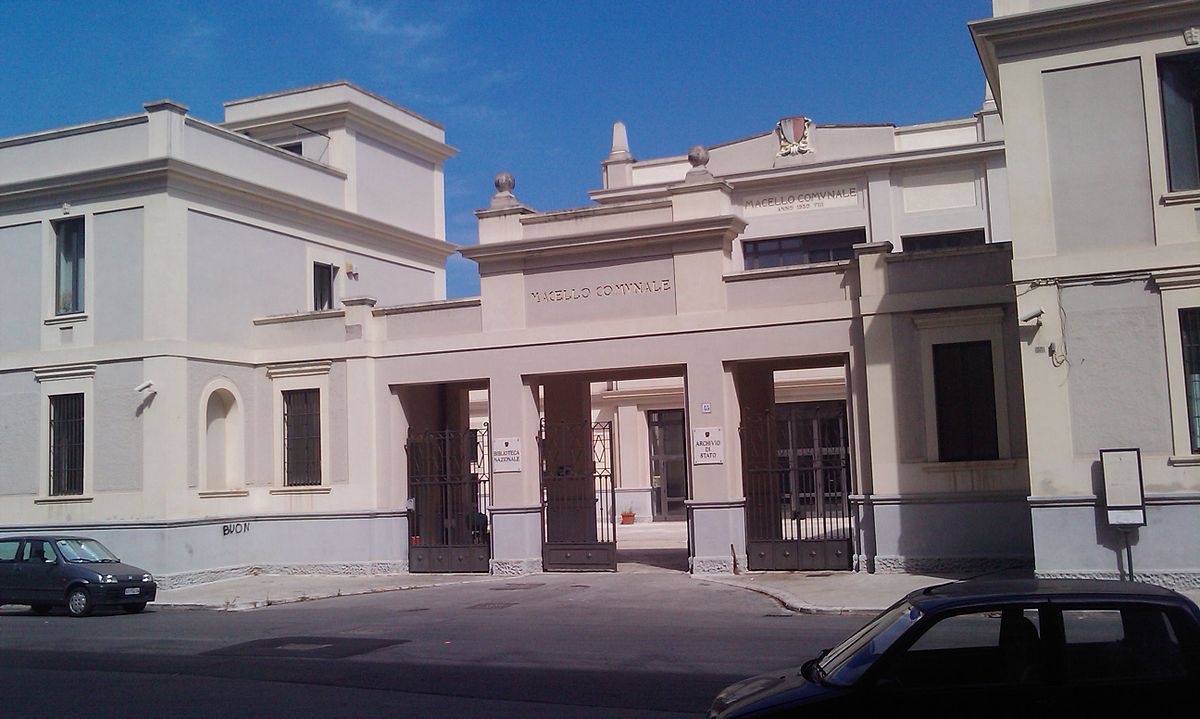
A new phase began for the National Library of Bari with the move from the ground floor of Palazzo Ateneo, its historic seat, to the new location inside the Cittadella della Cultura, a splendid example of 1930s architecture. This complex was the ancient Bari grain market city managed by the Municipal Grain Services Company and included the Municipal Refrigerator, the Municipal Slaughterhouse, and the Fish Market.
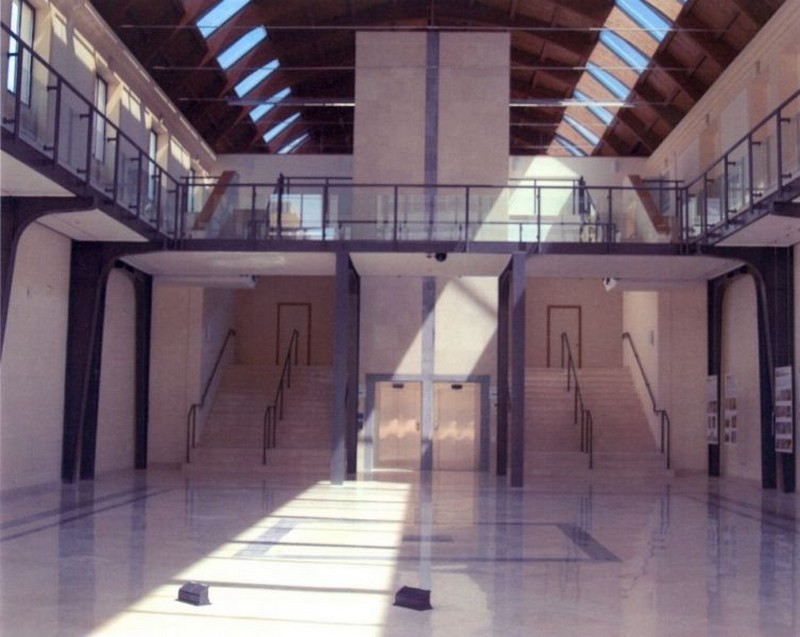
Since summer 2006, the Library occupies the former Refrigerator and Fish Market buildings, constructed in the 1920s and 1930s and restored with a conservative and functional intervention by the Ministry of Cultural Heritage and Activities. Both buildings boast exquisite aesthetic quality with Art Nouveau stylistic references.
The area available to the Library amounts to about 11,500 square meters: the ground floor and mezzanine spaces of the two buildings are intended for book storage, while the entire first floor, connected via a walkway that joins them, contains reading rooms and areas for the public and visitors.
On the first floor of the former Refrigerator, alongside the large reading room, there is an 80-seat auditorium equipped with the necessary technological equipment for conferences and lectures. The first floor of the Fish Market hosts two specialized study rooms (manuscripts and rare books, bibliographies, and catalogs).
Both buildings have distribution points for materials from the deposits on the first floor. In the public rooms, about two thousand linear meters of shelving are available for public use; another thousand linear meters of traditional shelving were installed in two deposits dedicated to rare and valuable materials and manuscripts. In the book storage areas, a compact shelving system with electric movement was set up, extending approximately 18,000 linear meters for book storage, including the mezzanine floor of the former Fish Market, designated for horizontal placement of newspaper collections and large formats.
Computer stations are installed in all public rooms for consulting the online catalog, digital materials available on the internal network, national and international OPACs, and internet navigation. On the ground floor, there are stations equipped for the blind and visually impaired.
Finally, on the second floor of the two buildings, the internal offices of the Library were created, all connected to the telematic network and sufficiently wide and spacious. The structure is served by six elevators, and all spaces are accessible to people with disabilities.