




Within the courtyards of Palazzo Arese-Litta, overlooking the oldest part of Milan and just steps away from the Imperial Palace of Mediolanum of Maximian, the lives of men and women from Roman times through Late Antiquity and into the Middle Ages unfolded, as revealed by the important findings unearthed in the Foro Buonaparte Courtyard, a natural extension of Via Illica.
Traces of prosperous periods (such as the mosaic from a 2nd-century AD Roman domus) alternate with signs of decline and rebirth (early medieval huts), the vibrancy of everyday life and industrial activity (18th-century lime processing pools found on site) layered with the remembrance of another life—one hoped to be more fulfilling—in a promised afterlife (ancient burial areas). These tangible remains documenting the evolution of the city from Roman through medieval times can now be explored in a stunning exhibition, with Palazzo Arese-Litta as a truly exceptional setting.
The history of this architectural complex intertwines everyday stories with those of prominent figures, not just in Italian politics and culture but European as well—people who, starting with the city’s progress, contributed to developments on a much larger scale.
For over two centuries, the palazzo was a symbol of Milanese culture and society, hosting unforgettable receptions, safeguarding artworks of painting, sculpture, and architecture, and opening its doors to artists of all kinds—musicians, poets, playwrights such as Wolfgang Amadeus Mozart, Giuseppe Parini, Carlo Goldoni, and others.
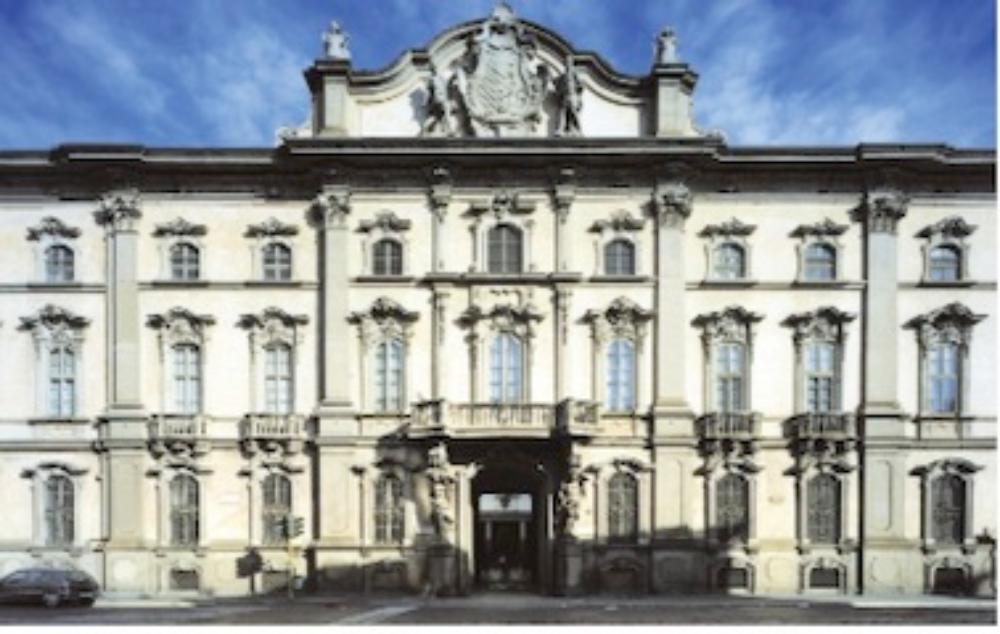
It is a prime example of Lombard Barocchetto (a style that spread in Milan and the surrounding area from the 1720s), with its elaborate 18th-century façade. However, its origins are older: the original nucleus, the imposing central courtyard with paired columns, was built some decades earlier, between 1642 and 1648, by Francesco Maria Richini for Count Bartolomeo Arese, one of Milan’s most powerful men at the time.
During Spanish rule, Count Arese—who came from a family of jurists and officials—rose to a distinguished public career and, in 1660, was appointed President of the Senate. Thanks to this prestigious role, the palace that Richini had built in a dignified classical style became a central hub of Milan’s social and political life.
The grand residence, once fronting what was then Porta Vercellina and complemented by lavish gardens stretching to the Castello Sforzesco bastions, hosted memorable banquets for Spanish royalty and also enjoyed the privilege of asylum: no one could be arrested within its walls without the Count’s consent. The tradition of grand celebrations continued even after the Arese family died out, with events in honor of Marianna of Habsburg, archduchess of Austria—on her way to marry King Philip IV of Spain in 1649—and for Margaretha Teresa, infanta of Spain, future wife to Emperor Leopold I in 1665. Later, celebrations were held for Elisabeth Christine of Brunswick, Maria Theresa of Austria, Eugène de Beauharnais, and even the arrival of Napoleon.
The 17th-century building preserves, beyond its overall noble layout, its honor courtyard, distinguished by an ample portico with architraves supported by doubled Doric columns and cruciform pillars at the corners. The upper façade features two stories of windows: alternating curved and triangular pediments on the main floor, and rectangular frames on the second. In 1671, a private chapel—another work by Richini—was consecrated, later converted in the late 18th century into the Teatro Litta, which still operates today and faces the Cortile dell’Orologio.
In 1674, the property passed to Bartolomeo Arese’s daughter, Margherita, wife of Fabio III Visconti Borromeo Arese, and later, in the mid-18th century, to the Litta family. From then, the palace adopted the Barocchetto style that still defines it, with various interventions transforming the noble wing. First came the scenic ‘scissors’ staircase leading to the main apartments by Francesco Merlo (1740), partly destroyed in the August 1943 bombings—miraculously sparing the rest of the palace—and rebuilt after the war; then the sumptuous painted decorations, largely entrusted to Giovanni Antonio Cucchi. Cucchi adorned the grand ballroom ceiling—the Sala degli Specchi—with his Apotheosis of a Litta. Paintings and decorative features from this period, notably large, elegant mirrors and intricately carved and gilded panels, are still preserved.
Between 1752 and 1761, Bartolomeo Bolli created the new palace façade, made up of two horizontal wings and a taller, protruding central section. Tall pilasters define the façade and support a cornice topped by two statues holding the Litta family crest. At the center of this richly adorned composition stands the portal, with two massive telamons supporting the curved balcony above. The palace once housed the famous Madonna Litta, a painting attributed to Leonardo or possibly a close pupil, which many regard as the most Leonardesque work by a follower. In 1865, Count Antonio Litta Visconti Arese sold it to Tsar Alexander II of Russia, who placed it in the Hermitage Museum in St. Petersburg, where it remains a highlight of the collection.
From the Cortile dell’Orologio you reach both the wings added in later centuries and what remains of the once extraordinary Arese garden. This green space, reduced in the early 1800s to make way for Foro Bonaparte, is now poised to become a unique spot of public greenery right in Milan’s city center.
Sold at auction in 1873, the palazzo was acquired by the Alta Italia Railway Company before passing in 1905 to the Italian State Railways, then into the hands of the State Property Agency, Railways branch. Since 1996, the complex has become an asset held by the State. In February 2007, the most valuable section of Palazzo Arese-Litta was handed over to the Ministry of Cultural Heritage and Activities (since 2013, Ministry of Cultural Heritage, Activities and Tourism) for the Regional Directorate for Cultural and Landscape Heritage of Lombardy.
Today, the palazzo is a full-fledged ministry seat in Milan, hosting offices for the Regional Directorate, the Archival Superintendence for Lombardy, and, in future, the Superintendence for Architectural and Landscape Heritage of Milan. It also houses libraries and archives, which are already open to the public and frequented by researchers. The palace opens for public events and is also available for fashion events, exhibitions, and guided tours with actors.