



Nei cortili del Arese-Litta Palace, overlooking the oldest part of the urban fabric and just a stone’s throw from the Imperial Palace of Maximian’s Mediolanum, the existence of men and women from the Roman age, late antiquity, and the medieval period has layered and unfolded, as evidenced by the numerous and very important finds from the excavations carried out in the Foro Buonaparte Courtyard, a natural continuation of via Illica.
Testimonies of prosperous periods (the mosaic of the 2nd century AD Roman domus) alternate with phases of decline and subsequent rebirth (traces of early medieval huts); the celebration of life and the industriousness of man (the eighteenth-century lime processing basins found on site) overlaps with the commemoration of another life – in hopes, more rewarding – in a better afterlife (funerary areas). The material evidence documenting the layering of the existence of men and women from the Roman age to late antiquity and the medieval period can be admired and known by the public thanks to a suggestive exhibition that has Palazzo Arese-Litta as its most extraordinary setting.
The evolution of the monumental complex is a succession and interweaving of common, ordinary, and daily stories, and exceptional stories, of characters from political and cultural history, not only Italian but also European, who, starting from the cultural and social progress of the city, have nourished with vital sap a development on a decidedly larger scale.
For over two centuries, the palace has represented the place of culture and worldliness of excellence for the city of Milan, a stage for memorable receptions, a precious treasure trove of art treasures of painting, sculpture, architecture, a salon open to artists of all kinds (musicians, poets, writers, playwrights, such as – according to chronicles – Wolfgang Amadeus Mozart, Giuseppe Parini, Carlo Goldoni, etc.).
A representative example of Lombard baroque (a style that spread in Milan and nearby from the second decade of the 18th century) with its imaginative eighteenth-century façade, the palace, however, has older roots: the original core of the complex architectural complex – the imposing main courtyard with paired columns – was actually built a few decades earlier, between 1642 and 1648, by Francesco Maria Richini for Count Bartolomeo Arese, then one of the most influential men in Milan.
During the years of Spanish rule, Count Arese, who came from a family of jurists and officials, made an important public career and, in 1660, was appointed President of the Senate. Also because of this prestigious institutional role, the palace, which Richini had built in classical and austere forms, became one of the main points of reference for the social and political life of the city.
The great residence, overlooking what was then the street of Porta Vercellina and softened by a lush garden that reached to the walls of the Sforza Castle, was the scene of unforgettable receptions in honor of the Spanish royals, but also privileged with the right of asylum: inside it, no one could be arrested without the consent of the powerful count. The tradition of great celebrations did not cease in the years following the extinction of the Arese family; solemn festivities are remembered in honor of Marianna of Austria, Archduchess of Austria, traveling to Madrid to marry King Philip IV of Spain in 1649, and that for Margaret Theresa, Infanta of Spain, wife of Emperor Leopold I in 1665. Later, those for Elisabeth Christine of Brunswick, Maria Theresa of Austria, Eugene of Beauharnais, Viceroy of the Kingdom of Italy, and even for the arrival of Napoleon.
From the seventeenth-century building, besides the general layout of the noble part of the complex, the honor courtyard remains, characterized by the large loggia with an architraved system on paired Doric columns and cruciform pilasters at the corners. The overlying wall is shaped by two orders of windows: on the noble floor with alternating curved and triangular pediments, on the second floor with square frames. In 1671 a family oratory, the work of Richini, was consecrated and was transformed in the second half of the eighteenth century into the theater still active today, the Litta Theater, which overlooks the Clock Courtyard.
In 1674 the palace passed by inheritance to Bartolomeo Arese’s daughter, Margherita, wife of Fabio III Visconti Borromeo Arese, later, in the mid-18th century, to the Litta family. It is from the mid-eighteenth century that the complex acquired the baroque style that still distinguishes it today, with interventions that completed and transformed the main body of the building. Starting, in chronological order, from the scenographic “scissor” staircase leading to the noble apartments, the work of Francesco Merlo (1740), partially destroyed during the bombing of August 1943 – which incredibly spared the rest of the palace – and rebuilt immediately after the war, and reaching the pictorial decoration, largely entrusted to the workshop of Giovanni Antonio Cucchi. Cucchi frescoed the great scene depicting the Apotheosis of a Litta on the vault of the majestic ballroom of the Palace, the Hall of Mirrors. In the room and adjoining areas, wall paintings and decorative settings of that period are still preserved, among which stand out particularly the imposing and graceful mirrors and the carved and gilded wainscots.
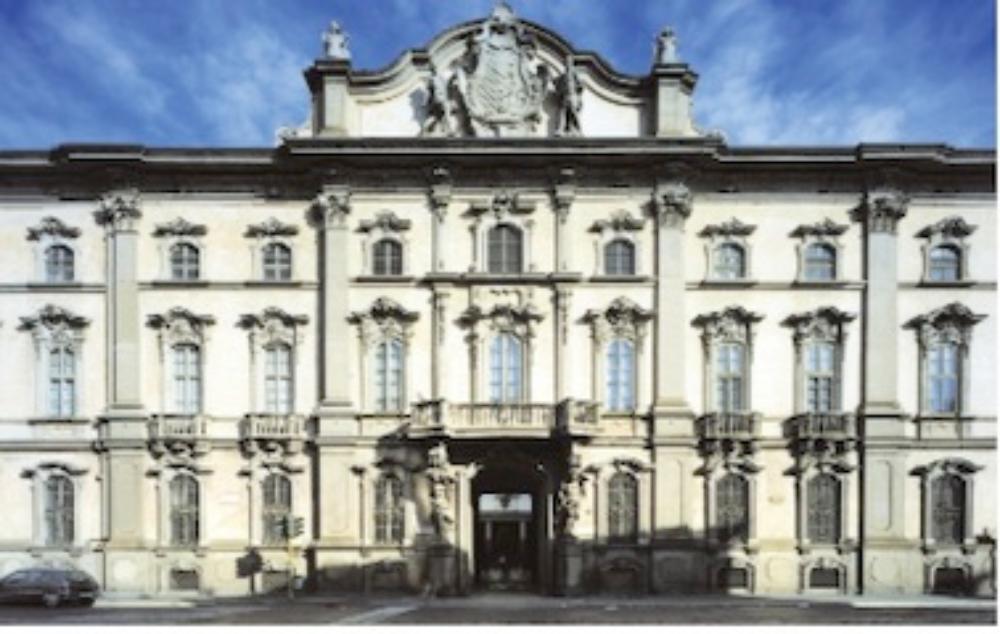
In the same years, between 1752 and 1761, Bartolomeo Bolli created the new façade of the palace, consisting of two horizontally oriented bodies and a taller central projecting one. Large pilasters outline the entire front and support the cornice topped by a pediment with two full-round statues holding the coat of arms of the Litta family. Standing out in the richly ornamented composition is the portal, in which two mighty telamons support the curvilinear balcony. In the palace was kept the famous Madonna Litta, a painting attributed to Leonardo, or perhaps to one of his pupils, but which would undoubtedly be by far the most Leonardesque among the works produced by the pupils. The work was sold in 1865 by Count Antonio Litta Visconti Arese to Czar Alexander II, who destined it to the collections of the Hermitage Museum in Saint Petersburg where it is still displayed among the masterpieces of its collections.
From the Clock Courtyard there is access both to the buildings erected in the following centuries and to what remains of the extraordinary Arese garden, depleted at the beginning of the nineteenth century by the works for the realization of Foro Bonaparte, from a hidden resource, it will transform into an interesting opportunity to enjoy public green spaces right in the center of Milan.
Sold at auction in 1873, the palace was acquired by the Upper Italian Railway Company to pass in 1905 to the Italian Railways, then property of the State Property Office, Railway branch. Since 1996 the complex has been part of the undisposable state patrimony. In February 2007, the largest and most valuable portion of the monumental complex of Palazzo Arese-Litta was handed over to the Ministry for Cultural Heritage and Activities (since 2013 Ministry of Cultural Heritage and Activities and Tourism), and for it to the Regional Directorate for Cultural and Landscape Heritage of Lombardy.
Today the palace is fully a ministerial seat in Milan with the offices of the Regional Directorate, the Archival Superintendence for Lombardy and, in the future, the Superintendence for Architectural and Landscape Heritage of Milan. It also houses the libraries and archives of the Institutes, structures already open to the public and frequented by scholars. The Palace is visitable on the occasion of public events and is also granted for use for fashion events, exhibitions, and guided tours conducted by actors.



