

It is worth remembering that the Church of Santa Chiara was decorated with beautiful 14th-century frescoes of the Rimini school. Removed around 1950, they are partly preserved at the National Museum of Ravenna and partly in Bologna, at the workshop of the noted restorer Ottorino Nonfarmale, pending the completion of the restoration work.
After the suppression of the church and convent in 1823, they were ceded to the Hospital of Santa Maria delle Croci, which took on the maintenance burden. Later, the hospital administration granted the entire complex in emphyteusis to Baron Pergami della Franchina, who transformed the church into a “horse stable,” a use that lasted until 1885; from 1847 to 1856 equestrian shows were held here (Ravaldini 1978, p. 198). However, as early as 1874, by private deed between the then mayor of Ravenna, Silvio Guerrini, and Baron Carlo Emilio Pergami-Belluzzi, the entire building was transferred to the municipality.
Meanwhile, the local Amateur Dramatic Academy, left without its own venue (the Bertoldi Theater), requested the concession of the Church of Santa Chiara in order to adapt it into a theater, committing to bear the expenses for the necessary adaptation work and also not to alter the apse. The new theater, initially called Filodrammatico, was inaugurated on May 8, 1892, with a performance of the comedy “Il deputato di Bombignac” by A. Bisson and a monologue written for the occasion by Luigi Rasi, then director of the Acting School of Florence.
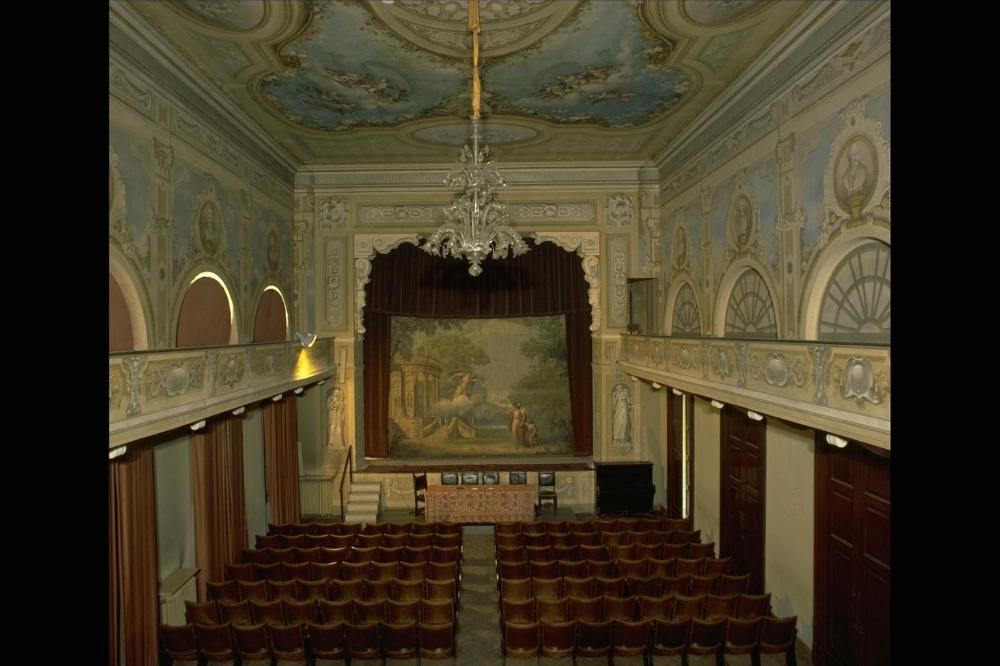
The hall of the Luigi Rasi Theater of Ravenna was realized over a hundred years ago in the former church of Santa Chiara, built along with the adjacent monastery by Chiara da Polenta in 1250 and suppressed in 1805 by Napoleonic decree. Not large in size, it could accommodate 220 spectators in the stalls on wooden seats while another 90 could find a place in the balcony, which consisted of a narrow central body with two side extensions, all supported by six iron columns and brackets. The curtain, whose subject is unknown, was painted by the mosaic painter Alessandro Azzaroni.
The Amateur Dramatic Academy carried out its activities in this theater from 1892 to 1919, then it merged with the Società Orfeonica Ravennate, operating since 1900, thus creating the Società Artistica Drammatico-Musicale di Ravenna with the aim of uniting enthusiasts of music and dramatic art and spreading greater cultural knowledge in this field. On this occasion, the theater was named after Luigi Rasi (1919). Under the presidency of Guido Franchi, the theater room experienced a period of very intense and diverse activity, from prose shows, to conferences, to chamber music concerts. The society’s activity continued at a steady pace until 1938, after which the theater was closed; two years later, it was given for use to the Provincial Dopolavoro of Ravenna for twenty years.
In 1943, demanding renovation works increased the hall’s capacity to 400 seats. From the post-war period onwards, numerous local amateur dramatic groups have been very active, and a dance school was also started. At the same time, the theater continued to undergo maintenance restorations and improvements until 1959 when the Provincial Surveillance Commission ordered its closure for safety reasons, so that in 1962 it became necessary to modernize the entire facility.
The most recent restoration and upgrading interventions have changed the appearance of the hall, making it more like a cinema than a historic theater, but the obvious defects due to the small stage size, imperfect acoustics, and rigid furnishings have not stifled its ancient soul.
Managed recently by Ravenna Teatro, this venue has embarked on the path of artistic and cultural innovation, presenting every year a packed calendar of initiatives including prose, contemporary theatre, children’s shows, dialect theatre, theatrical workshops with schools, and a particularly interesting project called “La via dei canti” dedicated to ethnic minority cultures. (Lidia Bortolotti)