

Outside the gates of the city of Bologna, on the road to Florence – in the hilly foothill area of Camaldoli hill – stood the Palazzo di Camaldoli, residence of the noble Marescotti family then of Filippo Maria and later of Raniero Aldrovandi Marescotti. With the death of his father Raniero, the thirty-two-year-old senator Gianfrancesco returned to the Bolognese residence after a long stay in Modena where he had met Marquis Alfonso Vincenzo Fontanelli, his future father-in-law, correspondent and translator of Voltaire. Excellence in supporting theatrical performances and training young knights for the same made it admired as long as he lived (Calore Uomini di teatro 1986 p. 105-107, Civiltà teatrale 1986, 40-51).
Gianfrancesco’s renewed passion for theatrical performances became a key reading model to understand the conscious cultural program in which theatre becomes the pivot of the complex restructuring work of the Palazzo (Lenzi 1987, p. 68) started around 1761.
The works began coinciding with the marriage to Lucrezia Fontanelli, who is believed, due to the particularly refined education she received, to have not been uninvolved (Lenzi, p. 68). In 1762 and 1763, the family’s ledger books record expenses for the little theatre, including payment for the creation of two painted scenes by Antonio Galli Bibiena and Prospero Pesci (Calore 1984, p.71; Calore, Il teatro 1986, pp. 35-40).
The inauguration took place on September 24 of the same year, 1763, with the representation of Voltaire’s Alzira. In the Diary of Galeati (Galeati, Diario) it is specified that among the actors – as usual in private theatres of noble families – were Gianfrancesco and his wife Lucrezia themselves, that the show was repeated three times, and that entrance was paid, a detail that is exceptional given current knowledge (Lenzi, p. 68). In 1764, a new balcony order was built, and in May, under the direction of foreman Giuseppe Berti, a portico facing the garden was made in a position perfectly symmetrical to the theatre, which, when suitably closed with wooden panels, would be used on the occasion of performances. Given that the last expenses were recorded in October, it is deduced that the theatre was finally completed by that year, 1764 (Lenzi p. 65, note 4).
The Camaldoli performances had already become a consolidated and especially high-level reality in the artistic panorama of the Emilia province by 1771. The interior design of the little theatre is certainly attributed to Senator Gianfrancesco under the direction of machinist Bentivoglio as clearly recalled in an inventory found by Deanna Lenzi (Lenzi, p. 69). The facade was probably made according to a design by Francesco Tadolini, active in Camaldoli from 1769 when the little theatre was already finished.
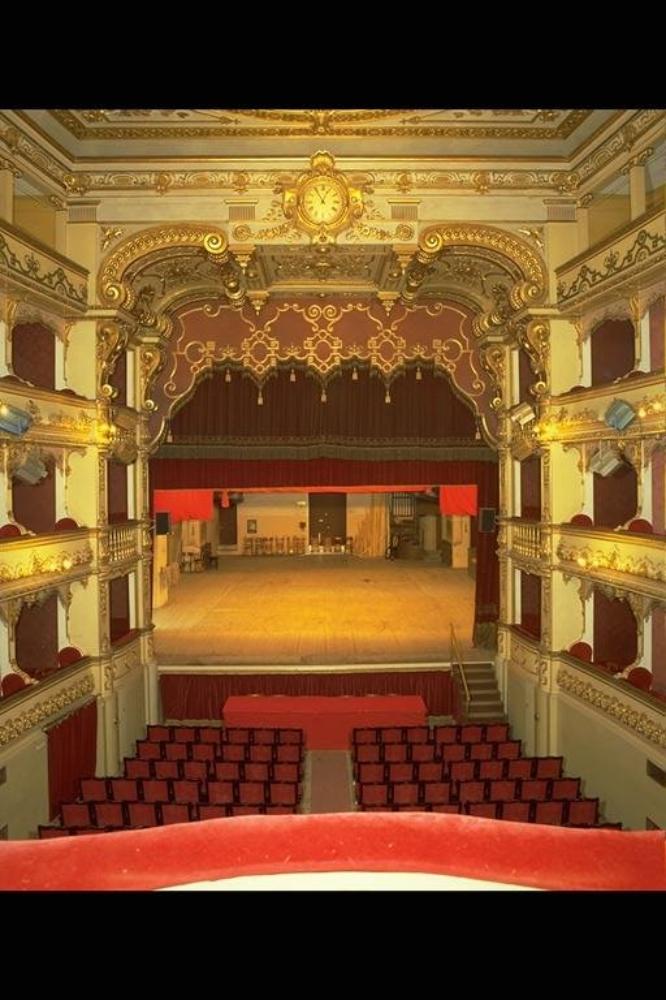
The 24 stucco statues with caryatids and mermaids, described as mannerist on antique models by Piò, probably belong to stucco artist Camporesi (Lenzi, p. 69) or a certain Balugani (Lenzi, p. 69), who also created statues for the terrace, stairs, and Palazzo facade (Lenzi 1987, p. 69). The stucco statues that so pleasantly characterize the theatre are all different in form, and although portrayed bearing the balconies on their backs, they have no structural function, much less the arms which, in some cases with carefully positioned hands, were used to hold garlands of fresh flowers hung during honor evenings (Rubini, p. 478).
The idea of mixing caryatids, tritons, atlantes, and mermaids was not as new as it might seem to us today; in fact, it was a widespread motif in ephemeral setups and in the decoration of halls throughout Europe. They were used in Rome in 1566 during the Carnival of Queen Christina, in Munich in 1654 in the Opera Theatre in Salvatorplatz, and in 1750-1753 in the court theatre of Francois Cuvilliàs, in Versailles in 1754 in a setup in the riding hall. Of particular interest, however, would be the comparison to a contemporary little theatre built by Frederick of Prussia at Postdam Castle between 1763 and 1769 (Lenzi, p. 70).
Gianfrancesco was succeeded by Carlo Filippo, who carried out regular maintenance for the good upkeep of the theatre, renewing scenes and costumes, the curtain, and the stage. On that occasion, perhaps two canvas backdrops representing the Prison and the Doric Atrium and some ceilings, scene elements that replaced the ceiling, were made. These few stage furnishings, of which only photographic memory remains, were lost except for the backdrop with the Atrium, possibly a youthful work of Pelagio Palagi, protégé of Carlo Filippo. The theatre remained active and well preserved by the Mazzacorati family until at least 1845, who respectfully added only their coat of arms on the proscenium. But when in 1937 it became property of the Social Security Institute and the Palazzo was converted into a convalescence home, the little theatre, which was to be demolished, was fortunately spared due to the intervention of the Modena Superintendency.
However, alterations were also made often without scientific criteria. The stage depth was reduced, the wooden floor was replaced, the room was electrified, and the Bolognese brick floor was replaced with Venetian-style flooring. In 1946, the roof was redone, damaged during a 1945 bombardment; clouds were painted on the ceiling, covering the original figures. Since 1970-1971, the little theatre has been property of the Emilia Romagna Region, which rented part of the Palazzo including the theatre to Quartiere Savena. In 1962, the first balcony was reinforced to bear a greater load. Around 1883, Professor Carlo Bellei restored the backdrop with the Atrium.
The simple façade with a portal and stone steps leads directly without intermediate rooms to the side theatre. The main private entrance, however, seems to be from the garden. From the outer colonnade, in fact, one accesses the theatre through a charming triangular atrium created by a junction formed with the construction of semicircular farm buildings. Other entrance doors on the ground and first floor facilitated privileged entry directly from inside the villa. The theatre stalls have a rectangular plan with two orders of balconies with decorated canvas parapets. The theatre is equipped with a stage and understage.
The interior of the theatre today accommodates 95 spectators. Originally, the hall could seat 200 people, but one must consider that theatrical spaces were once extremely crowded. The theatre requires restoration also due to infiltrations in the walls and ceiling. Since 1993, Quartiere Savena has promoted awareness initiatives with guided tours and theatrical performances; a conference has also been organized addressing issues related to a possible restoration. The restoration project is curated by Sara Franceschini of the Municipality of Bologna. (Caterina Spada)