




At 73 via della Stazione di Ottavia in Rome, beneath the Villino Cardani, lies the Hypogeum of the Octavii, discovered around 1920 during the development of the suburb near kilometer 9 of the via Trionfale: the new neighborhood was named Ottavia in memory of the figures whose tombs were found inside the Hypogeum and whose names were engraved on their respective sarcophagi: Octavia Paolina, her father Octavius Felix, and two other relatives.
The hypogeum was constructed around the early 3rd century AD, serving some rustic villas in the area, characterized by a monumentality befitting the social status of the owner. The burial chamber was preceded by a vestibule frescoed with geometric patterns, connected to a long dromos (corridor) access carved out of tuff, of which the floor laid in opus spicatum brickwork is still preserved.
Contrary to Octavius’s expectations, who surely planned to bury his family members in order of their seniority, the hypogeum first welcomed his “sweetest” and “dearest” little daughter, so much so that the tomb’s internal decoration is a genuine tribute to the child, who died at just six years old. Octavia Paolina was placed in the niche aligned with the entrance, in a sarcophagus decorated with scenes of children’s athletic competitions.
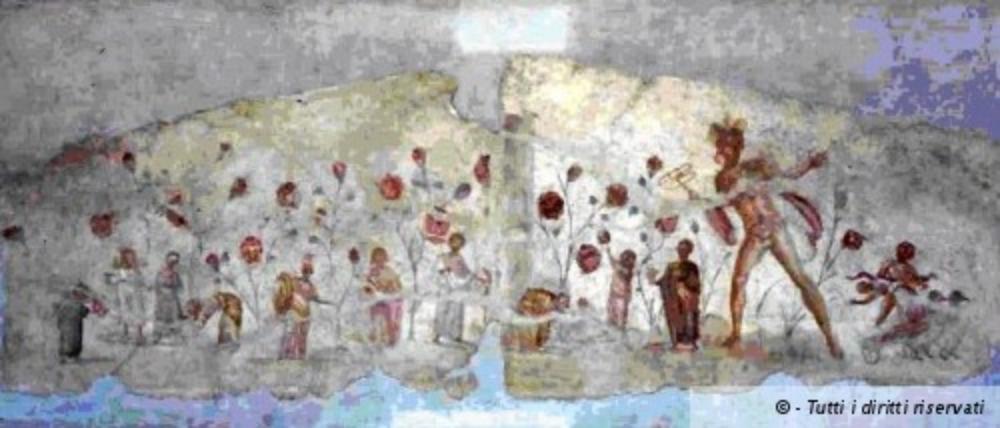
The childlike world also inspired the fresco of the arcosolium, now kept at the National Roman Museum, featuring a view of the Elysian Fields populated by children playing and picking giant roses, under the watch of Hermes (god of the dead); the rose motif is repeated on the upper walls, contrasted below by painted faux marble wainscoting and a white floor mosaic bordered by a double black band.
Two other female remains were placed in the side niches, in refined sarcophagi decorated with marine scenes: an allusion to the journey to the afterlife. Octavius Felix was buried at the center of the hypogeum room, in a simple strigillated sarcophagus bearing a plaque with his name and that of the freedman who dutifully handled his burial. This is the only sarcophagus still preserved in the hypogeum; Paolina’s sarcophagus is now in Milan, in a private collection; one of the two sarcophagi with marine scenes is housed in the National Roman Museum at Palazzo Massimo, while the other is located in a corridor at the Ministry of Public Education.



