


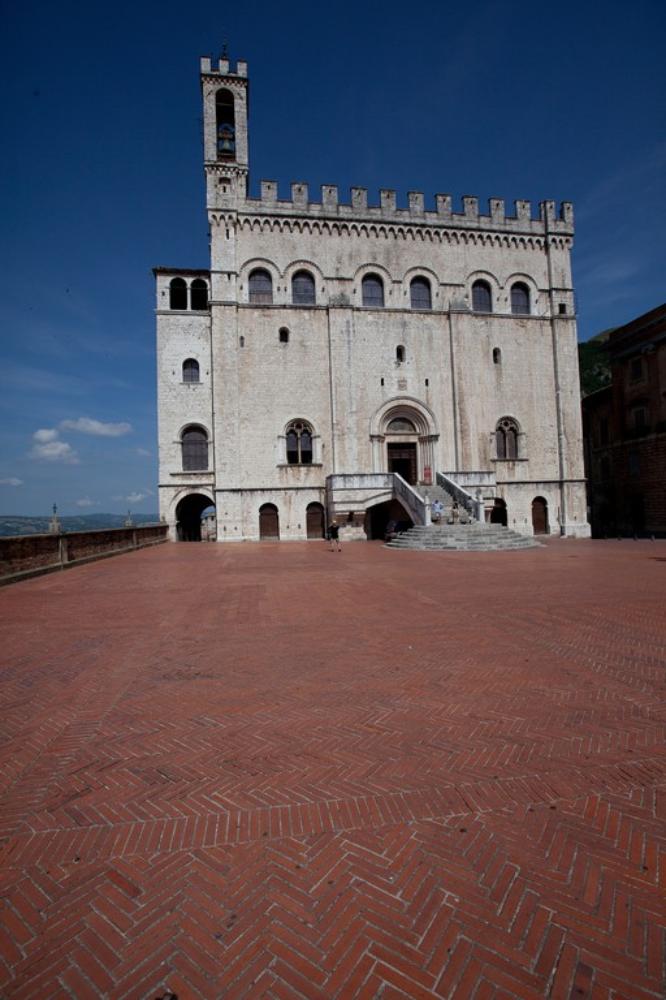


The Palazzo dei Consoli, easily visible even from a distance, is located in the historic center of Gubbio. Its facade overlooks Piazza Grande, a suspended terrace and the political heart of the city in the fourteenth century.
The building houses the Civic Museum, where you can see the Eugubine Tablets, a precious bronze testimony to the Umbrian language.
The palace was built between 1332 and 1349 according to a design by Angelo da Orvieto (commemorated in an inscription above the entrance arch) with the contribution of Matteo di Giovannello known as il Gattapone.
With a rectangular floor plan, it features a great Gothic height accentuated by vertical pilasters that divide the façade into three distinct sections.
The ground floor is distinguished by the portal, reached by a fan-shaped staircase; in the lunette there is a fresco by Bernardino di Nanni of the Eugenia, depicting the Madonna and Child between Saint John the Baptist and Saint Ubaldo (1495). The painting was heavily modified in the sixteenth century by Benedetto Nucci. On either side of the portal are two fully arched biforas.
The second floor is adorned with six fully arched windows, crowned by a dentil cornice that connects the arches.
The palace features a crenellated top embellished with pointed arches; the bell tower rises on the left.
The right side and the rear, visible from Via dei Consoli, maintain shapes very similar to the façade. On the left side, another building was attached, consisting of a portico that descended into Via Baldassini.
The entire first floor is occupied by the Arengo hall, covered by magnificent barrel vaults, which also houses part of the city’s stone collection.
The Palazzo dei Consoli, like the unfinished Palazzo Pretorio, was built in the first half of the fourteenth century during a period of significant city expansion. There was indeed the need for an adequate public space consistent with the economic and political power that Gubbio now exercised over its territory. Thus, the ancient Platea Communis in the upper part was abandoned, and slightly lower down the splendid raised square was created—a focal point that was meant to border all the districts but remain external to each, making it a neutral meeting point for political matters.
Information about Palazzo dei Consoli
Piazza Grande, 1
06024 Gubbio (Perugia)
0759274298
[email protected]
https://www.comune.gubbio.pg.it
Source: MIBACT